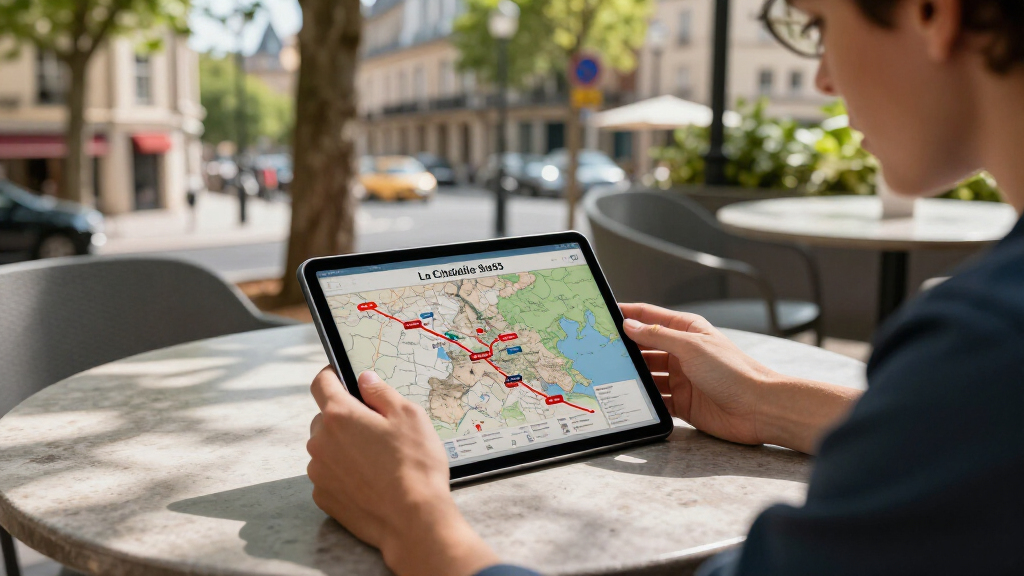

🔍 Read the full analysis: Digital History Gets A Boost With AI: La Citadelle Siege Of 1693 on ThorstenMeyerAI.com
TL;DR
An AI-generated interactive exhibit recreates the 1693 siege of La Citadelle, offering a detailed, cinematic digital experience. This development advances digital history projects and AI-driven visualization.
An AI-generated interactive exhibit now vividly reconstructs the 1693 siege of La Citadelle, offering a detailed, cinematic digital experience. This project, developed through a rigorous AI-guided workflow, represents a significant advance in digital history visualization, blending historical fidelity with artistic storytelling. The exhibit is currently live and accessible to the public, marking a notable milestone in the use of AI for educational and cultural preservation purposes.
The project, hosted on the site Fable/175, employs AI-driven design processes to create a dynamic, scroll-driven simulation of the 1693 siege of La Citadelle, a fortress in Montfaucon. Its core feature is a layered SVG-based map that visualizes military movements, earthworks, and artillery trajectories in real time, without the use of static images. The entire experience is built using only HTML, CSS, and JavaScript, ensuring scalability and responsiveness across devices.
According to the developers, the project follows a three-stage pipeline: initial construction with layered SVGs, an iterative critique driven by AI analysis focusing on visual coherence and historical plausibility, and final approval by an art director to balance educational content with aesthetic restraint. This process is guided by a detailed manual authored by an AI assistant, ensuring fidelity to historical siege tactics and engineering principles.
The site employs a restrained color palette rooted in parchment, fortress ink, smoke grey, and vivid red accents, creating an atmosphere reminiscent of archival engravings. Typography combines the grandeur of Cinzel with clarity from EB Garamond and Space Mono, establishing a layered textual hierarchy. The signature interaction involves animated earthworks, artillery trajectories, and fortress defenses, all orchestrated through precise JavaScript functions that simulate real-time movements and explosions, culminating in a cinematic depiction of the siege.
Why AI-Generated Digital History Matters Today
This project demonstrates how AI can influence digital history by enabling the creation of immersive, accurate, and visually detailed reconstructions of historical events. It provides new tools for education that facilitate user engagement through visual storytelling and interactive exploration, making complex military and engineering tactics more accessible. Such innovations have the potential to impact museums, classrooms, and cultural institutions by offering scalable, detailed simulations that help preserve and interpret history with a high degree of fidelity.
Additionally, the project highlights the potential for AI to streamline and enhance the development of digital exhibits, reducing reliance on static images and manual coding. It raises considerations about the future of digital preservation, storytelling, and AI’s role in cultural memory. As these technologies evolve, they may support more dynamic, personalized, and contextually rich history experiences, broadening access and understanding of the past.
interactive history simulation software
As an affiliate, we earn on qualifying purchases.
As an affiliate, we earn on qualifying purchases.
Historical and Technological Context of the 1693 Siege Reconstruction
The siege of La Citadelle in 1693 was a significant event during the Franco-Dutch War, involving complex military engineering and strategic maneuvers. Historically, it has been documented through engravings and written accounts, but detailed visual reconstructions have been limited. Recent advances in AI and web technologies have enabled the creation of digital models that simulate such events with high fidelity.
The development of this exhibit builds on a broader trend of integrating AI with digital humanities, aiming to produce interactive and educational content that transcends traditional static displays. The project follows a growing interest in using layered SVGs, canvas animations, and procedural storytelling to recreate historical scenes dynamically, providing users with a more detailed understanding of military history.
Prior efforts in digital history have often relied on static images or limited animations; this project distinguishes itself through its cinematic quality, layered architecture, and AI-guided critique process, which helps ensure both aesthetic coherence and historical plausibility.
digital history visualization tools
As an affiliate, we earn on qualifying purchases.
As an affiliate, we earn on qualifying purchases.
Uncertainties and Limitations of the Digital Reconstruction
While the exhibit is currently live and praised for its visual fidelity, it is not yet clear how accurately it reflects the full complexity of the historical siege. The reconstruction relies on available historical data and AI-driven interpretations, which may omit certain tactical details or contextual nuances. Additionally, the critique and approval process, though systematic, involves subjective judgments of aesthetic and educational balance.
Further evaluation is needed to determine how effectively users comprehend the historical events through this simulation and whether it can be integrated into educational or museum settings at scale.
historical siege reenactment models
As an affiliate, we earn on qualifying purchases.
As an affiliate, we earn on qualifying purchases.
Future Developments and Broader Applications of AI in Digital History
Developers plan to expand the platform with additional historical events, refining AI critique algorithms to improve accuracy and interactivity. Future updates may include more detailed narratives, augmented reality features, and user customization options. Researchers also aim to explore how AI can support collaborative curation and real-time updates based on new historical findings.
The broader goal is to establish AI as a standard tool in digital humanities, enabling institutions to produce immersive, scalable, and historically accurate reconstructions accessible through web browsers worldwide.
As an affiliate, we earn on qualifying purchases.
Key Questions
How accurate is the reconstruction of the 1693 siege?
The reconstruction is based on available historical data and AI analysis, aiming for high fidelity. However, some tactical details and contextual nuances may be simplified or omitted, and further validation is needed to assess its complete accuracy.
Can this digital exhibit be used in educational settings?
Yes, the exhibit offers an engaging way to explore military history and siege tactics. Its scalability and interactivity make it suitable for classroom use, though integration into formal curricula will require additional pedagogical development.
What technologies underpin the exhibit’s design?
The project relies on layered SVGs, CSS animations, JavaScript for interactivity, and procedural rendering techniques, all built without external frameworks or image assets to ensure scalability and responsiveness.
Will more historical events be reconstructed using this AI approach?
Developers plan to expand the platform with additional events, leveraging AI critique and procedural design to create immersive reconstructions across various periods and conflicts.
Source: ThorstenMeyerAI.com