
TL;DR

Get the latest gadgets delivered free with Prime
- Fast, free delivery on millions of items
- Prime Video, Amazon Music and more included
- Member-only deals all year
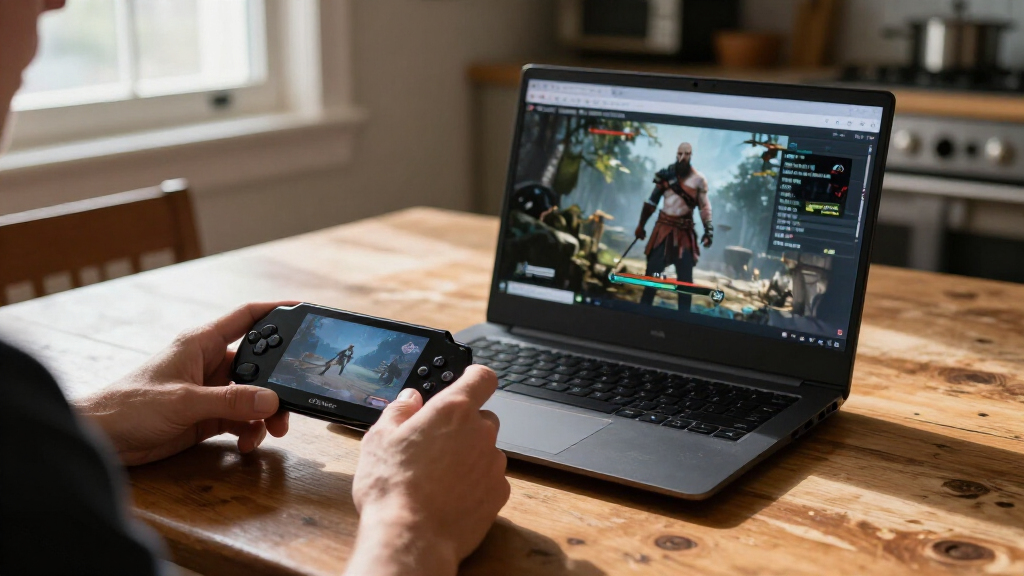
A GitHub project has demonstrated God of War: Chains of Olympus running in a browser after its PSP code was recompiled into WebAssembly. The project also reports a browser build of Ghost of Sparta; users must supply their own game data, and the work is a technical demonstration rather than an official release.
A GitHub project demonstrates God of War: Chains of Olympus running in a web browser after its PSP machine code was translated into C++, compiled to WebAssembly and connected to a small reimplementation of the handheld’s system software and graphics hardware. The project also reports that Ghost of Sparta runs through the same process, but it is a community technical effort, not an official browser release, and it does not include game files.
The project’s author says Chains of Olympus runs from startup through menus, cutscenes and combat. In scenes measured so far, it reaches 60 frames per second in Chrome and Firefox on a laptop, at up to four times the PSP’s native resolution of 480 by 272 pixels. Music, dialogue and sound effects are supported. The report says movies are skipped for now, so the demonstration does not reproduce every part of the game.
The browser version uses WebGL2 for graphics and can be played on phones using on-screen touch controls, according to the project documentation. Ghost of Sparta reportedly runs at 55 to 60 frames per second at three times native resolution. Its port needed support for a protected game file, several system calls and a lighting fix; the author says no performance-specific work was needed.
The repository does not provide the games themselves. Users supply a disc image they own, and the project’s scripts process the game data on the user’s machine to produce a web page. The project says disc data is streamed through HTTP Range requests, meaning only the executable is downloaded at the outset. The report does not establish what legal rules apply to making or using a game image in any particular location.
What Browser Recompilation Shows
The demonstration illustrates a route to browser-based play that differs from running a conventional emulator. Rather than interpreting PSP instructions as the game runs, PSPRecomp analyzes the executable ahead of time and emits C++ code, which is compiled into WebAssembly. That code runs with a model of the PSP’s registers and memory and a software layer that answers requests for operating-system services.
That distinction matters for preservation and access because a browser can run the resulting page without a separately installed PSP emulator, while the work still depends on the original game data. The reported performance also suggests that a carefully adapted translation can handle demanding 3D content on ordinary computers. It does not establish that every PSP title will work: games can rely on different system calls, graphics behavior, copy protection or timing.
The project’s account of performance work shows why the result is not simply a matter of compiling code. Its initial build ran at 6 frames per second. The author says the major gains came from matching the PSP’s asynchronous graphics behavior, reducing unnecessary rendering work and addressing differences between browsers and mobile graphics drivers. The reported frame rates are measurements from this project, not independent benchmark results.
Products Worth Considering

LG UltraGear 27-Inch QHD OLED Gaming Monitor, 240Hz, 0.03ms, G-SYNC Compatible, FreeSync Premium Pro, HDMI 2.1

Samsung 27-inch Odyssey OLED G6 QD-OLED QHD Gaming Monitor

LG UltraGear 32GX850A-B 32-Inch 4K UHD Glossy OLED Gaming Monitor
As an affiliate, we earn on qualifying purchases.
How the PSP Code Reaches WebGL
PSPRecomp identifies functions in a decrypted game executable and produces C++ translation units. The project adds a web target and a browser-side model of selected PSP services, including threads, memory, file access, controllers, sound, save data and message dialogs. Game time advances in frames so the software presents a steady 60 Hz clock to the game.
For graphics, the project decodes the PSP’s display lists on the CPU, then sends batched geometry and rendering state to WebGL2. It represents framebuffers as WebGL render targets and handles effects such as fog, texture-format reinterpretation and the PSP’s use of a framebuffer’s alpha channel for stencil data. A worker thread with an OffscreenCanvas handles graphics while the game prepares later work, reflecting the PSP’s separation of CPU and graphics tasks.
Audio combines a software implementation of the PSP’s voice synthesizer with ATRAC3+ decoding through FFmpeg, then sends the mix to an AudioWorklet. The project’s account says the second game required additional handling of a protected file and a lighting correction, illustrating that reuse of the recompiler still requires game-specific investigation.
““PSP games running in the browser without an emulator.””
— The project’s GitHub documentation
Limits of the Current Demonstration
The supplied project report does not provide an independent review of the performance claims, a full compatibility list or testing results across a broad range of devices. Its frame rates apply to scenes measured by the author and should not be read as a guarantee for the full games, every browser or every phone. The documentation says movie sequences are skipped, and it does not describe support for all PSP features or titles.
The material also does not specify a publication date, identify a formal release schedule or explain how the project handles every distribution and rights question. Although the author says users supply a disc image they own, the legality of creating and using such copies can depend on jurisdiction and circumstances. It remains unclear whether the project will be maintained, expanded to other games or packaged in a form accessible to less technical users.
Whether Support Expands Beyond Two Games
The next developments to watch are any updates to the repository, a broader list of tested games and further details on browser and device compatibility. The documentation supplied for this report does not announce a release date or a specific roadmap, so there is no confirmed next milestone.
For now, the project’s scripts and technical notes provide the route for users who can supply compatible game data and run the process locally. Any wider claim about compatibility, convenience or legal status will require information beyond the current demonstration.
Key Questions
Which God of War games are reported to run in a browser?
The project reports that Chains of Olympus runs through menus, cutscenes and combat, with movie sequences skipped. It also reports a browser build of Ghost of Sparta.
Is this a conventional PSP emulator?
The project describes its method as ahead-of-time recompilation, not running a conventional emulator. It translates game code into C++ and WebAssembly and supplies a lightweight implementation of selected PSP system and graphics functions.
Are the games included in the GitHub project?
No. The project says no game data is included. Users must provide their own disc image; the report does not give legal advice about making or using one.
What performance does the project report?
For scenes measured so far, the author reports up to 60 frames per second for Chains of Olympus in Chrome and Firefox on a laptop, at up to four times native resolution. Ghost of Sparta is reported at 55 to 60 frames per second at three times native resolution. These are project-reported results, not independent benchmarks.
Can the games be played on a phone?
The project says it supports phones with on-screen touch controls. The supplied report does not identify specific phone models or provide broad mobile performance results.
Source: hn