
🔍 Read the full analysis: Google’s Haiku In Orbit: A First Look At AI In Space on ThorstenMeyerAI.com

Get the latest gadgets delivered free with Prime
- Fast, free delivery on millions of items
- Prime Video, Amazon Music and more included
- Member-only deals all year
TL;DR
Google says a small satellite carrying its TPU chip answered a prompt with Gemma 4 during a ground-station pass this week. The test marks an early Project Suncatcher milestone, but the prototype’s limited power and unresolved costs, heat management, radiation and connectivity challenges mean it does not show that orbital data centers are commercially viable.
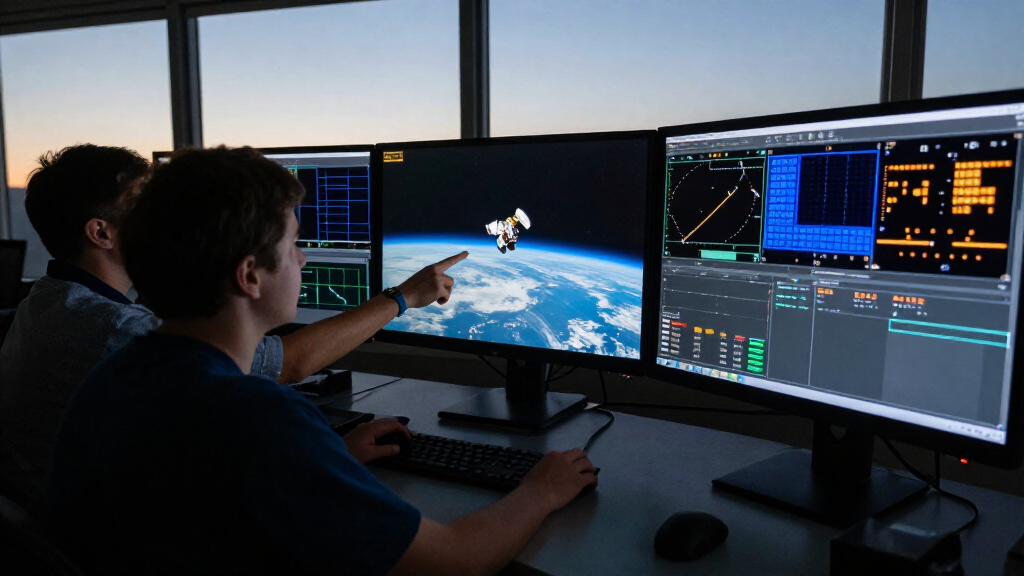
Google says its Gemma 4 AI model generated a haiku aboard a satellite carrying one of the company’s TPU chips, marking an early test of its Project Suncatcher effort to study computing in orbit. The small prototype launched on October 1, 2026, and returned its first prompt response during a ground-station pass this week, according to Google.
The satellite passed over Svalbard, Norway, as engineers sent it a prompt asking for a poem about space. Google said the response was downlinked to a ground station, calling the test its “Hello World” moment. The poem read: “Blue marble below / Data streams in silent grace / Starlight feeds my core.” Engineers also tested space-themed limericks and asked the payload to report technical status, the company said.
The spacecraft is based on a Planet satellite platform and carries four Google TPUs, TechCrunch reported. It generates up to about 1 kilowatt of power, limiting operation to one chip at a time. The source material says the chip ran in bursts of roughly 20 minutes during this week’s test; the prototype is intended for experiments, not sustained data-center workloads.
Google said the satellite had spent about three weeks in commissioning after its launch on a SpaceX rideshare mission. The company reported confirming contact and said the craft was “operating as expected.” The test establishes that a TPU can run a model and return a response in orbit; it does not establish that a large-scale orbital computing system can operate reliably or economically.
Infographic 01 · What flew and what it did
One satellite, four chips, one haiku
Google’s Project Suncatcher prototype is the first test of whether its AI data center chips can work in orbit. Here is what is on board and how it got there.
- 4 Nov 2025Project Suncatcher announcedResearch post and preprint; plan: two prototypes with Planet by early 2027
- 1 Oct 2026Prototype launchedSpaceX Transporter-18 rideshare, built with Planet; peer-reviewed paper in Joule
- Oct 2026About three weeks of commissioningHost and TPU trays powered up, early machine learning tests
- Week of 26 Oct“Hello World”First prompt to Gemma 4; the haiku came down during a pass over Svalbard, Norway
- NextHeat and radiation tests in orbitHow the TPUs behave under thermal stress and real space radiation
- 2027Twin interconnected satellitesMore power and laser links between satellites (Google, TechCrunch)
Scale check
The satellite vs. one power deal on Earth
890 MW = 890,000 kW, about 890,000 times the prototype (my arithmetic). The prototype bar is drawn at a visible minimum; to scale it would be invisible.
Not the first AI chip in orbit
Starcloud-1, launched November 2025 (CNBC)
- Carried one Nvidia H100, a data center GPU
- Trained a small language model in orbit
- Ran Google’s open model Gemma up there in December 2025
- Google’s claim is narrower: the first response from a data center class TPU in orbit
Sources: Google, 30 Oct 2026 · Google, 1 Oct 2026 · Google Research, 4 Nov 2025 · TechCrunch, 30 Oct 2026 · TechCrunch, 1 Oct 2026 · Google and Constellation, 6 Oct 2026 · CNBC, 10 Dec 2025.
Powered by Thorsten Meyer AI
Testing AI Beyond Earth
Project Suncatcher addresses a growing constraint on AI development: the electricity and infrastructure required by data centers. Google’s research explores whether solar-powered satellites could supply computing capacity in orbit, where sunlight can be more consistent in some orbital paths than on the ground. That is a long-term proposal, not a demonstrated way to relieve current electricity demand.
The prototype’s scale shows the gap between a successful demonstration and a working orbital data center. Its roughly 1-kilowatt power supply is small beside the hundreds of megawatts associated with terrestrial data-center energy projects. The near-term value is technical learning: whether computing hardware, thermal controls and communications can function in the space environment.
Google’s research also makes the economics conditional on launch prices falling substantially. The source material gives an estimate of about $14,700 per kilowatt-year in launch costs at current prices, compared with about $810 if launch costs reach $200 per kilogram. Those figures are estimates tied to stated assumptions, not a price quote for an operating service. The proposal would require major reductions in launch costs as well as solutions to engineering and operational risks.
Products Worth Considering

Jackery Explorer 2000 v2 Portable Power Station, 2042Wh, 2200W

Apple AirPods Pro (2nd Generation) Wireless Earbuds with USB-C MagSafe Charging Case

Bose QuietComfort Headphones (2nd Gen) – Wireless Over-Ear Noise Cancelling Headphones, Eucalyptus Green
As an affiliate, we earn on qualifying purchases.
From Research to Orbit
Google introduced Project Suncatcher in November 2025, describing a possible constellation of solar-powered satellites equipped with TPUs and connected through laser links. The company’s initial plan, as described in its research, called for a learning mission with Planet and two prototype satellites by early 2027. The October launch brought a smaller, single-satellite test earlier than that stated milestone, according to the source material.
Google is not the first company to put AI computing hardware in orbit. The source material says startup Starcloud launched a satellite with an Nvidia H100 GPU in November 2025, and CNBC later reported that the company had run Google’s Gemma model in orbit. Google’s claim is narrower: it describes this as the first response from a data-center-class TPU in orbit. Its proposed distinction is a future system in which satellites connect and work together, rather than computing independently on separate spacecraft.
Google’s research sketches clusters of 81 satellites flying at close range and linked by optical communications. That is a proposed design, not the configuration tested by the current prototype. The research was published as a preprint in 2025 and, according to the source material, a peer-reviewed version appeared in the journal Joule on October 1, 2026.
““the first-ever AI response from a data center class TPU in orbit””
The Limits Still Untested
The test does not yet show how TPUs will perform through extended exposure to radiation and thermal stress, which Google says it plans to examine. The prototype’s brief operating bursts also leave open whether hardware can run for longer periods while maintaining stable performance in orbit.
Other unresolved issues include how to remove heat in a vacuum, repair or replace failed equipment, and maintain reliable links between satellites and ground stations. A larger constellation would also have to contend with the crowded orbital environment; the source material cites about 47,000 tracked objects, without further detail on the tracking criteria or date for that count.
The reported launch-cost estimates depend on future prices and assumptions. It is not clear when launch costs could reach the $200-per-kilogram figure used in Google’s lower-cost scenario, or whether a constellation could meet the company’s projected performance and economic goals. No operating schedule, service price or commercial customer plan is provided in the source material.
Tests Before a Two-Satellite Trial
Google says the immediate next step is to test the TPU payload under thermal stress and radiation exposure. The results will help establish whether the chip can keep running in orbit beyond an initial prompt-response demonstration.
If those tests go well, the company’s stated next milestone is a pair of interconnected satellites in 2027. TechCrunch reported that the planned pair would generate more power and test optical links between spacecraft. That mission would address a central part of Suncatcher’s design: whether satellites can exchange data quickly enough to work together as a computing cluster. The schedule and outcome remain subject to testing and are not guarantees of a later commercial system.
Key Questions
What did Google’s satellite do?
Google says Gemma 4 generated a haiku on a satellite carrying a Google TPU. Engineers sent a prompt during a ground-station pass, and the response was sent back to Earth.
Is this the first AI system in orbit?
No. The source material describes Starcloud launching a satellite with an Nvidia H100 GPU in 2025 and later running Google’s Gemma model there. Google’s claim concerns a response from a data-center-class TPU, not the first AI computing hardware in space.
Can the satellite run a full data center?
No. The prototype produces up to about 1 kilowatt and can operate one TPU at a time in short bursts. It is an experimental satellite, not a full data center.
Why is Google testing computing in space?
Google is studying whether solar-powered satellites could eventually provide computing capacity. Its proposal depends on lower launch costs, reliable satellite links and solutions to power, cooling, radiation and repair challenges; the current test does not show that those conditions have been met.
What happens next?
Google says it will test the TPU’s response to radiation and thermal stress. If testing goes well, the company has described a two-satellite mission in 2027 to test inter-satellite optical links.
Source: ThorstenMeyerAI.com