
TL;DR

Get the latest gadgets delivered free with Prime
- Fast, free delivery on millions of items
- Prime Video, Amazon Music and more included
- Member-only deals all year
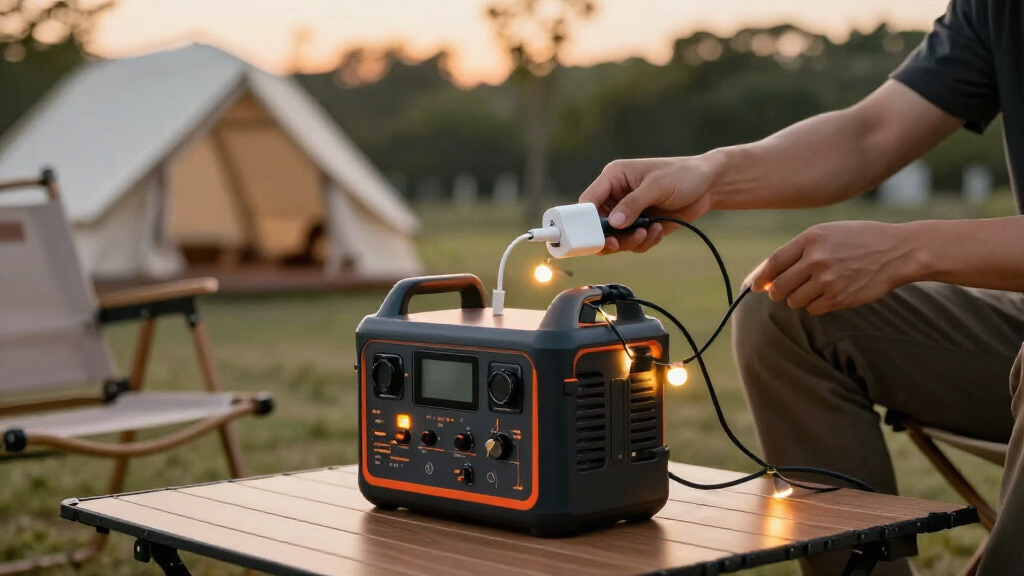
A buyer’s guide compares 10 portable power stations, ranging from an 88Wh compact unit to models rated at 3,584Wh. The source recommends the Jackery Solar Generator 1000 v2 for general use, while noting that product specifications, prices and charging claims should be checked against current listings.
A buyer’s guide labeled for 2027 compares 10 portable power stations across capacity, output and portability, recommending the Jackery Solar Generator 1000 v2 as its general-use pick, as detailed in the original analysis. The lineup also includes compact units for charging personal devices and larger models presented as options for home backup, giving readers a way to match a station’s rated power to the equipment they want to run, with more options in this portable power station guide.
The listed capacities range from 88Wh for the MARBERO Portable Power Station to 3,584Wh for the Jackery HomePower 3600 Plus. The guide gives the Jackery Solar Generator 1000 v2 a 1,070Wh capacity and 1,500W AC output. It describes that model as a balance for camping and light home backup, but does not provide a testing method or comparative price data to support its overall ranking.
For larger loads, the guide lists the HomePower 3600 Plus at 3,600W output and the EF ECOFLOW DELTA 3 Ultra at 3,072Wh capacity, 3,600W continuous output and 7,200W surge output, specifications relevant to higher-capacity power stations. It also names the Anker SOLIX C1000 Gen 2 as a fast-charging option, reporting a 49-minute AC recharge time. The source does not specify the charging conditions behind that figure.
Smaller entries include the Jackery Explorer 300 at 292Wh and the Anker SOLIX C300 DC at 288Wh. The latter is described as having seven ports and no AC outlets. The guide says stations below 300Wh are intended for electronics rather than high-wattage cooking or heating appliances; actual suitability depends on the device’s draw, runtime and the station’s available ports.
Choose power for your needs and the load you’ll run
A guide compares 10 portable power stations, from compact electronics chargers to larger backup options. Match capacity, output and weight to your devices, then verify current specifications before buying.
Match the station to the job
Capacity stores energy; output indicates what a station may run at once.
Personal electronics
The 88Wh MARBERO is listed at 3.2 pounds. Small stations are framed for phones and other electronics.
Jackery Solar Generator 1000 v2
The guide’s general-use pick has 1,070Wh capacity and 1,500W AC output.
Backup options
The HomePower 3600 Plus and EF ECOFLOW DELTA 3 Ultra are presented for higher-demand backup use.
Compare the listed specifications
| Model | Capacity | Output or feature |
|---|---|---|
| MARBERO Portable Power Station | 88Wh | 3.2 pounds |
| Jackery Explorer 300 | 292Wh | Compact option |
| Anker SOLIX C300 DC | 288Wh | Seven ports; no AC outlets |
| Jackery Solar Generator 1000 v2 | 1,070Wh | 1,500W AC output |
| EF ECOFLOW DELTA 3 Ultra | 3,072Wh | 3,600W continuous; 7,200W surge |
| Jackery HomePower 3600 Plus | 3,584Wh | 3,600W output |
Check fit before relying on it
A rating alone cannot tell you how long an appliance will run.
Check each device’s power draw and the runtime you need.
Compare appliance wattage with continuous and surge output, and estimate energy use against capacity.
Confirm specifications, weight, included accessories and charging compatibility with the current listing.
Know the limits of the comparison
- Capacity and output figures for comparing options
- Use cases from electronics charging to larger backup loads
- Some solar bundles, including Jackery kits
- Measured runtimes or independent test results
- Current prices or verified 2027 availability
- Whole-home coverage or solar recharge time in your conditions
Matching Capacity to Real Loads
The comparison highlights the tradeoff between carrying weight and usable power. The guide lists the MARBERO at 3.2 pounds and 88Wh, while the Jackery Explorer 1000 v2 is listed at 23.8 pounds and 1,070Wh. Those figures illustrate why a compact charger may suit phones and other small electronics while a larger station is more appropriate for higher-demand equipment, though the guide does not report independent runtime tests.
Buyers considering a station for outages should pay attention to both continuous output and capacity. Wattage indicates what a unit may run at a given moment; watt-hours describe stored energy. Neither figure alone establishes how long a particular appliance will operate. The source presents some large models as home-backup options, but does not establish that they can power an entire home or replace a permanently installed backup system.
Solar bundles may simplify off-grid charging, according to the guide, which highlights Jackery kits that include panels. The source gives no comparable solar recharge times or test conditions, so bundle inclusion alone does not show how much energy a panel will provide in a particular location or season.
Products Worth Considering

Jackery Explorer 300 Portable Power Station, 292Wh

Anker SOLIX C300 Portable Power Station, 288Wh

EcoFlow Delta 3 Portable Power Station – 1024 Wh, 1800 W
As an affiliate, we earn on qualifying purchases.
Ten Models, Different Roles
The list includes overlapping product families: the Jackery Solar Generator 1000 v2 and Explorer 1000 v2 are both listed at 1,070Wh, while the Anker SOLIX C1000 Gen 2 appears twice with the same 1,024Wh rating. The source gives the Jackery Solar Generator 1000 v2 a 200W panel bundle and lists a separate 1,070Wh Explorer 1000 v2 as a standalone unit. It does not explain whether repeated entries reflect distinct configurations or separate recommendations.
The guide also groups products by intended use, including backpacking, device charging and home backup. That framing is useful for narrowing choices, but labels such as “best” are the publisher’s judgments. No testing protocol, product review dates, prices or warranty comparisons are included in the supplied material.
The source says solar compatibility is common among the options and identifies the Jackery 1000 v2 and Jackery 300 bundles as convenient solar kits. It lists the Jackery 300 kit with a 40W panel and 292Wh capacity. The specifications do not state how long charging takes in sunlight or whether the included panel is sufficient for a reader’s expected use.
“The main tradeoff you will face is between weight and power.”
— Thorsten Meyer AI buyer’s guide
Specifications Need Current Checks
The supplied material does not include a publication date, links to product pages, prices, independent test results or a method for ranking the products. It is therefore unclear whether all listed models and specifications remain current for 2027. The source also gives different weight details for some products or bundles and omits certain output and chemistry fields in its specifications table.
Charging-speed claims, including the reported 49-minute recharge for the Anker C1000 Gen 2, lack details about starting charge, input settings and conditions. The guide does not provide measured runtimes, solar charging results, or evidence that the larger units can support a particular home’s essential circuits. Readers should verify product specifications and compatibility before relying on a unit for a specific appliance or backup plan.
Check Listings Before Buying
The guide directs readers to product listings for current prices, but the supplied source contains no price figures or dated availability information. The next practical step for a buyer is to compare the manufacturer’s current capacity, continuous and surge output, supported charging inputs, included accessories and weight with the intended devices.
For backup use, readers will need to check each appliance’s wattage and expected runtime against the station’s specifications. For off-grid use, they should verify panel compatibility and charging estimates for local conditions. The source provides no announced follow-up testing or update schedule.
Key Questions
Which model does the guide recommend for general use?
The guide names the Jackery Solar Generator 1000 v2, listed at 1,070Wh and 1,500W AC output. That is the publisher’s recommendation; no test method or price comparison is included in the source.
Which listed stations are intended for larger backup loads?
The guide highlights the Jackery HomePower 3600 Plus and EF ECOFLOW DELTA 3 Ultra. It lists them at 3,600W output, but does not show appliance runtime tests or establish whole-home coverage.
Can an 88Wh or 292Wh station run kitchen appliances?
The guide characterizes units below 300Wh as suited to electronics charging and says they cannot run heating or cooking appliances. Check the appliance’s power draw and the station’s output limits for the specific combination.
Does the comparison verify current prices and specifications?
No. The supplied material provides ratings and specifications but no publication date, current prices or independent verification. Confirm details with the manufacturer or seller before buying.
Source: Thorsten Meyer AI