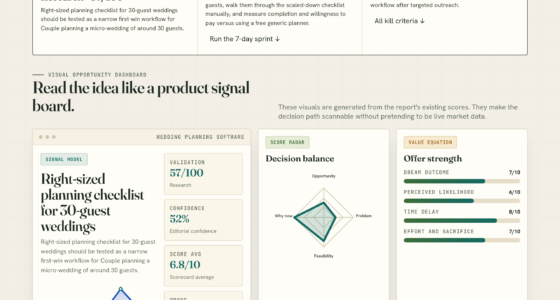

📊 Full opportunity report: Creative industries. The bifurcated reality. on ThorstenMeyerAI.com — validation score, market gap, and execution plan.
TL;DR
Recent evidence indicates a structural bifurcation in creative industries driven by AI. Top-tier professionals augment their work, while routine creative roles decline sharply, causing a ‘middle squeeze.’ This shift impacts employment and industry dynamics.
Recent data confirms a significant structural shift in creative industries, characterized by a bifurcation in employment patterns driven by AI adoption. Top-tier professionals are increasingly augmenting their work with AI tools, while routine creative roles have experienced sharp declines, exemplifying a ‘middle squeeze.’
Between 2023 and 2026, graphic design job postings dropped 33%, with similar declines in content production roles. Meanwhile, AI-collaboration job postings surged 340%, and 90% of content marketers plan to use AI by 2026, reflecting a rapid shift towards automation and augmentation.
Empirical evidence shows that AI-generated advertising imagery is rated more aesthetically appealing than human-created content, with some stock photos outperforming human ones in click-through rates. However, demand for routine creative services, such as stock illustration, copywriting, and translation, has declined markedly—by up to 21% in freelance opportunities.
This pattern indicates a ‘middle squeeze’: top-tier creative professionals are augmenting their capabilities with AI, while lower-tier, routine roles face displacement, leading to a bifurcation within the same workforce. The evidence comes from multiple sources, including Upwork data, industry reports, and platform usage statistics from Canva, Midjourney, Jasper, and Runway.
Creative industries.
The bifurcated reality.
Graphic designer postings -33% · AI-collaboration roles +340% · content production -28% · 90% content marketers using AI · stock photo bimodal click-through distribution · 21% freelance opportunity slash. The fourth distinct structural-pattern Phase 1 produces — creative-skill-spectrum bifurcation.
This is Atlas Essay 05 — the fourth and final Dimension 1 sector forensic in Phase 1. Creative industries produces the fourth distinct structural-pattern: creative-skill-spectrum bifurcation, a.k.a. the “middle squeeze.” Top-tier creative work augments — brand strategy, art direction, AI-orchestration · AI-collaboration job postings +340% 2023-2024. Commodity-tier creative work substitutes — stock photography, routine copy, template design · graphic designer postings -33% in 2025 · content production roles -28%. Middle creative-professional tier faces structural compression — the squeeze that makes the bifurcation pattern empirically distinct from cohort-bifurcation (Essay 02), sub-sector heterogeneity (Essay 03), and operational-scale displacement (Essay 04). Multi-source convergence: Brookings · Hui et al. Organization Science · Envato 2026 (1,780 creatives) · Figma 2025 · HubSpot · European Parliament study · Hartmann et al. 2025. Phase 1’s four-pattern integration is structurally complete.
Five sub-fields. One pattern.
Creative industries has the most empirically-fragmented evidence base across sub-fields of any Phase 1 sector. The consistent across-sub-field finding is the bifurcation pattern itself — top-tier augments, commodity substitutes, middle compresses, in every sub-field documented.
signal
vs quality
vs specialized
distribution
cutting
Three tiers. The middle squeeze.
The structural-empirical pattern across the five sub-fields. Creative industries displacement operates on a substitutable-output axis distinct from cohort, sub-sector, and operational-scale axes of the prior sectors. Top-tier augments, commodity substitutes, middle compresses.
Five factors. Substitutable-output.
The analytical decomposition extended to creative industries. Creative industries operates on a fifth attribution factor — the substitutable-output axis — that is structurally distinct from cohort-specific, pyramid-model, and operational-scale dynamics of the prior three sectors.
here
specific
Four patterns. Phase 1 complete.
The integrative observation Essay 05 produces. Phase 1 has now produced empirical evidence for four structurally distinct displacement patterns — operating across four structurally distinct axes determined by sectoral characteristics. “AI-driven labor displacement” is a family of patterns, not a single phenomenon.
axis
axis
operational axis
spectrum axis
Creative industries is the bifurcated reality empirically confirmed. Top-tier creative work augments — brand strategy, art direction, AI-orchestration · AI-collaboration roles +340%. Commodity-tier creative work substitutes — stock photography, routine copy, template design · graphic-design job postings -33%. Middle creative-professional tier faces structural compression — the “middle squeeze” pattern. This is the fourth distinct structural-pattern Phase 1 produces — creative-skill-spectrum bifurcation operating on a skill-tier axis rather than cohort, sub-sector, or operational axes. The Atlas framework’s Phase 1 empirical-evidence foundation is structurally complete. Four sector forensics. Four distinct structural-patterns. Five attribution factors. Essay 06 crystallizes the integrative synthesis.
Implications of the ‘Middle Squeeze’ in Creative Work
This shift fundamentally alters the employment landscape in creative industries. Top-tier professionals leverage AI to enhance their output, potentially increasing productivity and creative scope. Conversely, routine roles are shrinking, risking job displacement and industry fragmentation. The bifurcation challenges traditional notions of creative labor and raises questions about future skill requirements and industry structure.
AI-Assisted Cinema: How Artificial Intelligence Is Changing Film Production
As an affiliate, we earn on qualifying purchases.
As an affiliate, we earn on qualifying purchases.
Emerging Evidence of Structural Change in Creative Sectors
Previous research and industry analyses have observed AI’s growing role in creative fields, but recent empirical data from 2025-2026 confirms a distinct pattern: a ‘middle squeeze’ where mid-tier roles face significant decline while top-tier professionals augment their work. The pattern is evident across multiple sub-fields, including graphic design, copywriting, translation, and stock photography.
The data indicates that AI tools like Canva, Midjourney, Jasper, and Runway are reshaping content creation, with Canva commanding 44% of creative AI tool use, facilitating non-designers’ production of high-quality visual content. Meanwhile, AI-generated imagery and stock photos outperform human-created content in some metrics, further displacing routine work.
This structural change reflects a broader trend of automation-driven displacement in creative labor, contrasting with prior sector patterns focused on cohort or operational scale displacement.
“The empirical evidence supports a ‘middle squeeze’ pattern in creative industries, driven by AI augmentation at the top and routine job displacement at the bottom.”
— Thorsten Meyer
Master AI Photography: Stop Guessing, Start Directing. Turn Simple Prompts into Professional Photos with Any AI Image Generator
As an affiliate, we earn on qualifying purchases.
As an affiliate, we earn on qualifying purchases.
Unclear Aspects of the ‘Middle Squeeze’ Pattern
While the data demonstrates a clear bifurcation, the long-term implications for industry structure and employment stability remain uncertain. It is not yet clear how top-tier professionals will adapt to increasing AI augmentation or whether routine roles will recover or further decline. Additionally, the full impact on wages, job quality, and industry diversity is still emerging.

Claude AI for Beginners: The Complete Step-by-Step Guide to Prompt Engineering, Content Creation, Automation and Productivity with Claude AI. Includes … Can Use Today (The Claude AI Mastery Series)
As an affiliate, we earn on qualifying purchases.
As an affiliate, we earn on qualifying purchases.
Future Developments in Creative Industry Employment
Further monitoring of employment trends and AI adoption rates will clarify whether the ‘middle squeeze’ persists or evolves. Industry stakeholders are expected to explore new skill requirements, training programs, and job roles that could mitigate displacement effects. Additionally, ongoing research will assess how AI influences creative quality, consumer engagement, and industry profitability.

Google Gemini AI From Beginner to Pro: The Fast and Simple Way to Stop Using AI Casually and Start Transforming Your Work, Your Output and Your Results in 30 Days
As an affiliate, we earn on qualifying purchases.
As an affiliate, we earn on qualifying purchases.
Key Questions
What is the ‘middle squeeze’ in creative industries?
The ‘middle squeeze’ describes a pattern where routine creative roles decline sharply due to AI displacement, while top-tier professionals augment their work, creating a bifurcation within the workforce.
Which creative sub-fields are most affected?
Graphic design, copywriting, translation, and stock photography are among the most impacted, with significant job posting declines and increased AI use.
How is AI changing creative work?
AI is both augmenting high-end creative tasks, enabling professionals to produce more complex work, and substituting routine tasks, leading to job displacement at the middle and lower tiers.
Will routine creative jobs recover?
It is currently unclear whether routine roles will rebound or continue to decline; ongoing industry shifts and technological advancements will influence future employment patterns.
What can creative professionals do to adapt?
Developing advanced skills, integrating AI tools into workflows, and focusing on strategic, high-value creative tasks may help professionals remain competitive.
Source: ThorstenMeyerAI.com