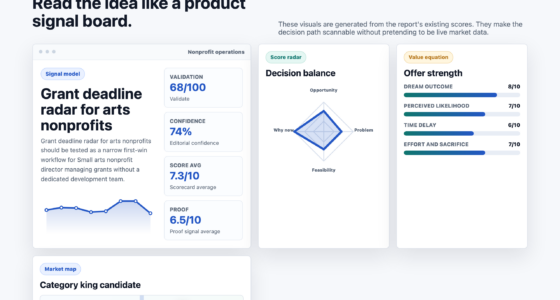

📊 Full opportunity report: When One Agent Isn’t Enough: Claude Now Builds Its Own Team of Agents on the Fly on ThorstenMeyerAI.com — validation score, market gap, and execution plan.
TL;DR
Claude has introduced a new feature called dynamic workflows, allowing it to create and coordinate multiple agents on the fly for complex tasks. This development aims to improve performance on high-value, multi-step projects by addressing limitations of single-agent operation.
Anthropic’s Claude AI now has the ability to build its own team of agents on the fly, enabling it to better handle complex, high-value tasks by orchestrating multiple specialized subagents during a single workflow. This feature, called dynamic workflows, marks a significant step in autonomous AI task management and is designed to address limitations observed in single-agent operations.
The new capability allows Claude to generate a custom orchestration harness — a small JavaScript program that spawns, coordinates, and manages multiple subagents, each with a dedicated role and context window. This enables Claude to perform tasks that require parallel processing, independent verification, or iterative refinement, which were previously challenging for a single agent.
According to Anthropic, the system can decide which model to assign to each subagent, choosing between faster, less costly models for routine work and more powerful models for judgment and verification. The process is designed to resume seamlessly if interrupted, making it suitable for complex, multi-stage projects. The feature is currently available for select users and is intended for high-value, intricate tasks where standard single-agent workflows fall short.
When one agent isn’t enough: Claude now builds its own team on the fly
Skills package what you know; loops decide how far you delegate over time. Dynamic workflows are the third axis — within a single task, Claude writes its own harness and assembles a temporary team of subagents. Think of it as Claude drawing an org chart for one job.
The shift is from prompting a worker to commissioning a team — more output, more cost, and a manager’s judgment required. Reach for a workflow when a task is big, parallel, adversarial, or judgment-heavy — and when you can feel a single agent getting lazy, grading its own homework, or losing the plot. Bound it (token budgets, pilot first) — workflows can spawn hundreds of agents and burn far more tokens. For everything else, don’t hire five people to change a lightbulb.
Implications for AI Workflow Automation
This development allows AI systems to manage complex projects more reliably by mimicking human team structures, reducing common failures such as partial work, self-bias, and goal drift. It broadens AI application scope to areas like research, verification, and multi-step problem solving, potentially transforming how organizations deploy AI for high-stakes tasks.
AI workflow orchestration software
As an affiliate, we earn on qualifying purchases.
As an affiliate, we earn on qualifying purchases.
Evolution of AI Task Management Capabilities
Prior to this, Claude operated primarily as a single-agent system, suitable for straightforward tasks like coding or simple data processing. Challenges emerged when tasks grew in complexity, involving multiple steps, verification, or parallel processing, leading to issues like incomplete work or goal erosion. The concept of dynamic workflows builds on previous improvements in skills and looping mechanisms, completing a trilogy aimed at making Claude more autonomous and capable in high-value scenarios.
This feature was developed alongside Claude Opus 4.8, which enhanced its reasoning abilities, enabling it to write its own harnesses tailored to specific jobs. The approach aligns with broader trends in AI towards more autonomous, modular, and scalable systems, but it is still in early adoption stages and primarily targeted at enterprise users.
“Claude’s ability to assemble its own team of agents on the fly represents a significant step toward autonomous, high-value AI workflows.”
— Thorsten Meyer, AI researcher at Anthropic
multi-agent AI system
As an affiliate, we earn on qualifying purchases.
As an affiliate, we earn on qualifying purchases.
Unconfirmed Aspects of Workflow Reliability and Safety
It is not yet clear how well the dynamic workflows perform in real-world, high-stakes environments at scale. While initial results are promising, long-term reliability, safety, and control mechanisms for autonomous agent orchestration remain under evaluation. Further testing is needed to confirm robustness and prevent unintended behaviors.
AI task management tools
As an affiliate, we earn on qualifying purchases.
As an affiliate, we earn on qualifying purchases.
Upcoming Deployment and Performance Evaluation Phases
Anthropic plans to expand access to the feature, gather user feedback, and conduct rigorous testing in diverse applications. Future updates may include enhanced safety controls, broader model support, and integrations with existing enterprise workflows. Monitoring how organizations leverage this capability will shape its evolution and adoption.
AI automation software for complex projects
As an affiliate, we earn on qualifying purchases.
As an affiliate, we earn on qualifying purchases.
Key Questions
How does Claude decide when to build a team of agents?
Claude determines the need for multiple agents based on task complexity, requiring parallel processing, verification, or iterative refinement, which are identified during task planning.
Can users control or customize the teams Claude builds?
Yes, users can specify the type of workflow or trigger it with specific commands like ‘ultracode,’ guiding Claude to generate tailored orchestration harnesses.
Is this feature available for all users now?
Currently, the dynamic workflows feature is available for select users as part of a phased rollout and testing program.
What are the main limitations of this approach?
It requires more tokens and computational resources, and is intended for complex, high-value tasks rather than simple fixes or straightforward questions.
How might this impact AI safety and control?
While promising, autonomous agent orchestration introduces new safety considerations, including managing unexpected behaviors, which are still under active research and development.
Source: ThorstenMeyerAI.com