
📊 Full opportunity report: Real-Time Business Liquidation Alerts: Making Asset Acquisition Easier on IdeaNavigator AI — validation score, market gap, and execution plan.

Get the latest gadgets delivered free with Prime
- Fast, free delivery on millions of items
- Prime Video, Amazon Music and more included
- Member-only deals all year
TL;DR
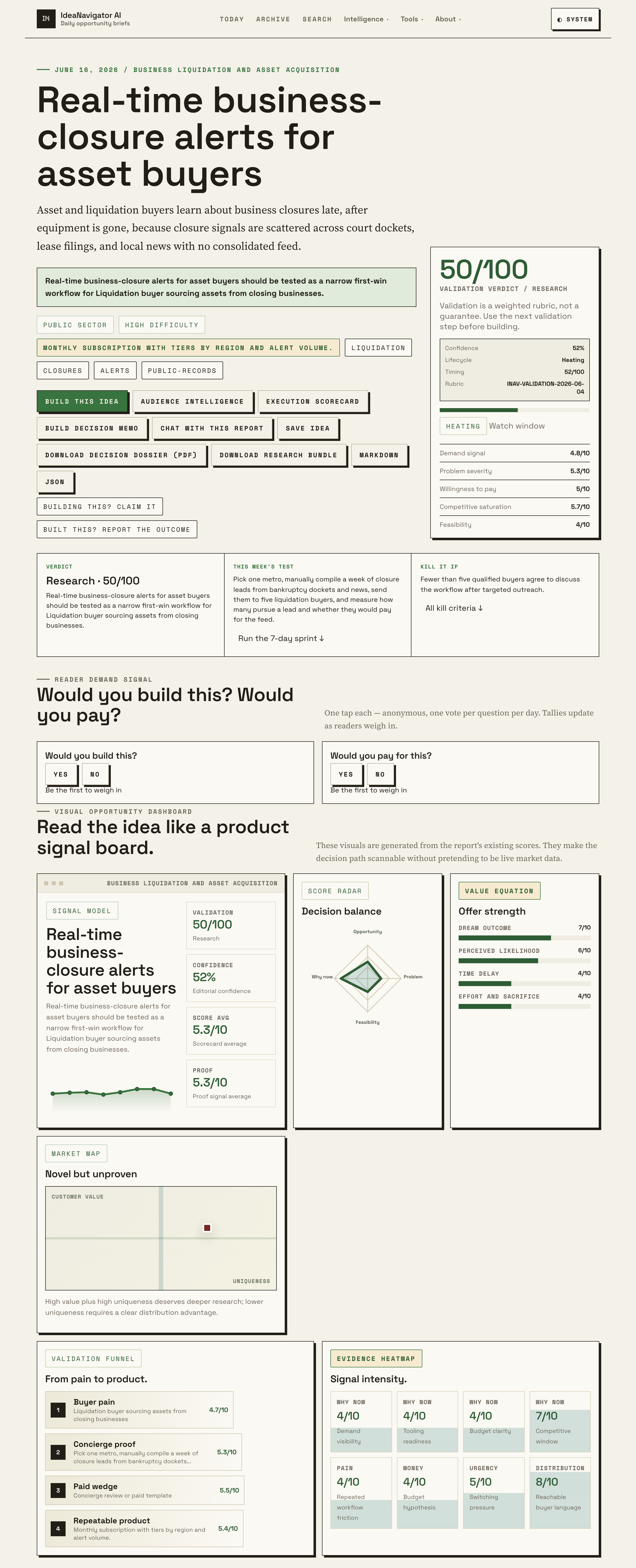
A new system for real-time alerts on business closures aims to improve asset acquisition by providing liquidation buyers with timely, consolidated data. This development could significantly reduce delays in sourcing assets from closing businesses.
IdeaNavigator AI reports the development of a real-time business closure alert system aimed at asset buyers and liquidation professionals. This system is designed to provide timely notifications about business closures, addressing a longstanding challenge where buyers learn about closures too late, often after assets have already been removed. The initiative is currently in a testing phase, with plans to validate its effectiveness through a pilot in a selected metro area.
The proposed alert system focuses on consolidating data from various sources such as court dockets, lease filings, and local news into a single, accessible feed. Currently, asset buyers face delays because closure signals are scattered and often outdated by the time they are discovered. The system would allow buyers to set regional and asset category preferences, with human curators scanning bankruptcy filings and news to send daily updates matching their criteria. This manual process is intended as an initial MVP to test market interest and operational feasibility.
Market participants involved include liquidation and asset acquisition firms, with revenue modeled through tiered monthly subscriptions based on region and alert volume. The initial validation involves compiling closure leads from bankruptcy dockets and local news in one metro, then measuring how many buyers pursue these leads and whether they are willing to pay for such a service.
Impact on Asset Sourcing Efficiency for Liquidation Buyers
This development could significantly improve the efficiency of asset acquisition processes for liquidation buyers by reducing the time lag in discovering business closures. Timely alerts enable buyers to act quickly, potentially securing assets before they are removed or sold elsewhere. As small-business closures and bankruptcies remain elevated post-pandemic, access to real-time data could become a critical advantage in a competitive liquidation market, potentially lowering acquisition costs and increasing asset recovery success rates.
business liquidation asset recovery tools
As an affiliate, we earn on qualifying purchases.
As an affiliate, we earn on qualifying purchases.
Growing Need for Timely Closure Data Post-Pandemic
Small-business closures and bankruptcies have remained high following the COVID-19 pandemic, leading to increased activity in the liquidation sector. Traditionally, signals of business closures are scattered across various public records, often delayed or incomplete. Recent advancements in electronic filing and data access make real-time aggregation feasible for the first time. The concept of alerts has been discussed in industry circles, but a practical, manually curated MVP is now being tested to validate the approach.
“Consolidating closure signals into a single feed could transform how liquidation buyers source assets, making the process both faster and more reliable.”
— an anonymous researcher
As an affiliate, we earn on qualifying purchases.
Uncertainties Around System Effectiveness and Adoption
It is still unclear how many liquidation buyers will adopt the alert system at scale, and whether the manual curation process can be scaled efficiently. The actual response from the market, including willingness to pay and pursuit of leads generated, remains to be validated through ongoing testing. Additionally, the accuracy and timeliness of the alerts depend on the quality of data sources and the effectiveness of human curators.
liquidation asset sourcing software
As an affiliate, we earn on qualifying purchases.
As an affiliate, we earn on qualifying purchases.
Next Steps for Validation and Market Rollout
The immediate next step is to complete the pilot in a selected metro area, compile a week of closure leads, and distribute them to participating liquidation buyers. The goal is to measure lead pursuit rates and willingness to pay. If successful, the system could expand regionally and incorporate automated data aggregation to improve scalability. Further development may include integrating machine learning to enhance alert accuracy and timeliness.
As an affiliate, we earn on qualifying purchases.
Key Questions
How will the alert system improve asset sourcing?
The system provides timely, consolidated notifications of business closures, enabling buyers to act quickly and secure assets before they are removed or sold elsewhere.
Is the alert system automated or manual?
The initial MVP involves manual curation of closure signals, but future versions may incorporate automation and machine learning to improve efficiency and scale.
What is the cost structure for using this alert service?
The service plans to operate on a tiered monthly subscription model based on region and alert volume, but specific pricing details are still under development.
When will the system be available for broader use?
The pilot phase is ongoing, with plans to evaluate results in the coming months. A broader rollout could follow if validation proves successful.
What sources of data are used for the alerts?
The system primarily relies on bankruptcy dockets, lease filings, and local news reports, which are electronically accessible and can be aggregated in real time.
Source: IdeaNavigator AI
Columbus Day / Indigenous Peoples' Day Picks
long weekend sales
As an affiliate, we earn on qualifying purchases.