
TL;DR

Get the latest gadgets delivered free with Prime
- Fast, free delivery on millions of items
- Prime Video, Amazon Music and more included
- Member-only deals all year
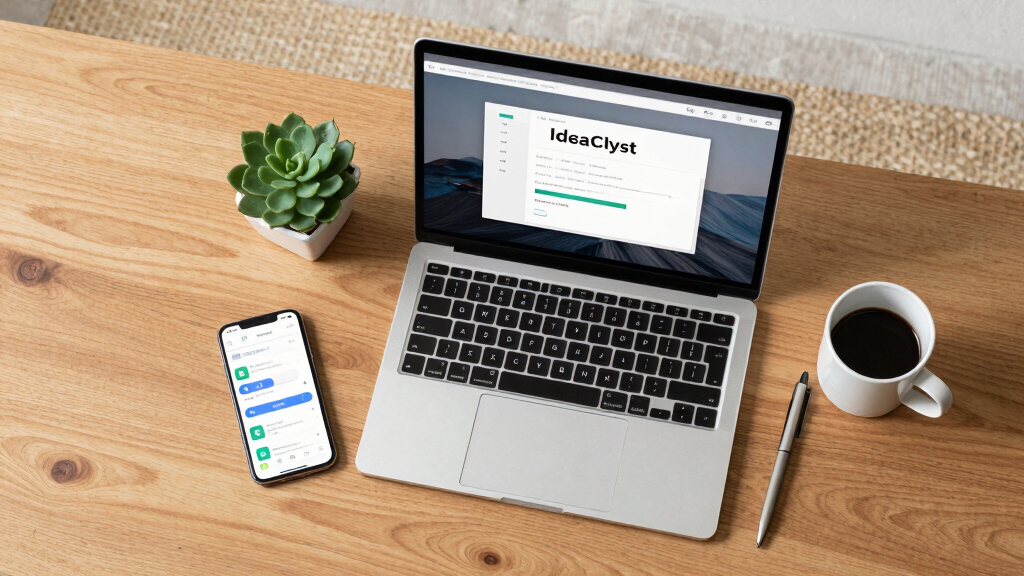
IdeaClyst is being presented as a standalone founder workspace for testing startup ideas before teams commit months of work. Source material describes a local-first tool with an AI council, discovery engine, research workflow and Markdown output, but does not specify launch status, pricing or adoption data.
IdeaClyst is being framed as a local-first startup idea validation tool for founders who need to decide which product idea is worth building, according to source material from Thorsten Meyer AI. The report matters because it places the product in a crowded AI tooling market while arguing that the higher-risk founder decision is no longer how fast software can be built, but whether the idea should be built at all.
The source material describes IdeaClyst as three tools in one: an AI council that pressure-tests ideas, a discovery engine that searches for demand signals, and a founder workspace that moves selected ideas from early concept to build planning. It says the tool runs locally, with idea files kept on the user’s machine, and describes the project as MIT-licensed.
The AI council is described as a five-step process. One role proposes product strategy, another proposes technical architecture, then separate critique passes attack the assumptions before a final synthesis produces a founder packet. The output is described as sectioned Markdown, with research, strategy, architecture, critique, validation tests and planning material written to disk.
The report also says IdeaClyst is designed to use real source material rather than free-form model opinion. According to the source, the tool can fetch pages, read competitor sites, scan discussions and attach links to validation evidence. The same source says that if the system cannot gather evidence, it is meant to say so rather than invent statistics, competitors or citations.
Why It Matters
The pitch behind IdeaClyst is aimed at a common founder risk: spending months building the wrong product. The source cites CB Insights for the claim that about 42% of startup failures are tied to lack of market need, and it cites 2026 industry estimates that a solo founder or small team can waste roughly $35,000 to $150,000 building the wrong thing over six to 12 months.
For readers, the product is relevant because AI coding tools have reduced the time needed to produce software, which can also make it easier to build before there is evidence of demand. IdeaClyst’s stated value is not faster shipping, but earlier refusal: helping a founder find weak assumptions, missing demand and unclear positioning before resources are committed.
startup idea validation software
As an affiliate, we earn on qualifying purchases.
As an affiliate, we earn on qualifying purchases.
Background
Thorsten Meyer AI says it previously covered IdeaClyst through a narrower use case: feeding scored suggestions into a Threlmark roadmap. The new report presents IdeaClyst as the larger standalone system behind that capability.
The source places the tool alongside Threlmark in a local-first philosophy. That approach is presented as a privacy and ownership choice for founders, because early product ideas, research notes and rejected concepts may be commercially sensitive. The article says the material remains as plain files on disk.
The report contrasts IdeaClyst with asking a general chatbot for validation. In that comparison, the issue is not whether an AI model can produce a polished answer, but whether the answer is grounded in fresh evidence and adversarial review.
“The build isn’t the hard part anymore — conviction is.”
— Thorsten Meyer AI source material
“The single most valuable thing a tool can do is talk you out of the wrong six months.”
— Thorsten Meyer AI source material
“I’d describe my idea to ChatGPT, it would say ‘great concept with strong market potential,’ and I’d take that as signal.”
— Founder quoted from r/SaaS in the source material
“No fabricated statistics, no imaginary competitors, no made-up citations.”
— Thorsten Meyer AI source material
As an affiliate, we earn on qualifying purchases.
What Remains Unclear
The source material does not provide independent adoption numbers, user results, pricing, system requirements or a public release timeline. It is also unclear how IdeaClyst verifies source quality, how often its research workflow fails to collect enough evidence, and which AI models or web-research providers are used in production.
The cost estimates and startup failure figures are attributed in the source, but the material provided here does not include direct links to the underlying CB Insights report or 2026 industry estimates. Those figures should be treated as sourced claims from the article, not independently verified findings in this report.
As an affiliate, we earn on qualifying purchases.
What’s Next
The next milestone is whether IdeaClyst’s described workflow is made available in a form founders can test and compare against existing validation methods. Readers should watch for release details, documentation, pricing, example founder packets and evidence of whether the tool changes product decisions before teams begin building.
AI-powered business planning tool
As an affiliate, we earn on qualifying purchases.
As an affiliate, we earn on qualifying purchases.
Key Questions
What is IdeaClyst?
IdeaClyst is described as a local-first founder workspace for testing startup ideas. The source says it combines an AI council, discovery engine and planning workspace.
What makes it different from asking a chatbot about an idea?
The source says IdeaClyst is built around structured disagreement and live research. Instead of giving one agreeable answer, it assigns roles to propose, critique and reconcile an idea, while attaching source material where evidence is available.
Does IdeaClyst send founder ideas to a cloud server?
The source describes the tool as local-first, with files kept on the user’s machine. The material provided does not include technical documentation confirming every data path.
Is IdeaClyst already launched?
The source material presents IdeaClyst as a standalone tool but does not give a launch date, download link, pricing model or availability status.
Why should founders care?
The tool is aimed at reducing the risk of spending months on an idea without enough evidence of demand. Its stated purpose is to expose weak assumptions before money, time and team focus are committed.
Source: Thorsten Meyer AI
Halloween Picks
halloween
As an affiliate, we earn on qualifying purchases.