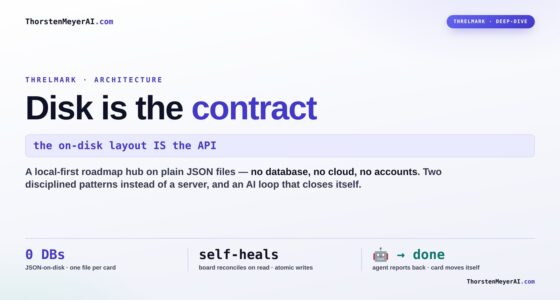
🔍 Read the full analysis: Could AI Change How You Choose And Use Software? on ThorstenMeyerAI.com

Get the latest gadgets delivered free with Prime
- Fast, free delivery on millions of items
- Prime Video, Amazon Music and more included
- Member-only deals all year
TL;DR
Thorsten Meyer says AI coding agents helped him replace several rented software services with custom tools that he runs and connects for his own work. His account illustrates how software creation may become more accessible, while also shifting responsibility for maintenance, security and review to the people building the tools.
Technology writer Thorsten Meyer says AI coding agents helped him replace several software subscriptions with custom tools for analytics, project tracking, PDFs and video recording, which he runs and connects for his own work. In an article published November 25, he described paying for Claude and Codex subscriptions while taking on the work of checking, maintaining and securing the tools himself—a trade-off that may matter to small businesses considering software built around their own workflows.
Meyer describes using Claude Code from Anthropic and Codex from OpenAI as coding agents. He gives them tasks in plain language; they can read and write project code, run tests and report results. Meyer says he sets the goals and reviews the output. His account is a description of his own practice, not an independent assessment of the products or evidence that they perform at the same level in other businesses.
He says seven tools in his repositories had 5,648 commits and 2,128 test files, measured on November 24, 2026. Those are figures from his own projects, not industry-wide measures. A commit is a saved change to code; the article does not give a comparison baseline, a count of active users or an external audit of the tools.
A central part of Meyer’s approach is making the tools usable by other software agents. He describes providing a readable guide to each tool and a way for software to send it requests, often through the Model Context Protocol, or MCP. He says this lets agents pass work among services without a person clicking through each interface. The method also introduces dependencies between services: a change in one can disrupt the route to another, he notes.
Custom Tools Shift Work to Users
Meyer’s account points to a practical change: some people may be able to build narrow software for their own needs rather than pay for a broad product that includes functions they do not use. For a small firm, that could make a particular workflow easier to tailor. It does not establish that building is cheaper overall; the time spent specifying needs, reviewing code, maintaining services and handling security also has a cost.
The approach also changes what users must be ready to manage. Meyer says he now depends heavily on Anthropic and OpenAI for coding-agent access, while his own tools create ongoing responsibilities. A custom system can reduce reliance on several software vendors yet increase reliance on a smaller number of AI providers and on the person responsible for the code.
For software companies, Meyer argues that customers may build simpler versions of some products themselves. That is his interpretation, not a demonstrated market-wide shift. His account does, however, highlight the continuing value of software that is reliable, secure, supported and straightforward for both people and agents to use.
Products Worth Considering

Jackery HomePower 3600 Plus Portable Power Station, 3584 Wh, 3600 W

Bose Lifestyle Ultra Wireless Home Speaker, White Smoke

DJI Mini 4K Drone with 4K UHD Camera
As an affiliate, we earn on qualifying purchases.
From Software Rental to Custom Services
Meyer frames the change against software as a service, where a provider runs an application on cloud infrastructure and customers use it, usually through a browser. He cites the U.S. National Institute of Standards and Technology’s definition in NIST Special Publication 800-145: the customer generally does not manage the underlying servers or storage, and has limited control over application capabilities. That arrangement offers ready-to-use software but leaves users dependent on the provider’s product and terms.
In Meyer’s description, an AI coding agent works within a software project rather than only answering questions in a chat. It can inspect files, make changes and run tests, but it still needs clear instructions and human review. He says he leaves project notes, rules and plans because an agent may not retain business-specific knowledge from one session to the next.
For agent-to-app connections, Meyer cites MCP, an open standard released by Anthropic on November 25, 2024, and a proposal called llms.txt, which describes a text file that can help agents use a website. These provide possible ways to describe and access tools; neither, by itself, decides what permissions an agent should have. Meyer says access controls and credentials remain the operator’s responsibility.
“The scarce part is no longer the code. It is knowing exactly what you need, and checking that you got it.”
— Thorsten Meyer, writing about his own practice
Costs and Risks Remain Unmeasured
The article does not provide a full cost comparison between Meyer’s former software subscriptions and his current setup. He says his software bill is now for Claude and Codex subscriptions, while models used to generate voices, images and video clips are paid per use. He does not report total spending, the time required to build and maintain the services, or how those costs compare with his previous bills.
There is also no independent review of the tools’ security, reliability or performance, and no evidence in the article about how well the approach works beyond Meyer’s own business. It remains unclear how the setup would handle outages, data protection obligations, changing subscription terms or a coding agent’s mistakes. His repository counts describe project activity, not whether the tools are safe or suitable for other users.
Testing the Approach Beyond One Business
The next evidence would come from other businesses testing similar workflows and reporting their complete costs, reliability and maintenance demands. Readers evaluating the approach would need to compare those figures with the cost and support offered by existing software, while checking access controls and data-handling requirements before connecting tools to business information.
Meyer’s article describes an existing personal setup rather than a product launch or a scheduled industry milestone. He does not announce a timetable for further results. For now, his account offers one example of what AI coding agents can help an individual build—and a reminder that the person using the tools remains responsible for deciding what is needed and checking whether it works.
Key Questions
What did Thorsten Meyer say he replaced?
Meyer says custom tools now handle web analytics, project tracking, PDFs and video recording for his work, replacing software he previously rented from vendors. This describes his own setup, not a general recommendation.
What are Claude Code and Codex in this account?
They are AI coding agents from Anthropic and OpenAI. Meyer says they can read and change code, run tests and report back; he sets tasks and reviews the results.
Does connecting tools through MCP make them safe?
No. MCP provides a way for software to connect, but does not set permissions or decide what an agent may do. Meyer says users remain responsible for access controls and credentials.
Are custom AI-built tools cheaper than software subscriptions?
The article does not establish that. Meyer reports paying for Claude and Codex subscriptions and paying per use for some generative models, but gives no full cost comparison that includes development time, maintenance and security work.
Source: ThorstenMeyerAI.com