
TL;DR

Get the latest gadgets delivered free with Prime
- Fast, free delivery on millions of items
- Prime Video, Amazon Music and more included
- Member-only deals all year
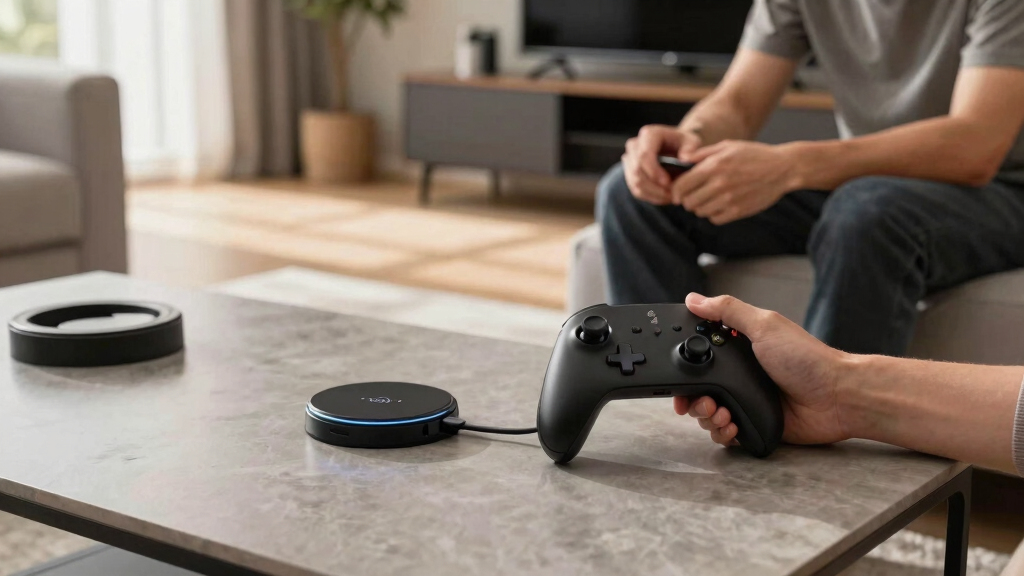
An open-source web application enables a Steam Controller to autonomously navigate and dock onto its magnetic charging puck using computer vision and WebHID. The project leverages optical flow tracking and haptic feedback to ensure precise alignment, representing a novel approach to controller charging automation.
An open-source web application has been developed to automatically guide a Steam Controller into its magnetic charging puck using optical flow computer vision and WebHID telemetry. This system enables the controller to dock autonomously, leveraging real-time visual tracking and haptic feedback, representing a significant innovation in gaming hardware automation.
The project employs OpenCV.js for optical flow tracking, monitoring user-selected points on the controller and puck via an overhead webcam. It then uses WebHID API to connect directly to the Triton Controller, streaming input and telemetry data, including battery status and voltage.
To guide the controller, the system fires 70Hz asymmetric haptic pulses through the controller’s internal Linear Resonant Actuators (LRAs). When the controller approaches within 150 pixels of the puck, the system automatically reduces haptic pulse frequency by half to facilitate gentle magnetic docking. The system confirms successful charging by intercepting specific telemetry reports, such as Report ID 121, and displays live battery data by parsing Report ID 67.
The setup requires only a Nix package manager and a Chromium-based browser. Users mount an overhead webcam pointed at their desk, place the controller and puck, then connect via the web interface to enable automatic tracking and docking. The project is built with a Vue 3 frontend, Rust/WASM for image processing, and custom WebHID abstractions, all open-source under the MIT License.
Implications for Gaming Hardware Automation
This development introduces a new level of automation for gaming peripherals, reducing manual effort to dock a controller for charging. It demonstrates the potential for integrating computer vision and web APIs into hardware management, which could influence future controller designs or accessories. For gamers and developers, it offers a glimpse into how autonomous docking could improve convenience and device longevity, especially in setups with multiple controllers or complex charging stations.
Steam Controller magnetic charging puck
As an affiliate, we earn on qualifying purchases.
As an affiliate, we earn on qualifying purchases.
Background on Controller Charging Automation
Traditionally, charging a Steam Controller or similar device requires manual placement on a puck or dock, which can be cumbersome, especially in multi-controller setups. Recent innovations have focused on wireless charging or simplified docking mechanisms, but automation remains limited. This project builds on prior work in computer vision and web-based control systems, applying these techniques to a common gaming hardware challenge. The use of optical flow tracking and haptic feedback for navigation represents a novel approach, inspired by hobbyist and open-source communities exploring automation in consumer electronics.
“This system showcases how accessible tools like OpenCV.js and WebHID can be combined to create autonomous device management solutions.”
— an anonymous researcher
automatic controller docking station
As an affiliate, we earn on qualifying purchases.
As an affiliate, we earn on qualifying purchases.
Unconfirmed Aspects and Technical Limitations
It is not yet clear how reliably the system performs under different lighting conditions or with various controller models. The project is currently in a pilot phase with limited testing, and real-world robustness remains unverified. Additionally, the safety and long-term durability of automated docking using haptic cues have not been formally evaluated. Further testing is needed to determine if this approach can be scaled or integrated into commercial products.
As an affiliate, we earn on qualifying purchases.
Next Steps for Development and Adoption
Developers plan to refine the tracking algorithm for improved accuracy and robustness, potentially integrating additional sensors or machine learning models. They also intend to test the system with different webcam setups and controller models. Future updates may include user-friendly interfaces and broader hardware support. Wider community involvement and formal testing will determine if this project influences mainstream controller charging solutions or remains a hobbyist innovation.
magnetic charging puck for gaming controllers
As an affiliate, we earn on qualifying purchases.
As an affiliate, we earn on qualifying purchases.
Key Questions
Can this system be used with any Steam Controller?
The project is designed for the Triton Controller, but the underlying principles could be adapted for other models with similar telemetry capabilities.
Does the system work in low-light conditions?
Performance under varying lighting conditions has not been fully tested; optimal results depend on good overhead illumination.
Is this safe for the controller’s hardware?
As an experimental open-source project, safety has not been formally validated. Users should exercise caution and avoid unattended operation.
Will this be available as a commercial product?
Currently, it is a community-driven open-source project; commercial deployment would require further development and validation.
How accurate is the docking process?
Tracking accuracy depends on camera placement and lighting; early tests suggest promising results but are not yet definitive.
Source: Hacker News
Halloween Picks
halloween
As an affiliate, we earn on qualifying purchases.