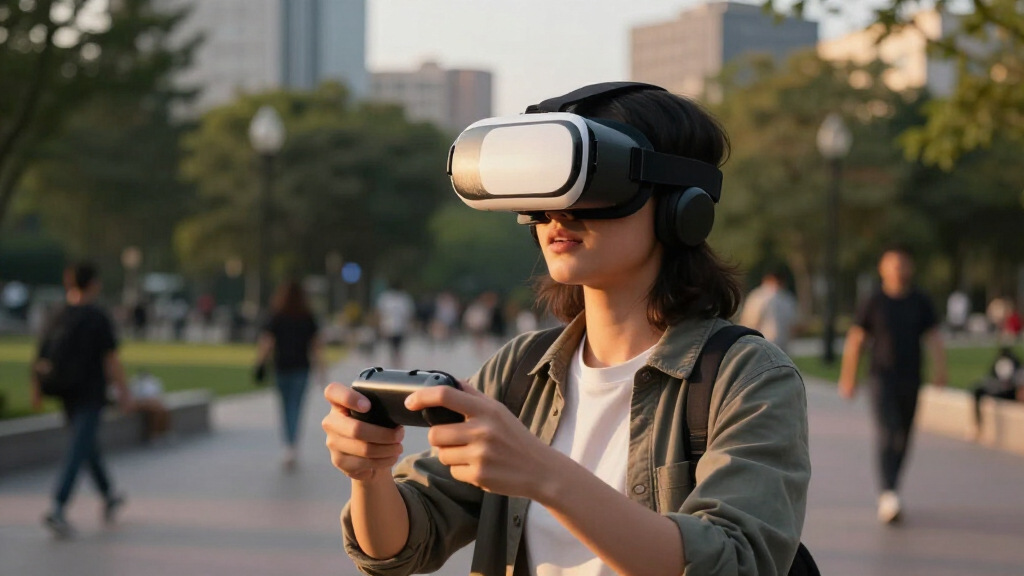

Exploring VR's Next Chapter: How Out-of-Home XR Entertainment Is Taking Shape
AIThis post was created with the assistance of artificial intelligence (AI).

TL;DR

Out-of-home XR entertainment is evolving rapidly, with new VR experiences like free-roaming arenas and IP-based attractions expanding VR’s audience. Major investments and innovations are driving the sector’s growth, signaling a new chapter for immersive entertainment outside traditional gaming venues.

Major advancements in out-of-home XR entertainment are transforming the virtual reality landscape, with new VR arena systems, IP-based experiences, and increased industry investments emerging as key drivers. These developments are expanding VR’s reach beyond traditional gaming, targeting broader audiences and commercial venues.

Recent industry reports and events, such as the Augmented World Expo (AWE) in June 2023, highlight a surge in out-of-home XR projects. Notably, Zero Latency announced the upcoming launch of ‘Jumanji: The Lost Levels’, a premium VR experience set to debut in over 170 venues by December 2023. Similarly, Sandbox VR has expanded to around 90 venues worldwide, offering experiences like ‘Squid Game Virtual’ and ‘Stranger Things: Catalyst’.

These experiences focus heavily on social and multiplayer engagement, with audiences of up to 40 players traversing virtual environments that recreate historical sites, fantasy worlds, or popular IPs. The sector also sees innovations like hybrid adventure experiences, exemplified by the Black Mirror immersive journey, which blends VR with theatrical storytelling.

Investment and development activity in this space are robust, with companies like The Rabbit Hole VR, Hololabs Studio, and Octopod VR launching new titles and expanding their venues. Hardware-wise, the sector favors robust headsets such as the PICO 4 Ultra VR and HTC VIVE, optimized for high usage, hygiene, and durability in public settings. Hygiene solutions like UV sanitization from Cleanbox Technologies are becoming standard for maintaining safety in shared equipment.

Mixed reality experiences are also gaining traction, with developers like Dreampark utilizing Quest 3’s pass-through mode to create AR-enhanced attractions, further broadening the scope of out-of-home immersive entertainment.

At a glance
reportWhen: ongoing, with recent announcements and…
The developmentThe development of out-of-home XR attractions, including new VR arena experiences and increased industry investments, is shaping the future of location-based immersive entertainment.
Exploring VR’s Next Chapter: How Out-of-Home XR Entertainment Is Taking Shape
Location-Based Immersive Entertainment · Field Report

Exploring VR’s Next Chapter

Out-of-home XR is moving beyond the traditional arcade. Free-roaming arenas, premium entertainment IP, mixed reality, and theatrical storytelling are turning immersive technology into a social destination for wider audiences.

170+ venues announced for the rollout of “Jumanji: The Lost Levels”
~90 Sandbox VR venues operating worldwide at the reported stage
40 players supported by some large-scale social XR environments
Core Format Free-roam
Growth Engine Premium IP
Audience Shift Social play
Next Layer Mixed reality
01 / FORMS

The experience map is widening

The emerging sector combines entertainment design, resilient public-use hardware, recognizable stories, and group participation. Each format solves a different part of the audience equation.

Arena Systems

Free-roaming VR

Players move through shared virtual spaces without remaining tethered to a single station, creating a more physical and memorable attraction.

Strength: movement + group presence
Licensed Worlds

IP-based attractions

Properties such as Jumanji, Squid Game, Stranger Things, and Black Mirror reduce the learning curve by giving audiences a familiar story world.

Strength: instant recognition
Multiplayer

Social competition

Cooperative missions and competitive challenges make XR a shared outing rather than an isolated headset session.

Strength: repeatable group demand
Hybrid Format

Theatrical journeys

Experiences can blend performers, sets, physical movement, and virtual scenes into a single story-led adventure.

Strength: premium spectacle
Spatial Computing

Mixed reality

Pass-through headsets connect virtual elements to the real venue, helping players remain aware of one another and the physical space.

Strength: physical-digital continuity
Destination Content

Virtual exploration

Historical locations, fantasy landscapes, and inaccessible environments can become walk-through attractions with broad cultural appeal.

Strength: reach beyond gamers

How location-based XR creates value

A successful attraction links recognizable content to reliable operations and an experience worth sharing.

🎬 Popular IP Builds awareness
👥 Group play Broadens appeal
🥽 Robust hardware Supports throughput
Premium visit Justifies pricing
📍 Venue growth Unlocks scale
02 / COMMERCIAL SIGNALS

Momentum is becoming visible

Industry activity points toward a market built around social value, recognizable content, and venue-ready technology. The bars show relative strategic importance, not market-share measurements.

Social multiplayer
Very high
Licensed IP
High
Hardware resilience
High
Mixed reality
Rising
Global scale
Emerging
Experience model Primary draw Social potential Operational load Scale outlook
Free-roaming arena Physical immersion High ~Medium to high Strong
IP-based multiplayer Familiar story world High ~Medium Strong
Hybrid theatrical XR Live spectacle High High ~Selective
Mixed reality attraction Physical-digital play High ~Evolving Promising
Traditional VR station Accessible gameplay Limited Lower ~Established
03 / OPERATIONS

The invisible infrastructure matters

Compelling content gets visitors through the door, but dependable hardware, sanitation, staffing, and safe physical design determine whether a venue can deliver the experience repeatedly.

H1

Durable headsets

PICO 4 Ultra VR and HTC VIVE-class systems reflect the demand for equipment designed around intensive use, maintenance, and rapid turnaround.

H2

Hygiene workflow

UV sanitization systems from providers such as Cleanbox Technologies help operators manage shared headsets between sessions.

H3

Safe spatial design

Tracking reliability, clear boundaries, supervision, and accessible onboarding become essential as more players move together.

H4

Content throughput

Session length, reset time, group capacity, and repeatability directly shape revenue potential and the guest experience.

Niche installation Repeatable venue model Mainstream attraction
Specialist content proves the experience concept. Operational standards improve consistency and economics. Recognizable IP and social formats invite mass audiences.
04 / NEXT CHAPTER

What the sector must prove next

“The investment in location-based XR has reached new heights this year, signaling a strong industry belief in its commercial viability and growth prospects.” AWE 2023 organizer
01

Convert launches into repeat visits

Premium releases must sustain demand after their initial novelty and attract both enthusiasts and first-time users.

02

Make economics travel

Global growth depends on viable costs, predictable throughput, and venue formats that work beyond major entertainment hubs.

03

Integrate mixed reality

Quest 3 pass-through projects from developers such as Dreampark indicate how real venues may become part of the content.

04

Standardize safety and care

Clearer practices for sanitation, accessibility, equipment durability, and large-group movement will support trust at scale.

05 / OPEN QUESTIONS

Signals to watch

Will mainstream audiences return?

Repeat visitation, not first-time curiosity, will reveal whether social XR can compete consistently with cinemas, escape rooms, and other group entertainment.

Can premium experiences scale?

High production values and licensed properties increase appeal, but they also raise content, hardware, staffing, and maintenance costs.

Which hardware model will prevail?

Operators must balance visual quality, tracking, comfort, hygiene, durability, and fleet management rather than choosing on consumer specifications alone.

How quickly will standards mature?

Safety expectations and operating practices are still evolving as venues support more movement, larger groups, and increasingly complex physical environments.

The outlook

Out-of-home XR is shifting from a headset demonstration into a destination business. If operators can pair memorable social content with reliable venue economics, immersive entertainment may reach audiences that consumer VR has struggled to convert.

Source context: Road to VR · Industry examples and announcements referenced in the supplied report Out-of-home XR Powered by Thorsten Meyer AI

Implications of the Growing Out-of-Home XR Sector

The expansion of out-of-home XR entertainment signifies a major shift in how virtual reality is deployed and monetized outside traditional gaming. It opens new revenue streams for IP owners, attracts diverse audiences, and offers scalable experiences that can be integrated into entertainment venues, theme parks, and arcades. This sector’s growth could accelerate the mainstream adoption of VR technology and reshape the landscape of immersive entertainment, making it more accessible and social.

Amazon

VR arena system

As an affiliate, we earn on qualifying purchases.

As an affiliate, we earn on qualifying purchases.

Background and Industry Momentum Behind Out-of-Home XR

The out-of-home XR sector has gained momentum over recent years, especially following the turbulence in consumer VR gaming markets. Industry leaders and investors are now focusing on location-based attractions as a more sustainable and profitable avenue for immersive experiences. Events like AWE 2023 underscored this trend, showcasing new projects, investments, and technological innovations aimed at scaling XR entertainment for public venues. Companies such as Zero Latency, Sandbox VR, and Hololabs Studio have been at the forefront, leveraging IP, multiplayer capabilities, and hybrid experiences to attract broader audiences.

Historically, VR arcades and free-roaming arenas have been niche, but recent technological improvements, increased investment, and strategic partnerships have pushed the sector toward mainstream adoption. Hardware advancements, including durable headsets and hygiene solutions, have addressed logistical challenges of public use, paving the way for rapid expansion.

Furthermore, the integration of mixed reality and social gaming elements aligns with broader trends in entertainment, emphasizing shared experiences and social interaction, which are key to appealing to mass audiences beyond traditional gamers.

“The investment in location-based XR has reached new heights this year, signaling a strong industry belief in its commercial viability and growth prospects.”

— AWE 2023 organizer

Amazon

out-of-home XR headset

As an affiliate, we earn on qualifying purchases.

As an affiliate, we earn on qualifying purchases.

Unresolved Questions About Sector Expansion and Technology Adoption

While growth appears promising, several uncertainties remain. It is not yet clear how quickly the out-of-home XR market will scale globally, especially outside major entertainment hubs. The long-term sustainability of high-cost experiences and the integration of new hardware, such as mixed reality headsets, into existing venues are still under evaluation. Additionally, the impact of hygiene protocols and equipment durability on operational costs and user experience remains to be fully understood.

Furthermore, the degree to which mainstream audiences will embrace these experiences over traditional entertainment options is still being tested, and regulatory or safety standards for large-scale VR attractions are evolving.

Amazon

multiplayer VR experience headset

As an affiliate, we earn on qualifying purchases.

As an affiliate, we earn on qualifying purchases.

Upcoming Developments and Industry Milestones

In the coming months, expect the rollout of ‘Jumanji: The Lost Levels’ across hundreds of venues, serving as a benchmark for premium IP-based VR attractions. Industry conferences like AWE 2023 and VRX 2024 will showcase new projects, hardware innovations, and investment deals, further shaping the sector’s trajectory. Additionally, more venues are likely to adopt mixed reality experiences, integrating AR elements to enhance social and interactive features.

Investors and developers will monitor user engagement and operational data to refine experiences, optimize costs, and expand into new markets. The sector’s growth will also depend on hardware improvements, hygiene solutions, and the development of scalable, cost-effective content.

Amazon

UV sanitization VR equipment

As an affiliate, we earn on qualifying purchases.

As an affiliate, we earn on qualifying purchases.

Key Questions

What are the main types of out-of-home XR experiences?

They include VR free-roaming arenas, IP-based multiplayer experiences, hybrid adventure journeys, and mixed reality attractions that combine physical and virtual elements.

Which hardware platforms are most common in out-of-home XR?

The sector primarily uses robust headsets like PICO 4 Ultra VR and HTC VIVE, optimized for high usage, hygiene, and durability. Meta Quest headsets are less common due to hardware limitations in public settings.

How is hygiene managed in shared VR attractions?

Companies like Cleanbox Technologies provide UV light sanitization solutions that are widely adopted to maintain hygiene standards and ensure safety for multiple users.

What challenges does the sector face in scaling?

Key challenges include hardware durability, operational costs, safety standards, and convincing mainstream audiences to adopt out-of-home XR experiences over traditional entertainment options.

What is the future outlook for out-of-home XR entertainment?

The sector is expected to continue expanding with new experiences, hardware innovations, and increased investment, potentially transforming the landscape of location-based immersive entertainment in the next few years.

Source: Road to VR

You May Also Like

Cleared by the US, derailed by the UK: Getty’s Shutterstock merger falls apart

Getty plans to end its $3.7B merger with Shutterstock after UK regulators impose restrictions, despite US approval, raising questions about deal viability.

Here’s what Mira Murati’s AI company is up to

Thinking Machines, founded by Mira Murati, demonstrates new AI ‘interaction models’ enabling real-time, multi-modal collaboration with users, with limited preview planned.

Marvel’s Spider-Man Remastered Enters The Steam Most-played Chart

The PC version of Marvel’s Spider-Man Remastered has entered Steam’s most-played chart, reaching a peak of over 14,000 players. This marks a significant milestone for the game on PC.

Tomodachi Life: Living the Dream 1.0.3 update out now, patch notes

Nintendo has launched the Tomodachi Life 1.0.3 update, including bug fixes and gameplay adjustments. Patch notes detail specific changes now available.