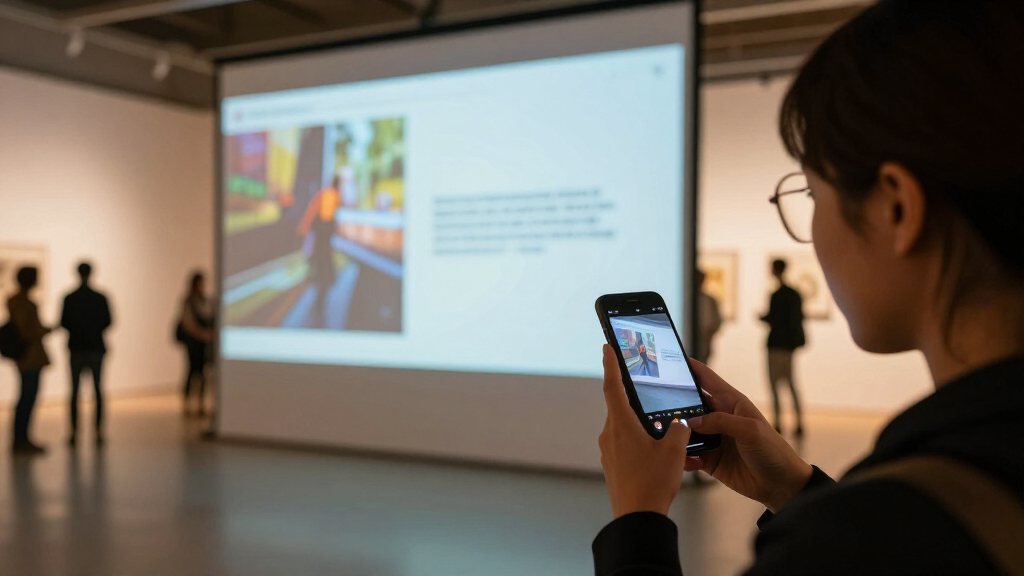

🔍 Read the full analysis: Inside “After Action”: AI, Credits, And An Exhibition That Lives on ThorstenMeyerAI.com

Get the latest gadgets delivered free with Prime
- Fast, free delivery on millions of items
- Prime Video, Amazon Music and more included
- Member-only deals all year
TL;DR
After Action is a live, AI-built exhibition that presents 24 fictional web experiences as productions in a cinema-style credit roll. Its creator’s description says the piece is a designed fiction, not a real company or an account of military activity; the page combines code-generated miniature scenes with a locally stored poster image and includes alternate ways to navigate the credits.
After Action, a live, AI-built exhibition presenting 24 fictional web experiences as a film’s closing credits, turns browsing into a navigable theater rather than a conventional gallery. The work’s description identifies its Wing V setting as fiction, not a real company or a record of military activity, and frames its miniature military-inspired scenes as design elements in an exhibition about web experiences, as detailed in the original analysis.
The site’s defining feature is a continuous credit roll interrupted at intervals by small, three-dimensional sand-table scenes. The credits list the 24 experiences as productions, with department headings and links; a separate stationary register offers another route to the same material. The source describes the project as Room 125 of 175 and calls the piece “After Action — Wing V Debrief Theater.”
The theater’s visual language draws on cinema: black, projector white, sand amber and credit gold, with compressed display lettering, monospaced labels, letterbox bars and film-like marks. The rolling text is controlled by JavaScript, which tracks elapsed time and moves a continuous track. Chapter stops coordinate the time display, locator, labels and jump controls, allowing visitors to pause or move between sections.
After every eight productions, the credit sequence gives way to a CSS-built diorama. The described scenes include a shield formation, a catapult arc and two keys approaching a shared lock. The source says the terrain, contours and markers are generated in code. A locally stored still image supplies the theater’s poster; the ambient video intended for the build was unavailable, so visual effects create the projector atmosphere around that still instead.
Inside “After Action”: AI, Credits, and an Exhibition That Lives
A live, AI-built exhibition turns 24 fictional web experiences into a cinema-style credit roll—part catalog, part theater, and part navigable fiction.
“The credits are not a scrolling text illusion or a CSS marquee.”
From the supplied project descriptionA credit roll built to be browsed
Instead of a static project grid, the exhibition makes navigation part of the presentation: the credits move, pause, jump between chapters, and lead to a fixed index.
One continuous roll
The 24 fictional experiences appear as productions, organized under department headings with links to their rooms.
Control the pace
Chapter stops coordinate the time display, locator, labels, and jump controls. Visitors can pause or move between sections.
A stationary register
A plain linked index presents the same entries. The moving names are removed from keyboard focus, according to the project description.
Built atmosphere, miniature worlds
The theater borrows cinema cues—letterbox bars, compressed display lettering, monospaced labels, and film-like marks—while keeping its small scenes visibly constructed.
What the source describes
These bars summarize the described ingredients; they are not measured quantities.
Shield formation. Catapult arc. Two keys approaching a shared lock.
The supplied material says terrain, contours, markers, and atmospheric layers are generated in code. Toy-like forms underline that these are designed scenes.
What the project record says—and leaves open
The room is presented as an AI coding-agent art direction brief made live. The details below come from the supplied project description, not an independent technical audit.
| Topic | Described in the source | Not established there |
|---|---|---|
| Creative framing | ✓ Fictional Wing V theater and miniature scenes | Evidence of real military activity or a real company |
| Build approach | ✓ HTML, CSS, and JavaScript; no framework or build step requested | Independent verification of implementation or external requests |
| Motion access | ✓ Pause, chapter jumps, hidden-page pause, reduced-motion alternative | Accessibility test results or browser compatibility findings |
| Visual assets | ✓ Code-built dioramas and a locally stored hero still | Ambient video in the described build; whether it will return |
| Publication record | ✓ A live page is reported by the supplied source | Launch date, audience figures, reception, or current availability |
From art direction to exhibition
The supplied brief credits “Claude Fable 5” as art director and the “FABLE/175 pipeline” as executor. It does not independently identify the people behind the pipeline or detail how the AI agent was used.
Key questions
Use the live page’s moving credits or the stationary linked register described by its creator.
What is After Action?
A live, AI-built web exhibition presenting 24 fictional web experiences as cinema-style credits, interrupted by miniature scenes.
Is Wing V a real military project?
No. The supplied description calls the theater fictional and says it is not an account of real military activity or a real company.
How can visitors navigate the roll?
The project describes pause and chapter controls, a stationary linked register, and a manual-scroll alternative for reduced-motion users.
Are all visuals AI-generated?
The source says the dioramas and atmospheric layers are code-generated, while the hero uses a local still. It does not say every visual was AI-generated.
Was the ambient video included?
Not in the build described. The source says the intended video was unavailable, so effects create atmosphere around the local still.
What happens next?
No next milestone or update plan is confirmed. Any restoration of video or changes to linked rooms remain unannounced in the supplied material.
A Credit Roll Built to Be Browsed
After Action makes the navigation itself the exhibition. Rather than placing projects in a static grid, it gives visitors a timed sequence, then provides controls to pause, jump between chapters or consult a fixed index. That approach links the visual conceit to a practical browsing structure: the credits are both presentation and catalogue.
The implementation also shows how a web artwork can use motion without making motion the only way in. According to the project description, the moving names are removed from keyboard focus, while a stationary linked register presents the same entries. Animation pauses when the page is hidden, and visitors who prefer reduced motion receive a manual-scroll alternative. These choices matter because the central design—a moving text roll—could otherwise make content difficult to locate or follow.
The military imagery is presented as a stylized frame for interaction design, not evidence of actual operations. The source says the miniatures are deliberately reduced to toy-like forms, emphasizing the constructed nature of the scenes. That distinction helps readers understand what the work depicts and what it does not claim to document.
interactive digital exhibition software
As an affiliate, we earn on qualifying purchases.
As an affiliate, we earn on qualifying purchases.
From Wing V Brief to Live Room
The source presents the page as the result of an AI coding-agent art direction brief, credited to “Claude Fable 5” as art director and the “FABLE/175 pipeline” as executor. The brief called for a single-page showcase with a cinematic end-credit sequence, 24 linked rooms, sand-table interludes, a plain-text index and motion controls. Those details are presented in the supplied material; it does not provide an independent account of the production process or identify the people behind the pipeline.
The brief’s requested stack was HTML, CSS and JavaScript, without frameworks, build steps, content-delivery networks or external requests. The room description says its dioramas and atmospheric layers are code-generated, while the hero uses a local image. It also describes pausing animation when the page is hidden and simplifying the display for reduced-motion settings. These are project-reported design and implementation details, not results from an outside technical audit.
The exhibition sits within a larger sequence identified as 175 rooms. Its linked productions are named in the brief, from Ghost Division and Flightdeck to Vampire Hour. The supplied material points to a live page at the FABLE site, but gives no publication date, launch announcement or visitor figures.
““The credits are not a scrolling text illusion or a CSS marquee.””
— The supplied project description
As an affiliate, we earn on qualifying purchases.
What the Project Record Leaves Open
The supplied material does not establish when the exhibition launched, who built each part, or how the AI coding agent was used beyond the brief’s credits. It also does not provide independent testing of accessibility, performance, browser compatibility or the claim that the page avoids external requests. The brief specifies intended quality targets, but the source does not include test results or screenshots to verify them.
The ambient video was unavailable in the described build, and the source does not say whether it will be added later. It also does not report audience numbers, reception or whether all 24 linked rooms are currently available. The source describes a live site, but its status may change; the page’s present availability is not independently verified here.
As an affiliate, we earn on qualifying purchases.
The Theater’s Next Showing
Visitors can explore the live After Action page through its moving credits or use the stationary linked index described by the project. The source provides no scheduled exhibition events, update calendar or announced next milestone. The next observable developments would be any change to the live page—such as restoration of the intended ambient video or updates to the linked rooms—but no such plans are confirmed in the supplied material.
As an affiliate, we earn on qualifying purchases.
Key Questions
What is After Action?
After Action is a live, AI-built web exhibition that presents 24 fictional web experiences as productions in a cinema-style credit sequence, interrupted by miniature scenes.
Is Wing V a real company or military project?
No. The supplied exhibition description says the Wing V theater is fictional and is not an account of real military activity or a real company.
How can visitors navigate the moving credits?
The project description says visitors can pause the roll, jump between chapters and use a stationary linked register after the theater. It also describes a manual-scroll alternative for reduced-motion users.
Are the scenes and theater visuals all AI-generated?
The supplied material says the dioramas and atmospheric layers are generated with code, while the theater’s hero uses a locally stored still image. It does not say that every visual was generated by AI.
Was the planned ambient video included?
Not in the build described by the source. It says the intended ambient video was unavailable, so the theater uses a local still image with visual effects; the source does not say whether video will be added later.
Source: ThorstenMeyerAI.com
Halloween Picks
halloween
As an affiliate, we earn on qualifying purchases.


![Samsung’s confusing ‘Galaxy Z Fold 8 Ultra’ name is basically official in latest leak [Gallery]](https://techieus.com/wp-content/uploads/2026/07/samsung-s-confusing-galaxy-z-fold-8-ultra-name-is-basically-official-in-latest-l-featured-560x300.jpg)