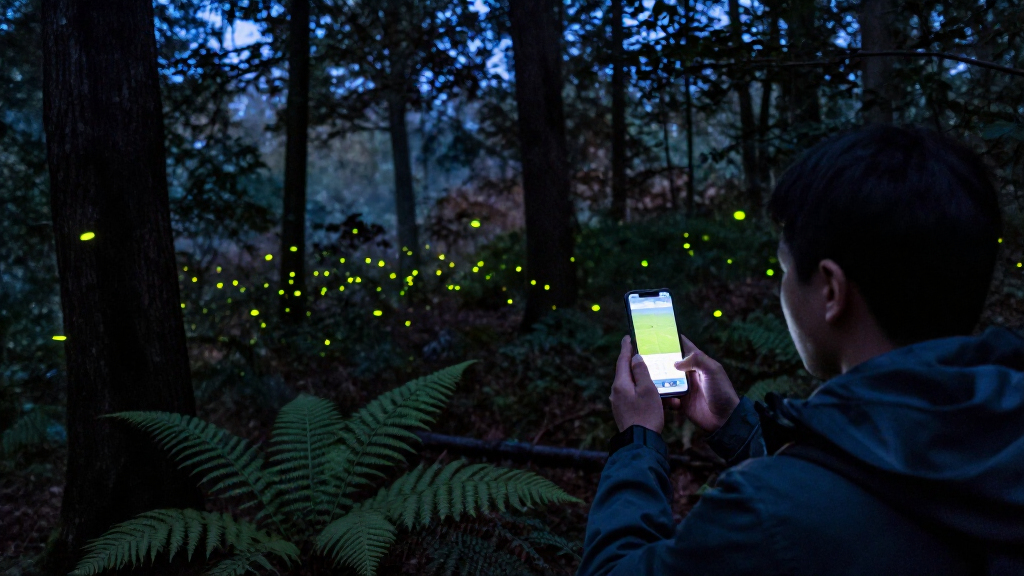
🔍 Read the full analysis: Why Tell A Story About Vallon Creux’s Synchronous Fireflies? on ThorstenMeyerAI.com

Get the latest gadgets delivered free with Prime
- Fast, free delivery on millions of items
- Prime Video, Amazon Music and more included
- Member-only deals all year
TL;DR
ThorstenMeyerAI.com describes Room 155, “Luciole — The Synchronous Fireflies of Vallon Creux,” an AI-built interactive exhibit about 96 simulated fireflies moving from scattered flashes toward a shared rhythm. The place and fireflies are fictional; the simulation is based on the Kuramoto synchronization model, and the exhibit’s site says its visuals are generated with code.
ThorstenMeyerAI.com’s Room 155, titled “Luciole — The Synchronous Fireflies of Vallon Creux,” presents an AI-built interactive field notebook in which 96 simulated fireflies gradually synchronize their flashes, as detailed in the original analysis. The exhibit is not a report of real wildlife: Vallon Creux and its fireflies are fictional, while the on-screen behavior is generated by a model of synchronization.
The exhibit lets visitors watch the simulated lights begin out of rhythm and move toward a collective pulse. A coupling control changes how strongly each simulated insect responds to nearby signals. Pointer interaction can disturb the phases, after which the model continues running and the field can settle again. A live coherence measure, a trace of the disturbance and recovery, and a phase diagram are presented as readings drawn from the simulation.
The site’s description identifies the underlying approach as the Kuramoto model: each firefly is represented as an oscillator with its own phase and tempo, influenced by nearby oscillators while retaining its own rhythm. This is a simulation of coordinated behavior, not evidence about a real population or field study. The exhibit says its visual elements are made with HTML, CSS, SVG and canvas, rather than downloaded images or prerecorded firefly footage.
Room 155 is part of a larger series, listed as room 155 of 175. The accompanying art direction calls for a forest-dark palette, chartreuse flashes and notebook-like text, with the interaction built around watching order emerge and then disrupting it. The site description also says animation pauses when relevant views are offscreen or the browser tab is hidden, and that the presentation responds to reduced-motion preferences.
Room 155 · Interactive field notebook
Why Tell a Story About Vallon Creux’s Synchronous Fireflies?
“Luciole” turns synchronization into an experience: watch 96 simulated fireflies begin with scattered flashes, settle toward a shared rhythm, then respond when you disturb the field. The setting and fireflies are fictional; the behavior is calculated from a synchronization model.
“Breaking the sync and watching it heal.”
Art direction · Room 15501 / What the story makes visible
Order emerges from local signals
The exhibit makes an abstract idea observable. Visitors can adjust coupling, interrupt the pattern, and watch the same simulated rules shape what happens next.
Scattered flashes
Each simulated light starts with its own phase and tempo, so the field begins without a shared beat.
Change the coupling
A control changes how strongly each oscillator responds to nearby signals. Pointer interaction can disturb the phases.
Watch recovery
A live coherence measure, disturbance trace, and phase diagram show readings generated by the running simulation.
02 / The mechanism
A rhythm built from neighbors
The project describes its approach as the Kuramoto synchronization model: each firefly is represented as an oscillator, influenced by nearby oscillators while keeping its own rhythm.
Local influence, collective pulse
As coupling changes, neighboring phases can draw closer together. The coherence reading and phase diagram are outputs of the simulation; they do not validate claims about actual fireflies.
03 / Visitor journey
Disturb the field. Follow the change.
The interaction turns the exhibit into a small experiment with visible inputs and consequences.
Notice flashes beginning out of rhythm.
Adjust coupling between nearby oscillators.
Use pointer interaction to disturb the phases.
See the model continue and the field settle again.
04 / Keep the boundary clear
Fictional field notes, real model behavior
The naturalist notebook framing invites close attention, while the exhibit’s own description draws a clear line between its invented setting and its computational demonstration.
Vallon Creux is fictional
The place and its fireflies were created for the exhibit. This is not a conservation project, field study, or report on a named research site.
96 is the described setup
The project describes 96 simulated individuals. Other references to “hundreds” appear as creative direction, not confirmation of the finished room.
Project claims are attributed
The site describes the exhibit as AI-built and says its visuals use HTML, CSS, SVG, and canvas. The supplied material offers no independent technical audit.
Some details are proposals
Invented species notes and a two-week season appear in the creative brief; the material does not confirm they are present in the live room.
Explore Room 155
Visit the live exhibit to check its controls, readings, and behavior on your own device. The project description also says animation pauses when relevant views are offscreen or the tab is hidden, and that the experience responds to reduced-motion preferences.
How the Simulation Makes Order Visible
The exhibit turns an abstract idea—emergent synchronization—into something visitors can observe and alter. Rather than showing a finished animation of insects flashing together, it exposes controls and measures alongside the moving field. The visitor can change the degree of coupling, interrupt the pattern and watch what the same rules produce afterward.
That format matters because it distinguishes a visual metaphor from a model whose behavior is being calculated on screen. The coherence reading and phase diagram are described as outputs of the simulation, giving visitors a way to connect the visual change to the system’s changing state. They do not, however, validate claims about actual fireflies; the exhibit’s subject is explicitly fictional.
The project also makes the production method part of its subject. Its creator describes the website as AI-built, with the prompt that shaped the room available through a footer link. That offers visitors a view of both the finished digital artwork and the instructions behind it. The supplied material does not independently document how much of the design or code was generated by AI, so that characterization remains the exhibit’s own description.
interactive firefly simulation kit
As an affiliate, we earn on qualifying purchases.
As an affiliate, we earn on qualifying purchases.
A Fictional Field Notebook by Design
“Luciole” is presented as one room in a numbered web exhibition, not as a conservation project, scientific paper or account from a named research site. The exhibit specifically states that Vallon Creux is fictional and that the fireflies are simulated. Its naturalist-notebook framing—observational notes, marginal annotations and a slow visual rhythm—is an artistic choice intended to make visitors spend time with the process.
The supplied brief describes the visual language as forest black-green, bright chartreuse and dusk mauve, with literary serif text and occasional handwritten-style accents. It also proposes content about invented species, flash-pattern differences and a two-week season. Those details appear in the creative brief; the source material does not establish them as facts about real fireflies. The distinction matters because the exhibit borrows the form of field observation while presenting a fictional setting and a computational demonstration.
The brief says the room was made as a single-page website with HTML, CSS and JavaScript, without frameworks or external requests. It also calls for accessibility and performance features, including keyboard focus styles, mobile support and reduced-motion handling. These are production specifications in the supplied description, rather than the findings of an external technical audit.
““Luciole and Vallon Creux are fictional, created for the exhibit—not a real company, place, or field study.””
— ThorstenMeyerAI.com’s description of Room 155
synchronization model educational kit
As an affiliate, we earn on qualifying purchases.
As an affiliate, we earn on qualifying purchases.
What the Exhibit Does Not Establish
The supplied material does not give a publication date, independent review or technical evaluation of the live site. It does not provide test results for performance, accessibility or the accuracy of the implementation. Its statements about AI construction and code-generated visuals are descriptions supplied by the project, not independently verified findings.
The material also does not show whether the live room includes every element listed in the art-direction prompt, such as the proposed species notes and seasonal calendar. Nor does it report measurements from real fireflies. The 96 simulated individuals are the described exhibit setup; the prompt’s separate references to “hundreds” are design instructions, not confirmation of the number shown in the finished room.
As an affiliate, we earn on qualifying purchases.
What Visitors Can Check Live
The project directs visitors to the live Room 155 exhibit at fable-25-830.netlify.app/sites/luciole/. There, readers can check how the simulation behaves, whether the displayed controls and measurements are present, and how the experience works on their own device. The supplied material announces no research release, real-world field study or future update schedule; any such development remains unreported.
As an affiliate, we earn on qualifying purchases.
Key Questions
Are the Vallon Creux fireflies real?
No. The exhibit says Vallon Creux and its fireflies are fictional. The flashing insects are simulated rather than observed in a real field study.
What does the interactive exhibit show?
It shows 96 simulated fireflies whose flashes can move toward a shared rhythm. Visitors can adjust how strongly they influence one another and disturb the field through pointer interaction.
What model does the exhibit use?
The project describes each insect as an oscillator with its own phase and tempo, influenced by nearby oscillators. It identifies this approach with the Kuramoto synchronization model.
Does the simulation prove how real fireflies behave?
No. It demonstrates the behavior of a computational model. The supplied material does not present field observations or claim that the simulation establishes findings about real fireflies.
Where can I see Room 155?
The project lists the live exhibit at https://fable-25-830.netlify.app/sites/luciole/. The source material does not specify a publication date or a schedule for future changes.
Source: ThorstenMeyerAI.com
Halloween Picks
halloween
As an affiliate, we earn on qualifying purchases.


![A Walkable ASCII Cyberpunk City In One HTML File [Video]](https://techieus.com/wp-content/uploads/2026/09/a-walkable-ascii-cyberpunk-city-in-one-html-file-video-featured-560x300.jpg)