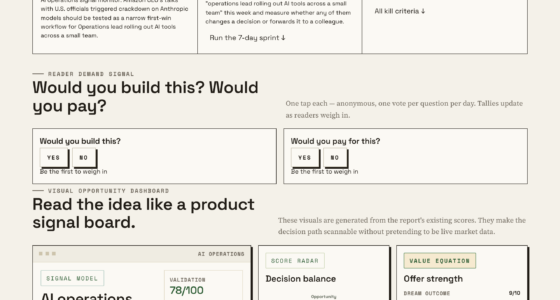

📊 Full opportunity report: Anthropic’s AI Watermarking And Its Role In Shaping Responsible Innovation on ThorstenMeyerAI.com — validation score, market gap, and execution plan.

Get the latest gadgets delivered free with Prime
- Fast, free delivery on millions of items
- Prime Video, Amazon Music and more included
- Member-only deals all year
TL;DR
Anthropic has announced the addition of watermarking to outputs from its Claude AI system. The move aims to improve content provenance but details about the technology and its effectiveness remain unclear. This development could impact how AI-generated content is verified across industries, as detailed in the original analysis.
Anthropic has introduced watermarking for outputs generated by its Claude AI system, according to a recent report. This move aims to support content provenance verification, which could influence how publishers, educators, and online platforms assess digital material. The development is confirmed but details about the technical implementation remain undisclosed, and its reliability is yet to be evaluated.
The watermarking is applied specifically to outputs from Claude, but Anthropic has not revealed how the system embeds the mark, whether it is visible or hidden, or which product versions or output formats are affected. The available information does not specify if the watermark can be inspected, disabled, or removed by users. Experts note that such signals typically rely on subtle modifications to text or metadata that can be difficult to detect after editing or translation, as explained in this analysis.
Current understanding indicates that the system aims to enable verification through specialized software, but no public results or performance metrics have been shared. The scope of the watermark—whether it applies to text, images, or other media—is also unclear. This raises questions about its practical reliability, especially in cases involving heavy editing or multilingual content.
Implications for Content Verification and Responsibility
This development could significantly influence how digital content is authenticated and attributed, particularly in contexts such as journalism, education, and online platforms. Reliable AI provenance tools may help identify automated influence campaigns, academic misconduct, or undisclosed commercial content. However, the effectiveness of Anthropic’s watermarking system remains uncertain until independent testing and validation are conducted.
While a watermark could serve as a valuable tool for verifying AI-generated material, it is not a definitive proof of authorship or intent. The potential for misuse, such as unmarked models or human editing to bypass detection, also presents challenges. Ultimately, the social and legal value of this technology depends on its accuracy, robustness, and integration into broader standards for content verification.
As an affiliate, we earn on qualifying purchases.
Background on AI Watermarking and Content Provenance
Watermarking AI outputs is an emerging approach to address concerns over content authenticity. Historically, researchers have explored two main methods: statistical detection of AI patterns and embedding signals during generation. Provider-specific watermarking, like Anthropic’s, offers stronger attribution under controlled conditions but depends on the system’s technical design and detection capabilities.
Prior to this announcement, many organizations have relied on third-party AI detectors, which analyze statistical patterns but often face reliability issues, especially after content editing or translation. The introduction of system-embedded watermarks aims to provide a more direct and potentially more reliable means of identification, though its effectiveness remains to be proven through testing and independent evaluation.
“The introduction of watermarking by Anthropic is a step toward more accountable AI, but without transparency about the technical details, its real-world utility is uncertain.”
— Thorsten Meyer, AI researcher
As an affiliate, we earn on qualifying purchases.
Technical Details and Effectiveness Still Unclear
Many key aspects of Anthropic’s watermarking system remain undisclosed, including the technical mechanism, detection process, scope of application, and robustness against editing or translation. No independent testing results are available to assess accuracy, false positives, or durability. It is also unclear how users will verify or challenge watermark detection, or whether the system will be adopted broadly across platforms and content types.
digital content provenance verification
As an affiliate, we earn on qualifying purchases.
As an affiliate, we earn on qualifying purchases.
Expected Next Steps: Transparency and Testing
Anthropic is expected to release detailed documentation explaining where and how the watermark is applied, along with guidelines for verification. Independent researchers and affected organizations will likely conduct tests across different languages, editing levels, and content formats to evaluate reliability. The industry will also watch for potential adoption of standards for AI content provenance, which could shape future policies and regulations.
AI-generated text watermarking tools
As an affiliate, we earn on qualifying purchases.
As an affiliate, we earn on qualifying purchases.
Key Questions
What exactly is Anthropic’s watermarking technology?
Details about the technical implementation of Anthropic’s watermarking system have not been disclosed. It is not yet clear whether it involves metadata, pattern modifications, or other methods.
Can users remove or disable the watermark?
It is unknown whether the watermark can be inspected, disabled, or removed by users, as Anthropic has not provided specific information about user controls or technical safeguards.
Will the watermark work after content is edited or translated?
The resilience of the watermark against editing, paraphrasing, or translation is still untested and uncertain, which impacts its practical reliability.
Will this system be adopted by other AI providers?
Currently, it is unclear whether other AI developers will implement similar watermarking solutions or if industry standards will emerge for content provenance.
What are the implications for content verification?
If effective, watermarking could provide a new tool for verifying AI-generated content, helping combat misinformation, academic misconduct, and undisclosed automation. However, its limitations and potential for circumvention mean it should be part of a broader verification framework.
Source: ThorstenMeyerAI.com
Fall Picks
fall essentials
As an affiliate, we earn on qualifying purchases.