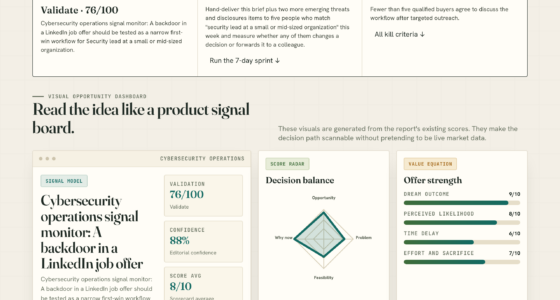

📊 Full opportunity report: Ensuring Reliability In Frontier Cyber AI By Choosing Trusted Managers on ThorstenMeyerAI.com — validation score, market gap, and execution plan.

Get the latest gadgets delivered free with Prime
- Fast, free delivery on millions of items
- Prime Video, Amazon Music and more included
- Member-only deals all year
TL;DR
OpenAI has announced a new initiative to place frontier cybersecurity AI models in more trusted hands, focusing on access control and recipient verification. Details on eligibility, safeguards, and implementation are still pending, raising questions about scope and impact.
OpenAI has publicly announced an initiative titled “Putting frontier cyber models in more trusted hands”, signaling a move towards tighter control over access to its most advanced cybersecurity AI systems, as detailed in the original analysis. The company has not disclosed specific eligibility criteria, technical safeguards, or implementation timelines, but the announcement indicates a focus on managing who can utilize these powerful models, given their dual-use potential in cybersecurity defense and exploitation.
The announcement confirms that OpenAI intends to regulate access to what it describes as “frontier cyber models”, though it has not clarified which models are included or how they will be classified. This approach is discussed in the detailed coverage on cybersecurity AI safety. The company has not provided details on recipient verification processes, permitted use cases, or monitoring procedures. It remains unclear whether access will be limited to governments, security firms, or other organizations, as well as what criteria will determine “trustworthiness”.
While the announcement emphasizes control and trusted management, it does not specify the technical or contractual safeguards that will underpin this initiative. For more insights, see the coverage on AI safety and trust frameworks. OpenAI has not revealed whether existing safety policies will evolve or if new oversight mechanisms will be introduced. The lack of concrete details leaves open questions about how the program will operate, its scale, and its potential impact on cybersecurity research and defense efforts.
Implications for Cybersecurity Model Distribution
This initiative highlights a shift towards more controlled distribution of advanced AI models in cybersecurity, aiming to mitigate misuse while enabling defensive capabilities. It underscores the importance of recipient vetting and access management in balancing innovation with safety. The move could influence industry standards, research participation, and government involvement, but the lack of specific criteria raises concerns about fairness, transparency, and effectiveness in reducing risks.
cybersecurity AI model access control
As an affiliate, we earn on qualifying purchases.
As an affiliate, we earn on qualifying purchases.
OpenAI’s Previous Cyber AI Access Practices and Industry Trends
OpenAI has historically released AI models with varying levels of access restrictions, often balancing safety concerns with openness to foster research and innovation. The recent announcement aligns with broader industry efforts to tighten control over dual-use AI capabilities, especially in areas like cybersecurity where the potential for misuse is high. Prior to this, OpenAI has engaged in limited access programs for specialized models, but details about the criteria and safeguards have generally been sparse or non-specific.
This development comes amid increasing awareness of the risks associated with powerful AI tools, particularly those capable of identifying vulnerabilities or aiding malicious actors. The announcement signals a strategic move to formalize access governance, though concrete policies remain forthcoming.
As an affiliate, we earn on qualifying purchases.
Unspecified Criteria and Implementation Details
It remains unclear how OpenAI will determine who qualifies as “trusted”, what specific safeguards will be implemented, or how recipients will be monitored. The company has not announced any eligibility standards, security requirements, or review processes, leaving the scope and effectiveness of the initiative uncertain.
Additionally, it is unknown whether this will involve new models, restricted access to existing models, or a dedicated testing environment. The absence of detailed policies raises questions about the initiative’s actual reach and impact.
As an affiliate, we earn on qualifying purchases.
Expected Release of Specific Access Policies and Criteria
The next step for OpenAI is to publish detailed eligibility standards, application procedures, and safeguards. Stakeholders should watch for announcements regarding model names, permitted activities, oversight mechanisms, and how the company will evaluate and enforce compliance. Clarification on how outcomes will be measured and how misuse will be addressed is also anticipated.
Until then, the initiative remains a direction rather than a fully operational program, with ongoing discussions likely as the company develops its approach.
As an affiliate, we earn on qualifying purchases.
Key Questions
What models will be affected by OpenAI’s new trust initiative?
OpenAI has not specified which models are included or what capabilities they possess. The announcement refers broadly to “frontier cyber models,” but details are still forthcoming.
How will OpenAI determine who is trusted?
The criteria for trustworthiness, including any required credentials, institutional backing, or security clearances, have not been disclosed. Details on evaluation processes are still pending.
Will this restrict access for small organizations or independent researchers?
It is unclear at this stage. The announcement suggests a focus on trusted entities, but specific eligibility requirements and whether smaller groups can participate remain unknown.
Could this limit the beneficial use of cybersecurity AI?
Potentially, if access is restricted to a narrow group, it might slow broader research and defensive efforts. The impact depends on how the criteria are defined and enforced.
When will OpenAI release detailed policies?
There is no confirmed timeline. Stakeholders should expect future announcements outlining eligibility, safeguards, and operational procedures.
Source: ThorstenMeyerAI.com
Halloween Picks
halloween
As an affiliate, we earn on qualifying purchases.