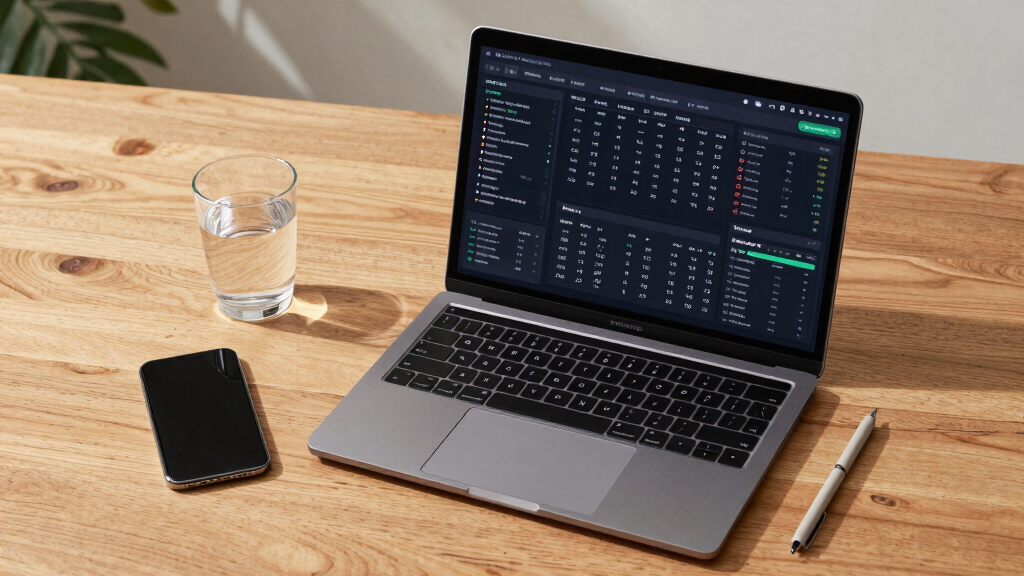

📊 Full opportunity report: Introducing Forezai · TradingAgents — a committee of LLMs decides paper-trades on ThorstenMeyerAI.com — validation score, market gap, and execution plan.

Get the latest gadgets delivered free with Prime
- Fast, free delivery on millions of items
- Prime Video, Amazon Music and more included
- Member-only deals all year
TL;DR
Forezai · TradingAgents is a new project that uses a committee of specialized LLMs to generate paper-trading decisions. It extends previous research on parametric strategies, aiming to explore whether AI can make better-than-random market decisions. The system is now operational with an autonomous loop, multi-broker support, and a web dashboard.
Forezai · TradingAgents has introduced an operational system that employs a committee of large language models (LLMs) to generate paper-trading decisions based on structured analysis and debate among specialized AI agents.
The project is a fork of the open-source TradingAgents framework, which structures multiple LLMs into roles such as analysts, debate agents, and decision-makers. It now includes an autonomous loop that runs daily, executing simulated trades on a configured watchlist, with features like position management, multi-broker support, and a web dashboard for monitoring.
This development builds on prior research showing parametric trading strategies often fail to survive real-market testing, prompting researchers to explore AI-based decision-making. The new system aims to assess whether a committee of LLMs, each with distinct biases, can outperform random decisions in paper trading environments.
Introducing Forezai · TradingAgents.
A committee of LLMs
decides paper-trades.
Analysts · Debate · Risk · Decision
combined with -33% bankroll
services, HTTP routes (starting baseline)
(falls back to public API per token)
The bet is on a different mechanism, not a different parameter setting. The point is not to find a money-printing AI. The point is to put honest measurements of these systems into the public record — so the next person looking at the space starts a step further along than the last.Thorsten Meyer AI · Introducing Forezai · TradingAgents · § 03
Potential Impact of AI-Driven Multi-Agent Trading Systems
This project advances understanding of whether AI, specifically structured committees of LLMs, can produce more reliable trading signals than traditional rule-based strategies. Although it currently focuses on paper trading, success could influence future research on AI-assisted investment decision-making and risk management, highlighting both the possibilities and limitations of AI in financial analysis.
As an affiliate, we earn on qualifying purchases.
Background on Parametric Strategies and AI in Trading
Previous experiments with parametric trading strategies, such as those tested against Polymarket prediction markets, revealed that most explicit-rule approaches tend to fail over time due to mechanical artifacts and overfitting. This prompted researchers to consider less rule-bound AI methods, like multi-agent systems of LLMs, which can articulate reasoning explicitly and debate opposing theses.
The TradingAgents framework, developed by TauricResearch, structures multiple specialized LLMs into stages of analysis, debate, and decision, but lacked operational features necessary for live or simulated trading. Forezai’s fork adds these capabilities, enabling continuous, automated paper trading based on the AI committee’s outputs.
“Our goal is to see if a structured committee of LLMs can produce decisions that are at least no worse than a coin flip after fees, and perhaps even discover edges that elude traditional strategies.”
— Thorsten Meyer, lead researcher
As an affiliate, we earn on qualifying purchases.
Unconfirmed Aspects of AI Trading Effectiveness
It remains unclear whether the committee of LLMs will outperform random or rule-based strategies in live or extended paper trading scenarios. The system’s effectiveness depends on the quality of the reasoning process, the robustness of the architecture, and how well it adapts to market dynamics, which are still being tested.
As an affiliate, we earn on qualifying purchases.
Next Steps for Testing and Validation
The project will continue running automated paper trades, collecting data on decision quality, win rates, and drawdowns. Researchers plan to analyze the AI committee’s reasoning processes and compare performance against baseline strategies. Future developments may include refining the agent roles, expanding the watchlist, and exploring real-money trading with strict safeguards.
As an affiliate, we earn on qualifying purchases.
Key Questions
Can this AI system trade with real money?
Currently, the system is configured for paper trading only. It does not trade with real money unless operators deliberately override safety restrictions, which is not recommended at this stage.
How does the AI committee make decisions?
The system employs multiple specialized LLM agents that analyze data, debate opposing theses, and synthesize their reasoning into final buy, hold, or sell signals, articulating their rationale explicitly.
What are the main limitations of this approach?
Its effectiveness depends on the quality of the AI reasoning and debate, which may not outperform traditional strategies or human judgment. Additionally, the system’s success in live markets remains unproven.
Is this project available for public use?
The code is open-source under the Apache-2.0 license, but the operational system is currently used for research purposes and not intended for live trading by the public.
Source: ThorstenMeyerAI.com
Halloween Picks
halloween
As an affiliate, we earn on qualifying purchases.