
📊 Full opportunity report: Parental Consent Processes For Vendors Serving Young Users on IdeaNavigator AI — validation score, market gap, and execution plan.

Get the latest gadgets delivered free with Prime
- Fast, free delivery on millions of items
- Prime Video, Amazon Music and more included
- Member-only deals all year
TL;DR
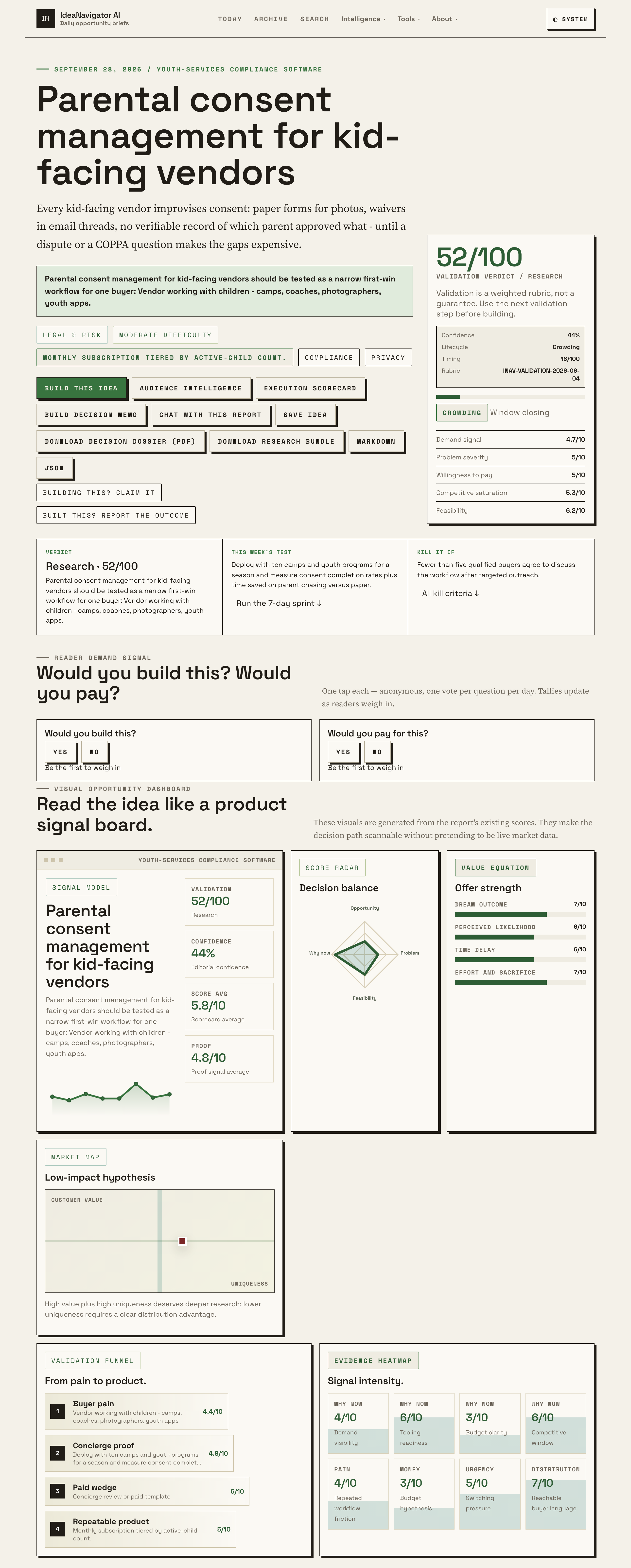
IdeaNavigator AI proposes testing a parental consent management service with 10 camps and youth programs for one season. The proposal describes phone-based forms and consent records, but provides no evidence yet that a pilot has begun or that the product is available.
IdeaNavigator AI has proposed testing a parental consent management service with 10 camps and youth programs over a season, targeting vendors that work with children. The concept would replace scattered paper forms and email approvals with phone-based consent flows and per-child records, but no pilot results or product launch are reported.
The proposed service is aimed at camps, coaches, photographers and youth apps. IdeaNavigator AI describes a recurring problem: vendors may collect photo permissions, waivers and other approvals through separate forms or email threads, leaving them without an easy way to verify which parent agreed to which use. The proposal says such gaps can become costly if a dispute arises or a privacy question is raised.
The proposed minimum product would let each vendor offer branded consent forms completed on a phone. Form categories could include photo use, data collection, medical information and liability waivers. The system would keep a consent record for each child, track when approvals expire, and provide an audit export. Identity checks would be selected according to the perceived risk of the consent involved; the proposal does not specify how those checks would work.
The proposed business model is a monthly subscription priced by active-child count. To assess whether the product solves a meaningful operational problem, IdeaNavigator AI suggests deploying it with 10 camps and youth programs for a season. The proposed measures are consent completion rates and the time staff spend following up with parents compared with paper-based processes. No participating organizations, results or implementation dates are identified.
Records Could Change Parent Follow-Up
For organizations working with children, consent is both a routine administrative task and a record of what a parent authorized. A system that keeps approvals together could make it easier for staff to check whether permission covers a specific use, whether it remains current, and which child it concerns. That may help vendors respond more consistently when parents ask about photos or data use.
The proposal also reflects a wider compliance pressure described by IdeaNavigator AI: it points to changes in children’s privacy enforcement, including COPPA updates and state laws, alongside parents’ challenges to how organizations use children’s images and information. The material does not identify particular laws or enforcement actions, so it does not establish that every vendor needs the same process. Requirements depend on the service and the data involved. For small programs, the practical question is whether a dedicated tool reduces follow-up work while producing records they can retrieve and explain.
The proposed pilot’s value would depend on observable results. If programs complete more forms on time and spend less staff time chasing approvals, that would support the operational case for the service. Those outcomes have not been measured or reported, and the proposal does not show that digital records by themselves guarantee legal compliance.
A Seasonal Pilot Would Test Demand
IdeaNavigator AI frames parental consent management as a narrow initial use case for vendors serving children, rather than as a general-purpose compliance platform. Camps and youth programs are the suggested first customers, with photographers, coaches and youth apps also identified as potential users. The proposed customer group has recurring interactions with parents and may need to collect different kinds of permission.
The suggested validation plan is limited in scope: work with 10 camps and youth programs for one season, then compare completion rates and staff time spent pursuing consent against paper-based handling. That would offer an early indication of whether the workflow is useful in practice. The proposal gives no season dates, recruitment details, pricing figures, or description of how the comparison would be conducted.
The platform concept combines several functions—forms, identity checks, child-level records, expiry tracking and exportable audit histories. These are proposed features, not confirmed capabilities of an operating product. The available description does not identify a company launch, customer commitments, or completed testing.
Pilot Status and Safeguards Remain Open
It is not clear whether a pilot has started, whether any camps have agreed to participate, or when a season-long test might take place. No product name, launch date, subscription price, or measured outcome is given. The proposal also does not say how long consent records would be kept or how parents could change or withdraw an approval.
Other open questions concern implementation. The description does not explain how identity verification would be matched to different levels of risk, how medical or other sensitive information would be protected, or whether families could use the service in languages other than English. It also provides no independent legal assessment or evidence that the proposed audit records would satisfy the requirements applicable to a particular vendor.
Results Would Determine the Next Step
The next stated step is a season-long test with 10 youth programs, with completion rates and staff follow-up time used to assess the workflow. The proposal does not give a start date or say when findings would be published. Confirmation of participating programs and a defined comparison with paper-based processes would help readers judge what the test can show.
If a pilot proceeds, reported results could clarify whether vendors save time and whether parents complete forms more reliably. Further details on pricing, record retention, data protection and consent withdrawal would also be needed to assess how the service would work for families and organizations. For now, the platform remains a proposal with a suggested validation plan.
Source: IdeaNavigator AI
Key Questions
Has the parental consent platform launched?
The available proposal does not report a launch or say that the service is available to customers.
Who is the proposed service for?
It is aimed at vendors serving children, including camps, coaches, photographers, youth programs and youth apps.
What would the suggested pilot measure?
The proposed season-long test with 10 camps and youth programs would track consent completion rates and staff time spent following up with parents compared with paper processes.
What features are proposed?
The concept includes phone-based consent forms, identity checks matched to risk, per-child records, expiry tracking and audit exports. These are proposed features, not reported product capabilities.
Are pilot results available?
No results are reported. The proposal does not specify whether the pilot has begun or when findings might be available.
Source: IdeaNavigator AI
Halloween Picks
halloween
As an affiliate, we earn on qualifying purchases.