
📊 Full opportunity report: Why Investors Are Viewing AI Operations As A Potential Data Center REIT Boom on IdeaNavigator AI — validation score, market gap, and execution plan.

Get the latest gadgets delivered free with Prime
- Fast, free delivery on millions of items
- Prime Video, Amazon Music and more included
- Member-only deals all year
TL;DR
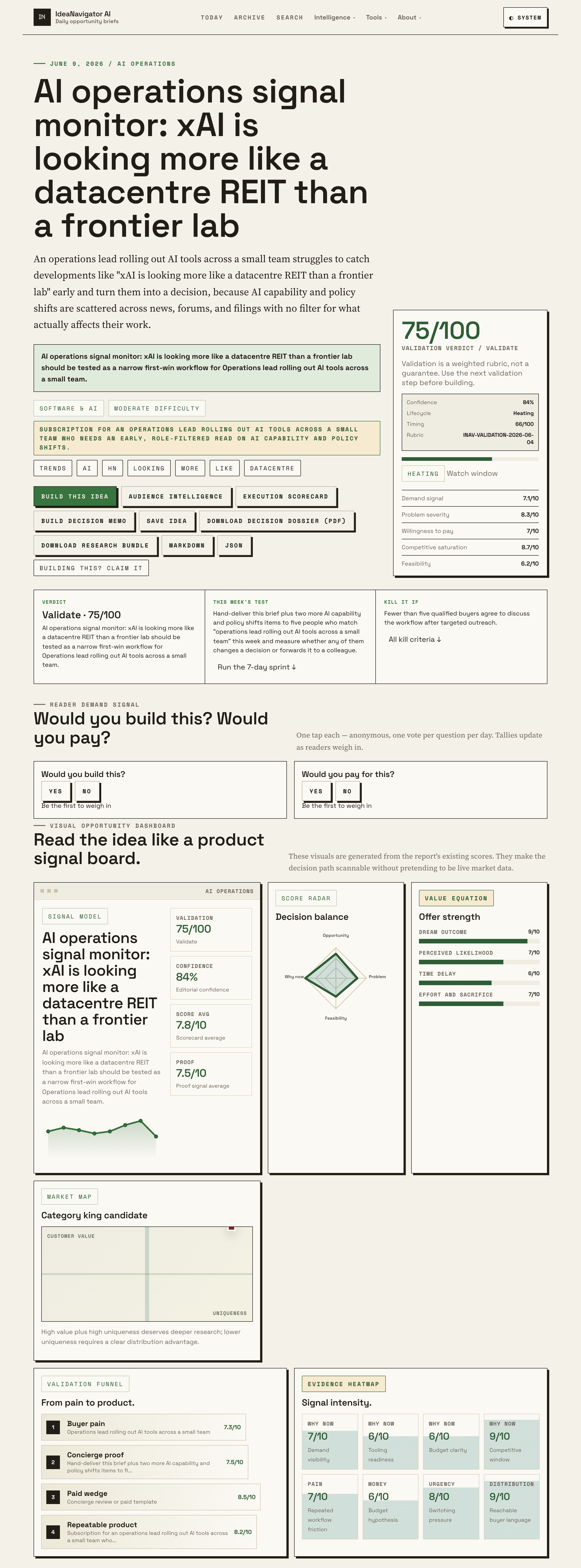
Investors are increasingly viewing AI operations, especially those like xAI, as resembling data center REITs. This shift could signal a new investment trend, driven by the infrastructure needs of AI workloads.
Investors are increasingly viewing AI operations, notably companies like xAI, as resembling data center REITs rather than traditional AI research labs, according to recent market signals. This shift highlights a potential new avenue for investment in infrastructure assets driven by AI demands, making it a significant development for financial markets and infrastructure investors.
Recent observations suggest that AI-focused operations are exhibiting infrastructure and scalability characteristics typical of data center REITs. Analysts note that companies like xAI are emphasizing hardware, networking, and energy infrastructure, which are core to data center models. This trend is driven by the increasing computational needs of AI workloads, requiring substantial physical assets and operational scale.
Market analysts point out that this alignment could lead to a surge in investments similar to those seen in traditional real estate investment trusts (REITs), but focused on AI infrastructure. The shift is partly fueled by the rapid pace of AI capability and policy changes, which demand flexible, scalable infrastructure investments that can be managed as REIT-like assets.
While specific companies are not yet classified as AI data center REITs, the pattern of infrastructure investment and operational focus is prompting investors to consider AI infrastructure as a new asset class. This has sparked interest among institutional investors seeking stable, income-generating assets tied to the growth of AI technology.
Implications of AI Infrastructure Resembling Data Center REITs
This development matters because it suggests a potential shift in how AI infrastructure is valued and invested in. If AI operations are viewed as REIT-like assets, it could lead to a new class of infrastructure investments that offer stable returns and diversification benefits for investors. Additionally, it signals a recognition of the physical and operational needs of AI workloads, emphasizing hardware, energy, and network infrastructure as critical assets.
For the broader market, this could accelerate infrastructure funding for AI, influence valuations, and reshape investment strategies around AI technology. It also raises questions about regulatory frameworks and valuation models that traditionally apply to real estate, which may soon extend to AI infrastructure assets.
As an affiliate, we earn on qualifying purchases.
Growing Infrastructure Needs of AI Operations
The trend toward viewing AI operations as infrastructure assets is rooted in the increasing computational and data requirements of AI workloads. Over the past few years, AI models have grown exponentially in size and complexity, demanding more powerful hardware, energy, and networking capabilities. Companies like xAI are emphasizing hardware deployment and operational scale, mirroring data center strategies.
This shift is reinforced by recent signals from market forums and news outlets, which highlight that AI infrastructure is becoming a key focus for investors seeking stable, asset-backed returns. The analogy to data center REITs is not new, but recent developments suggest a more concrete alignment as AI companies prioritize infrastructure investments to support their growth.
Historically, data center REITs have been valued for their predictable cash flows and tangible assets. Now, AI infrastructure appears to be following a similar path, with investors recognizing its potential as a long-term, income-generating asset class.
“The rapid pace of AI capability and policy shifts is pushing infrastructure investments to the forefront, resembling the model of data center REITs.”
— an industry observer
As an affiliate, we earn on qualifying purchases.
Unclear Regulatory and Valuation Frameworks
It remains uncertain how regulatory frameworks will adapt to classify and govern AI infrastructure assets as REIT-like properties. Additionally, valuation models for these assets are still evolving, and it is unclear how traditional REIT metrics will apply to AI infrastructure investments in the near term.
Further, the pace at which this trend will develop into a formal asset class or whether specific companies will be designated as AI data center REITs is still unknown. Market participants are closely watching regulatory developments and investor interest to gauge the trajectory of this potential boom.
high performance networking switches
As an affiliate, we earn on qualifying purchases.
As an affiliate, we earn on qualifying purchases.
Monitoring Investment Trends and Regulatory Developments
Next steps include tracking investor interest in AI infrastructure assets, observing potential new listings or REIT designations, and monitoring regulatory responses. Market analysts expect increased funding and strategic partnerships focusing on AI hardware and infrastructure, which could accelerate this trend.
Additionally, industry reports and filings will reveal whether companies begin to structure AI infrastructure investments as REIT-like entities, potentially validating this emerging asset class. Regulatory agencies may also issue guidance on classification and valuation in the coming months.
As an affiliate, we earn on qualifying purchases.
Key Questions
Why are investors interested in AI infrastructure now?
Investors see AI infrastructure as a stable, asset-backed investment with predictable cash flows, similar to traditional data center REITs, driven by the increasing computational demands of AI workloads.
How does viewing AI operations as REITs impact the market?
This perspective could lead to a new asset class, attracting institutional investment and potentially increasing funding for AI infrastructure projects, which could accelerate AI development and deployment.
Are there any companies currently classified as AI data center REITs?
As of now, no companies are officially classified as AI data center REITs, but the infrastructure focus of existing AI firms is prompting speculation about future classifications.
What are the risks of this emerging trend?
Uncertainties include regulatory classification, valuation models, and whether the infrastructure can generate stable, long-term income comparable to traditional REITs. Market volatility and technological shifts also pose risks.
What should investors watch for next?
Investors should monitor regulatory developments, company filings, and market signals indicating the formalization of AI infrastructure as a distinct asset class or REIT-like investment vehicle.
Source: IdeaNavigator AI
Halloween Picks
halloween
As an affiliate, we earn on qualifying purchases.