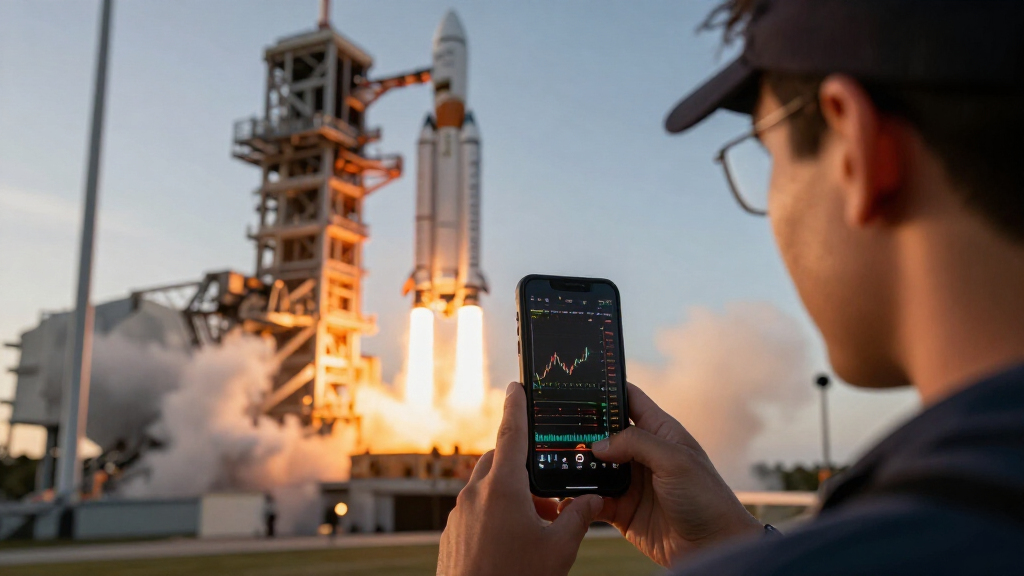
🔍 Read the full analysis: Can SpaceX Build On Its First Profitable Public Quarter As Musk Promises $1 Trillion? on ThorstenMeyerAI.com

Get the latest gadgets delivered free with Prime
- Fast, free delivery on millions of items
- Prime Video, Amazon Music and more included
- Member-only deals all year
TL;DR
SpaceX reported $14.6 billion in third-quarter revenue and $4.4 billion in net income, its first profitable quarter as a public company, according to the supplied report. Elon Musk then projected $500 billion to $1 trillion in annual recurring revenue by the end of 2027, a target that is not company guidance and was not accompanied by a detailed plan. The company is spending heavily on AI compute infrastructure as it expands Starship and Starlink.
SpaceX reported $14.6 billion in Q3 revenue and $4.4 billion in net income on October 20, its first profitable quarter as a public company, according to the supplied report. On the earnings call, Chief Executive Elon Musk projected that the company could reach $500 billion to $1 trillion in annual recurring revenue by the end of 2027—a personal target, not formal company guidance, and one that would require a sharp expansion from current revenue.
Revenue increased 161% from a year earlier, while adjusted EBITDA was $8.8 billion, up 306%, the report said. Revenue also exceeded analyst estimates of about $12.7 billion, and SpaceX shares rose roughly 8% in after-hours trading. The report lists $2.8 billion in income from operations, below net income, and says the difference reflected interest income on IPO cash, other income and a tax benefit. Those items mean the headline net profit does not, by itself, describe the performance of ongoing operations.
The largest reported business by revenue was Super Intelligence, the segment formerly called AI. It generated $7.6 billion, compared with $5.2 billion for Starlink connectivity and $1.8 billion for the Space segment. Super Intelligence posted $431 million in operating income, including $1.2 billion in stock compensation tied to the Cursor deal; the source says operating income would have been about $1.6 billion without that expense. The figures point to AI compute as the main reported growth driver, although the segment’s reported operating profit was modest relative to its revenue.
SpaceX’s investment pace is also high. The company spent $48 billion on capital projects in the first nine months, against $13.1 billion in operating cash flow, and guided to $35 billion to $40 billion of capital expenditure in Q4. The report attributes the funding capacity to IPO proceeds: $85.7 billion in net proceeds, with $51.3 billion in cash and $38.6 billion in marketable securities at the end of September. It also reports a $63 billion backlog and Q1 2027 revenue guidance of $33 billion to $37 billion.
Infographic 01 · The quarter in numbers
AI compute is now SpaceX's biggest business.
Revenue rose 161% to $14.6 billion. Super Intelligence (formerly AI) is more than half of it, and takes 84% of all capital spending.
Revenue by segment, Q3 2026
Bar length on a $0–8B scale.
SI revenue +830% y/y: cloud services agreements, Cursor ($608M since 14 Aug) and Grok; $538M of it is advertising.
Capital spending, Q3 2026
Where the $19.6B went. Bar length on a $0–17B scale.
Nine months: $48.1B capex vs $13.1B operating cash flow, funded by $85.7B of IPO proceeds.
Profit by segment
Q3 2026. SI operating income includes $1.2B Cursor-related stock compensation.
| Segment | Revenue | Op. income | Adj. EBITDA |
|---|---|---|---|
| Space | $1.8B | −$7M | $357M |
| Connectivity | $5.2B | $2.4B | $3.5B |
| Super Intelligence | $7.6B | $431M | $5.0B |
| Total | $14.6B | $2.8B | $8.8B |
Source: SpaceX Q3 2026 results (20 Oct 2026); Q4 capex guidance from the earnings call.
Powered by Thorsten Meyer AI
The Cost of SpaceX’s AI Ambition
The results show a company whose reported business mix is shifting: Super Intelligence produced more than half of Q3 revenue, while the rocket division recorded $1.8 billion. That matters because Musk’s revenue projection depends heavily on scaling compute and related services, not simply increasing launch activity. It also makes capital deployment central to the story: SpaceX’s reported Q3 capital expenditure was $19.6 billion, and the company expects another $35 billion to $40 billion in Q4.
The contrast between profit and investment is significant for readers evaluating whether the business can sustain its growth. Net income was $4.4 billion, but operating cash flow over the first nine months was far below capital spending. IPO cash gives the company resources to fund construction, yet the supplied figures do not establish whether the new infrastructure will earn returns at the rate or scale Musk described. The $1 trillion figure is a projection, not a result or a board-approved forecast cited in the report.
The other initiatives add execution demands. Musk described faster Starship launch cycles and a major increase in Starlink bandwidth, while the company is building compute capacity. Each requires infrastructure, financing and delivery milestones. The earnings report offers concrete financial figures; the call’s longer-range targets remain dependent on future performance.
As an affiliate, we earn on qualifying purchases.
From Rocket Company to Compute
SpaceX’s Q3 report separates its activities into Space, Connectivity and Super Intelligence. The Space segment includes launch and related work; Connectivity is primarily Starlink; Super Intelligence covers compute and AI-related activity and, according to the source, includes Cursor, acquired in August. The segment figures help explain why the company can report strong revenue growth even as its traditional launch business is not the largest part of the quarter’s revenue.
Musk’s recurring-revenue target is especially ambitious against the figures supplied. Q3 revenue of $14.6 billion equates to roughly $58 billion at an annualized pace, while the company’s Q1 2027 revenue guidance of $33 billion to $37 billion would equal roughly $140 billion if maintained for a full year. These are simple annualized comparisons, not company forecasts. The report says CFO Bret Johnsen expects $100 billion in ARR by the end of 2026, measured using December revenue; Musk’s much higher range was stated separately on the call.
The report also describes Starship developments. Flight 14 was identified as the first orbital Starship flight and the first to generate revenue, deploying 26 Starlink V3 satellites. SpaceX planned Flight 15 for the following month, with an attempt to catch both the booster and upper stage at the launch tower. A separate company announcement described a proposed Louisiana spaceport, with a first launch target of 2029. These are future milestones, not completed capabilities.
“Somewhere between 500 billion and a trillion”
— Elon Musk, as quoted in the supplied report
AI compute server for small business
As an affiliate, we earn on qualifying purchases.
As an affiliate, we earn on qualifying purchases.
The Gap Between Targets and Guidance
The supplied report does not describe Musk’s $500 billion-to-$1 trillion projection as formal guidance, and says no definition or revenue bridge was provided during the call. Annual recurring revenue is commonly calculated by multiplying a recent month’s recurring revenue by 12, but the report does not say what exact methodology SpaceX would apply to its businesses. It is also unclear how much of the target would come from compute, Starlink, launch services or other products.
Profitability also needs qualification. The $4.4 billion net income included $873 million in interest income on IPO cash, $1 billion in other income—$561 million of it from a related party—and a $390 million tax benefit, according to the supplied report. The report does not provide enough detail here to determine how repeatable each item is. Nor does it establish whether the rapid growth in AI revenue can continue at the same pace or produce higher operating margins as capital costs rise.
Several operational milestones remain ahead, including the planned Starship stage-catch attempt, orbital refuelling and the proposed increase in launch cadence. The source gives targets and expectations, not completed outcomes. The information provided also ends during the discussion of Starlink’s bandwidth plans, leaving details about the proposed network expansion incomplete.
As an affiliate, we earn on qualifying purchases.
Upcoming Tests and Spending Plans
Near-term indicators include SpaceX’s Q4 results and capital spending, its guided Q1 2027 revenue of $33 billion to $37 billion, and whether it can approach the CFO’s stated $100 billion ARR target for the end of 2026. Those figures will give investors a clearer basis for comparing reported performance with the much larger 2027 projection, though ARR and quarterly revenue are different measures.
On the engineering side, the supplied report says Flight 15 was expected the month after the call and would attempt to catch the Starship booster and upper stage at the tower. President Gwynne Shotwell cited reflying a second stage and attempting orbital refuelling early in 2027. SpaceX’s stated longer-range plans include weekly Starship flights in the first half of 2027 and a proposed Louisiana spaceport whose first launch is targeted for 2029. The outcomes of those tests and the pace of construction will shape how much of Musk’s revenue outlook is achievable.
space exploration educational toys
As an affiliate, we earn on qualifying purchases.
As an affiliate, we earn on qualifying purchases.
Key Questions
Was SpaceX profitable in Q3 2026?
Yes. The supplied report says SpaceX recorded $4.4 billion in net income on $14.6 billion in revenue, its first profitable quarter as a public company. It also reports $2.8 billion in income from operations, a different measure that excludes some non-operating items.
Is $1 trillion in annual recurring revenue a formal SpaceX forecast?
No formal guidance is identified for that figure. The report attributes the $500 billion-to-$1 trillion range to Musk’s remarks on the earnings call and says he did not provide a formal definition or a detailed bridge showing how the company would reach it.
Which SpaceX segment had the most Q3 revenue?
Super Intelligence reported $7.6 billion in Q3 revenue, ahead of Starlink connectivity at $5.2 billion and the Space segment at $1.8 billion, according to the supplied figures.
How is SpaceX funding its high capital spending?
The report says SpaceX spent $48 billion on capital projects in the first nine months, compared with $13.1 billion in operating cash flow. It cites $85.7 billion in net IPO proceeds and cash and marketable securities at the end of September as funding resources. The company guided to another $35 billion to $40 billion in Q4 capex.
What Starship milestones are expected next?
The source says the next planned flight was expected to attempt catches of both Starship stages at the tower. SpaceX also cited a second-stage reflight and an orbital-refuelling attempt for early 2027. These are planned milestones, and the report does not say they have been completed.
Source: ThorstenMeyerAI.com
Fall Picks
fall essentials
As an affiliate, we earn on qualifying purchases.