
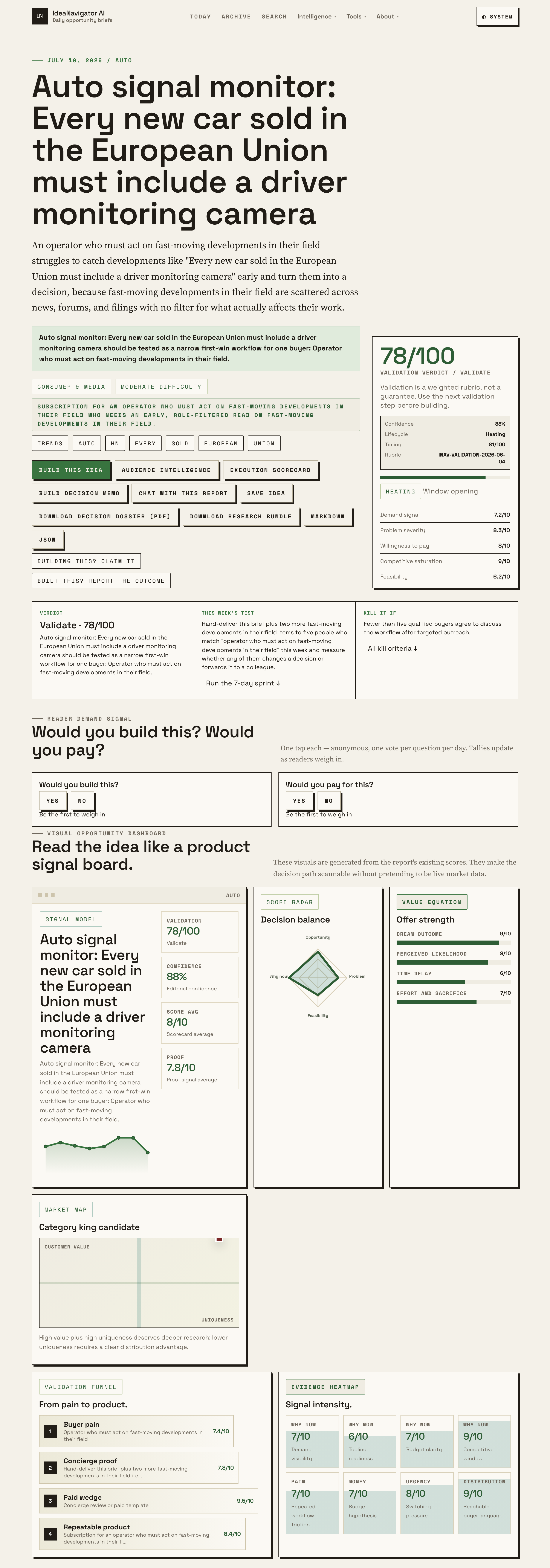
📊 Full opportunity report: European Union Makes Driver Monitoring Cameras Mandatory In Every New Car on IdeaNavigator AI — validation score, market gap, and execution plan.

Get the latest gadgets delivered free with Prime
- Fast, free delivery on millions of items
- Prime Video, Amazon Music and more included
- Member-only deals all year
TL;DR
Rules under the EU’s General Safety Regulation Phase 2 require driver monitoring capability in new vehicles, with camera-based systems becoming the industry’s dominant approach. The requirement applies to all new cars sold in the EU from July 2026, after applying to new type approvals from July 2024.
Every new car sold in the European Union will need to include a driver monitoring system — technology the industry is increasingly implementing as an in-cabin camera that watches the driver for drowsiness and distraction — under the EU’s General Safety Regulation Phase 2. The requirement, tracked as a fast-moving development by IdeaNavigator AI after it surfaced with strong signal on Hacker News, has applied to new type approvals since July 2024 and extends to all new cars sold in the EU from July 2026. For operators in the automotive sector, the shift is now moving from regulatory paperwork into showroom reality as the compliance deadline approaches.
The mandate stems from EU Regulation 2019/2144, known as the General Safety Regulation Phase 2 (GSR2), which requires a suite of safety technologies in new vehicles. Among them are driver drowsiness and attention warning systems, which must detect when a driver is fatigued or distracted and issue warnings. While the regulation mandates the capability rather than a specific technology, camera-based driver monitoring systems (DMS) have become the leading way automakers meet the requirement, because a camera pointed at the driver’s face can track eye closure, gaze direction and head position more reliably than steering-input-based methods.
Safety body Euro NCAP has reinforced this direction by awarding credit in its crash-safety ratings to vehicles with camera-based driver monitoring, which has pushed manufacturers toward the technology faster than the legal minimum requires. Several major automakers already fit camera DMS in models sold in Europe, particularly those with Level 2 driver assistance features, where monitoring the driver’s attention is a condition of allowing hands-on-the-wheel assisted driving.
The development was flagged by IdeaNavigator AI as an example of a fast-moving regulatory change in the automotive field, surfacing with an 88/100 signal score on Hacker News — a measure of how much attention the item drew, not of regulatory weight. The underlying rule is already law: the remaining variable is how quickly the full vehicle market complies and how consumers respond to always-on in-cabin cameras.
What the Camera Mandate Means for Carmakers and Drivers
The requirement matters on three levels. For automakers and suppliers, it adds cost and engineering work to every vehicle sold in the EU market, and it effectively creates a single technical direction — camera-based monitoring — that component makers are now scaling. For fleet operators and company-car buyers, who account for a large share of new EU car sales, the systems arrive with questions about how driver data is stored, processed and potentially used, which intersects with EU data protection law. For drivers, it means a camera inside the cabin becomes a standard feature of new car ownership in Europe, an unfamiliar presence that will likely shape how the technology is received publicly.
There is also a safety rationale backed by regulators: driver distraction and fatigue are consistently identified among the leading causes of road crashes in EU statistics, and in-cabin monitoring is the first widely deployed technology aimed directly at the driver’s condition rather than the vehicle’s surroundings. Whether the systems measurably reduce crash rates at population scale will become clear only as deployment widens.
How GSR2 Brought Monitoring Into Law
The General Safety Regulation was adopted in 2019 and took effect for new vehicle type approvals in July 2022, with its second phase applying from July 2024. GSR2 requires around 30 safety measures in total, including intelligent speed assistance, lane-keeping assistance, event data recorders and reversing detection, alongside the driver drowsiness and attention warning requirement. From July 2026, these requirements apply not only to newly approved models but to every new car sold in the EU, closing the loophole that allowed older designs to continue without the technology.
Driver monitoring itself is not new. Camera-based DMS appeared first in higher-end vehicles and in commercial trucking, where fleet safety programmes used it to detect fatigue on long hauls. Euro NCAP’s decision to include DMS performance in its rating protocol from 2023 gave manufacturers a market incentive beyond the legal floor, and the EU requirement now makes the capability universal.
Open Questions on Privacy and Enforcement
Several things remain unclear. The regulation itself does not specify a camera; it requires a driver drowsiness and attention warning function, and how strictly the requirement is enforced across member states and whether non-camera solutions pass approval varies in practice. The privacy picture is also unsettled: in-cabin cameras continuously capture biometric-adjacent data such as face and gaze, and how manufacturers balance GDPR obligations with the safety mandate — where footage is processed, whether it leaves the vehicle, and how long it is stored — differs between brands and has not been uniformly tested by regulators. There is no confirmed EU-wide figure yet for how the requirement affects car prices. Public acceptance is another unknown: early camera DMS rollouts drew driver complaints about false alerts and discomfort with in-cabin cameras, and it is not yet clear whether that reaction softens as the technology becomes standard.
The July 2026 Deadline and Beyond
The key date is 7 July 2026, when the driver monitoring requirement — along with the rest of the GSR2 package — applies to all new cars sold in the EU, not just newly approved models. Expect a wave of model updates and phase-outs of non-compliant variants in the months before the deadline, as manufacturers clear old inventory. Beyond that, Euro NCAP protocols are expected to keep tightening DMS scoring criteria, and EU regulators have signalled interest in extending monitoring requirements in future rule rounds. Watch also for privacy guidance or enforcement actions from national data protection authorities as camera-equipped cars become the norm, which could shape how manufacturers design the systems’ data handling.
Key Questions
Do all new cars in the EU need a driver monitoring camera?
All new cars sold in the EU from July 2026 must have a driver drowsiness and attention warning system under GSR2. The law does not mandate a camera specifically, but camera-based systems have become the industry’s main approach to meeting the requirement.
When did the EU driver monitoring requirement take effect?
The requirement applied to new vehicle type approvals from July 2024. It extends to every new car sold in the EU from 7 July 2026.
Does the driver monitoring camera record video?
Most systems process images in real time on board the vehicle to detect eye closure, gaze and head position, and do not continuously store footage. However, data-handling practices vary by manufacturer, and how these systems interact with GDPR is still being clarified — it is not yet uniformly regulated in detail.
Can a driver turn the camera off?
Because the monitoring function is legally required, it generally cannot be permanently disabled, though some systems allow temporary deactivation in defined situations. Behaviour varies between brands and models.
Why is the EU requiring driver monitoring?
Regulators identify driver distraction and fatigue among the leading causes of road crashes. In-cabin monitoring is intended to warn drivers before fatigue- or distraction-related collisions occur, complementing systems that address the vehicle’s surroundings.
Source: IdeaNavigator AI
Fall Picks
fall essentials
As an affiliate, we earn on qualifying purchases.