
TL;DR

Get the latest gadgets delivered free with Prime
- Fast, free delivery on millions of items
- Prime Video, Amazon Music and more included
- Member-only deals all year
A master’s student is exploring the potential of virtual reality to improve firefighting training. While initial tests are promising, definitive conclusions are still pending. This development could impact future firefighter training methods.
A master’s student is conducting initial experiments to determine if virtual reality (VR) can be used to improve firefighting skills. This research aims to explore VR’s potential as a training tool, which could revolutionize firefighter preparation if proven effective.
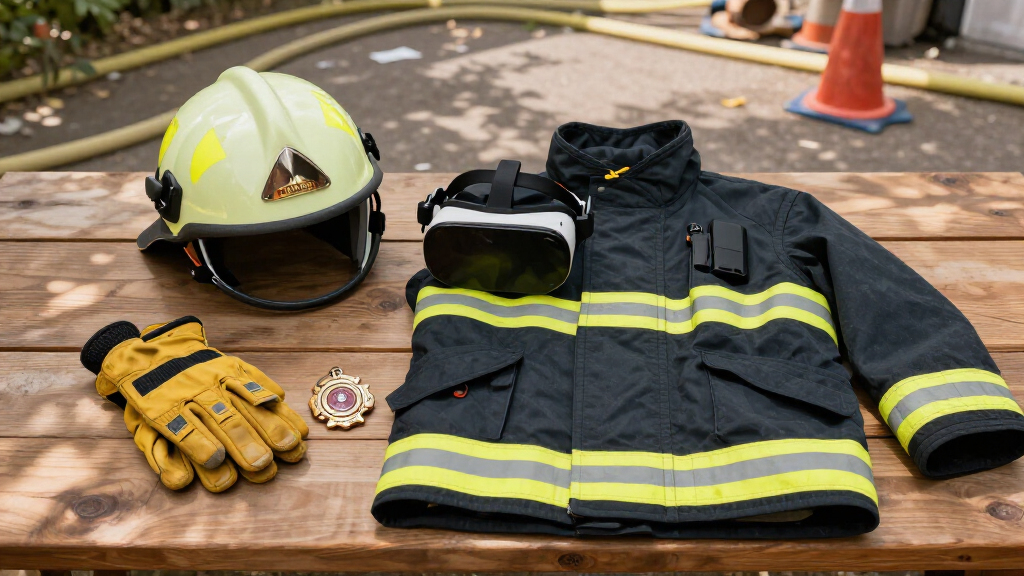
The researcher is developing a VR simulation designed to replicate real fire scenarios, allowing trainees to practice responses in a controlled environment. Early tests suggest that VR could help improve decision-making and technical skills, but formal results are not yet available.
According to an anonymous researcher involved in the project, the goal is to evaluate whether VR training can match or surpass traditional methods in terms of effectiveness and safety. The project is still in the experimental stage, with data collection ongoing.
Can Virtual Reality Improve Firefighting Skills?
A master’s student is testing whether immersive simulation can strengthen firefighter decision-making and technical performance. Early signals are promising, but the evidence is still preliminary and definitive conclusions remain pending.
Initial experiments are underway.
Hazards simulated without live exposure.
Formal outcomes are not yet available.
Preliminary findings are anticipated.
Why VR could matter
Immersive environments could extend traditional preparation with repeatable scenarios, controlled complexity and immediate practice—without placing trainees inside an actual emergency.
Practice danger safely
Smoke, fire progression and high-pressure decisions can be simulated without exposing participants to heat, structural hazards or toxic environments.
Repeat critical decisions
Trainees could revisit the same incident, compare responses and build confidence through deliberate repetition.
Reduce training friction
VR may lower reliance on physical space, specialist equipment and live-fire exercises, although cost savings still require validation.
VR complements a proven mix
Traditional drills remain essential for physical realism. The central research question is whether VR can add measurable value—or replace selected components—without weakening real-world readiness.
| Training dimension | Classroom | Physical drills | Live fire | Virtual reality |
|---|---|---|---|---|
| Hazard-free repetition | ~ Partial | ~ Partial | ✗ Limited | ✓ Strong |
| Physical realism | ✗ Low | ✓ Strong | ✓ Highest | ~ Developing |
| Scenario repeatability | ✓ Strong | ~ Moderate | ✗ Difficult | ✓ Strong |
| Decision tracking | ~ Manual | ~ Observer-led | ~ Observer-led | ✓ Potentially detailed |
| Validated real-world transfer | ✓ Established | ✓ Established | ✓ Established | ~ Not yet proven |
Potential is ahead of proof
The strongest current arguments concern safety and repeatability. Confidence drops when the question shifts to real-world performance, cost-effectiveness and large-scale implementation.
Research maturity
The project remains in experimental testing. Larger participant groups, comparative performance data and cost analysis are still needed before adoption decisions can be justified.
From simulation to evidence
The research pathway connects realistic virtual incidents to measurable trainee outcomes and, eventually, evidence about operational performance.
Build scenarios
Recreate fire behavior, hazards and operational pressure.
Run controlled trials
Place trainees inside repeatable virtual incidents.
Capture performance
Measure decisions, timing and technical responses.
Compare methods
Test outcomes against conventional preparation.
Assess transfer
Determine whether virtual gains improve field readiness.
What the trials must answer
Adoption depends on more than technical feasibility. The decisive test is whether VR produces reliable, scalable improvements that carry into real emergency conditions.
Can VR replace traditional training?
It is too early to tell. The more realistic near-term role is likely to be a supplement for selected scenarios and decision practice.
Will virtual skills transfer to the field?
That is the core unresolved issue. Controlled gains must be linked to performance under real physical and psychological pressure.
Could VR lower costs?
Potentially, but hardware, software, scenario development and program integration must be included in a full cost-benefit analysis.
What could slow implementation?
Simulation realism, user comfort, instructor acceptance, system maintenance and integration with existing standards may all affect scalability.
Bottom line: promising supplement, unproven replacement
VR offers a compelling way to rehearse dangerous situations safely. Larger trials and transparent comparative results are required before claims about superior performance, lower costs or full replacement can be supported.
Potential Impact of VR on Firefighting Training
If VR proves to be an effective training tool, it could significantly enhance firefighter preparedness by providing realistic, risk-free practice scenarios. This technology could reduce training costs, improve response times, and increase safety for trainees and professionals alike.
Experts note that immersive VR environments can simulate dangerous situations without exposing trainees to actual hazards, potentially leading to better skill retention and confidence.
virtual reality firefighting training simulator
As an affiliate, we earn on qualifying purchases.
As an affiliate, we earn on qualifying purchases.
Current State of Firefighting Training Methods
Traditional firefighting training relies heavily on physical drills, classroom instruction, and live fire exercises, which can be costly, logistically complex, and risky. Recent advances in simulation technology have begun to supplement these methods, but widespread adoption remains limited.
The concept of using VR for firefighter training has been discussed for several years, with some pilot programs testing its feasibility. However, comprehensive studies evaluating its effectiveness are still in development.
“Our goal is to see if virtual reality can serve as a safe, effective supplement or alternative to traditional training methods.”
— an anonymous researcher
As an affiliate, we earn on qualifying purchases.
Unclear Effectiveness and Practical Implementation
It is not yet clear whether VR training will match or outperform traditional methods in real-world firefighting scenarios. The project is still in early testing phases, and comprehensive data on outcomes, cost-effectiveness, and scalability are pending.
Details about the specific VR systems used and how trainees’ performance compares to conventional training are still emerging.
firefighting VR simulation software
As an affiliate, we earn on qualifying purchases.
As an affiliate, we earn on qualifying purchases.
Next Steps in VR Firefighting Research
The research team plans to conduct more extensive trials with larger participant groups to assess the effectiveness of VR training. They aim to publish preliminary findings within the next year and explore potential partnerships for broader implementation.
Further development of realistic simulation scenarios and integration with existing training programs are also anticipated.
immersive firefighting training VR
As an affiliate, we earn on qualifying purchases.
As an affiliate, we earn on qualifying purchases.
Key Questions
Can VR replace traditional firefighting training?
It is too early to say whether VR can fully replace traditional methods. Current research aims to determine if it can serve as an effective supplement or alternative in specific training contexts.
What are the benefits of using VR for firefighting training?
VR offers a safe, cost-effective way to simulate dangerous scenarios, allowing trainees to practice responses without real-world risks, potentially improving decision-making and technical skills.
When will more conclusive results be available?
The research team expects to publish initial findings within the next year, based on ongoing trials and data collection.
What challenges might VR training face in firefighting?
Challenges include ensuring the realism of simulations, integrating VR with existing training programs, and demonstrating measurable improvements in real-world performance.
Could VR reduce training costs?
Potentially, yes. VR could lower costs by reducing the need for physical space, equipment, and live fire exercises, but comprehensive cost-benefit analyses are still underway.
Source: rss
Fall Picks
fall essentials
As an affiliate, we earn on qualifying purchases.