TL;DR

Get the latest gadgets delivered free with Prime
- Fast, free delivery on millions of items
- Prime Video, Amazon Music and more included
- Member-only deals all year
A guest post in The Quantum Insider describes a three-qubit Grover search run on a diamond processor at room temperature and pressure, without a vacuum chamber or cryostat. The result is a limited demonstration, not evidence that diamond quantum computers have solved scaling or outperform other platforms overall; its significance is the possibility of reducing dependence on bulky operating infrastructure.
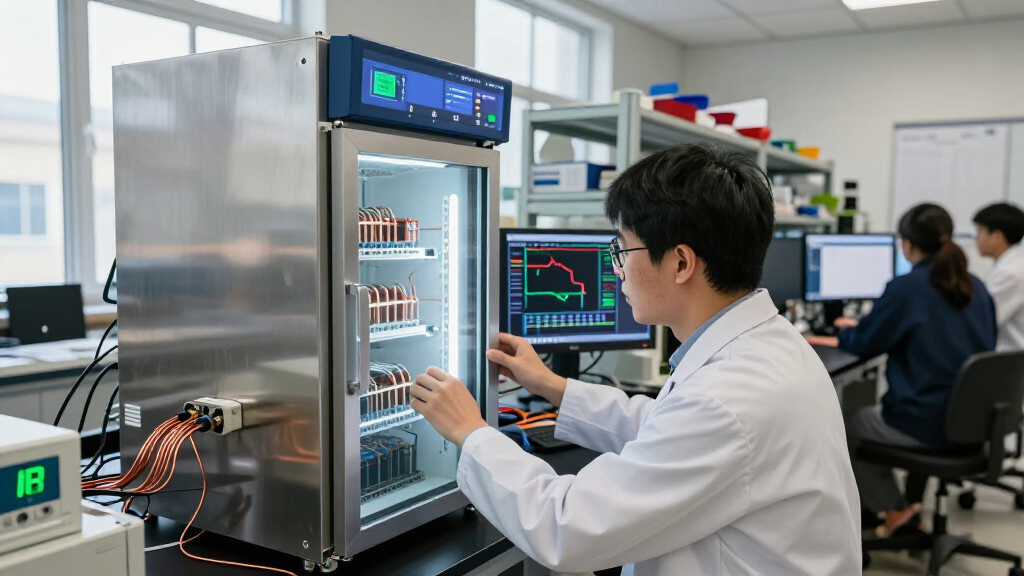
A three-qubit quantum processor made from diamond has run Grover’s search algorithm at room temperature and pressure, without a vacuum chamber or cryostat, according to a guest post published October 9 by The Quantum Insider. The small-scale demonstration does not establish a practical quantum advantage or resolve how the technology will scale, but its author argues that operating without extensive vacuum or cooling infrastructure could matter as quantum hardware develops.
The demonstration used a commercial processor based on nitrogen-vacancy (NV) centers in diamond. Rather than using the NV center’s electron spin as the calculation qubit, the system used three nearby, longer-lived nuclear spins: a nitrogen-14 nucleus and two carbon-13 nuclei. The guest post says these spins retain quantum information for several milliseconds, while the electron spin acts as an optical interface.
The processor searched an eight-item, unstructured set. The post reports an average success probability of 77.3% when one state was marked and 87.0% when either of two states was marked. It compares those results with classical success probabilities of 37.5% and 46.4%, respectively, for the same number of oracle queries. The reported average single-qubit Clifford fidelity was 99.90%, while two-qubit subspace gate fidelity averaged 95.7%.
The system operated at an average temperature of 296.3 kelvin and used about 600 watts, according to the post. Those conditions contrast with superconducting processors, which typically require dilution refrigerators operating at millikelvin temperatures, and trapped-ion or neutral-atom systems that rely on ultra-high-vacuum equipment. The article says the diamond processor’s result is comparable to or higher than some reported demonstrations on those platforms, but it also acknowledges that ion traps retain the best raw fidelities across modalities.
Why Operating Without Cryogenics Matters
The result’s importance is less about a three-qubit search outperforming existing quantum machines than about what surrounds the processor. Many quantum computing approaches depend on specialized equipment to keep qubits cold or isolated from air. If a solid-state platform can perform useful operations under ordinary laboratory conditions, it could reduce the size, energy demand and engineering burden of the support systems required for each device.
The guest post frames this as a possible echo of the shift from vacuum tubes to transistors. In that historical comparison, the decisive advantage was not simply a single performance result: semiconductor devices could be integrated and manufactured at scale. Applied to quantum computing, the argument is that manufacturing and operating costs may matter as much as qubit performance. The current demonstration does not prove that diamond will follow the same path, but it highlights infrastructure as a point of comparison often obscured by headline qubit counts.
For companies and public programmes investing in quantum hardware, this raises a practical question: how much of the expense lies in fabricating qubits, and how much in keeping them operational? A room-temperature processor could offer a different route if it can be expanded while preserving reliability. The reported experiment is a starting point for that question, not an answer about commercial readiness.
As an affiliate, we earn on qualifying purchases.
From Diamond Devices to Grover’s Search
The source places the experiment in a sequence of earlier diamond milestones. It says researchers in Leipzig demonstrated a working one-qubit diamond quantum computer in 2020. In 2023, NV-center fabrication was demonstrated at production scale under Germany’s national quantum computing initiative. The guest post reports that sulfur doping and activation increased the yield of usable, entangled centers to roughly 85%, compared with roughly 1% in earlier undoped approaches. These figures and the broader industrial comparison are presented by the guest-post author, rather than independently examined in the article.
Grover’s algorithm is a standard test because it searches an unstructured set with a proven quadratic query advantage over classical brute-force search. Running the algorithm end to end exercises a sequence of gates, making it a more demanding demonstration than showing an isolated operation. Still, a search over just eight possible items is a small proof of capability, not a test of a large-scale machine or a commercially valuable workload.
“The real question is how fast it happens – and what it means for the tens of billions of dollars committed to vacuum-dependent modalities.”
— Prof. Dr. Marius Grundmann, CEO of SAXON Q and author of the guest post
As an affiliate, we earn on qualifying purchases.
Scaling Beyond Three Nuclear Spins
The reported experiment establishes a small-scale, room-temperature demonstration; it does not show how many qubits a diamond processor can support while retaining its reported fidelities and success rates. The guest post does not provide a scaling roadmap, a comparison of total system costs, or evidence that the device can correct errors at a scale required for fault-tolerant computing.
It is also unclear how directly the reported success probabilities compare with results from other platforms, since hardware, implementations and test conditions can differ. The source characterizes the diamond performance as competitive in this particular search, while acknowledging that trapped-ion systems lead on raw fidelities. Its claims about manufacturing yield and the historical analogy are arguments made by the guest-post author, not proof that diamond hardware will displace other approaches.
As an affiliate, we earn on qualifying purchases.
The Next Test Is Larger Systems
The next meaningful test will be whether diamond processors can grow beyond a three-qubit search while preserving coherence, gate performance and operation without cryogenic or vacuum equipment. Further demonstrations would need to report results across larger circuits and explain how reliably usable centers can be manufactured and integrated.
The guest post does not announce a follow-up experiment, product release or timetable. For now, the result adds a data point to comparisons among quantum hardware platforms. Whether it marks a broader shift will depend on evidence about scaling, error correction, manufacturing yield and full-system energy use, none of which is settled by this search alone.
As an affiliate, we earn on qualifying purchases.
Key Questions
What did the diamond processor demonstrate?
It ran a three-qubit Grover search over an eight-item set using nuclear spins associated with nitrogen-vacancy centers in diamond, at room temperature and pressure.Does the experiment show a practical quantum advantage?
No. The result was a small-scale algorithm demonstration. Its reported success probabilities exceeded the cited classical results for the same number of oracle queries, but it does not establish an advantage on a useful real-world task.Why is room-temperature operation relevant?
Many quantum processors rely on cryogenic cooling or ultra-high vacuum. Operating without those systems could reduce equipment and energy demands, though the experiment does not establish total costs or commercial scalability.Does this mean diamond is better than other quantum platforms?
The source does not establish that. It says the diamond result compares favorably on this search with some reported demonstrations, while noting that trapped-ion systems retain the best raw fidelities across modalities.What remains to be demonstrated?
Researchers would need to show that diamond processors can scale to larger systems while maintaining reliable gates and coherence, and provide evidence about error correction, manufacturing and full-system performance.Source: rss
Halloween Picks
halloween
As an affiliate, we earn on qualifying purchases.