
TL;DR

Get the latest gadgets delivered free with Prime
- Fast, free delivery on millions of items
- Prime Video, Amazon Music and more included
- Member-only deals all year
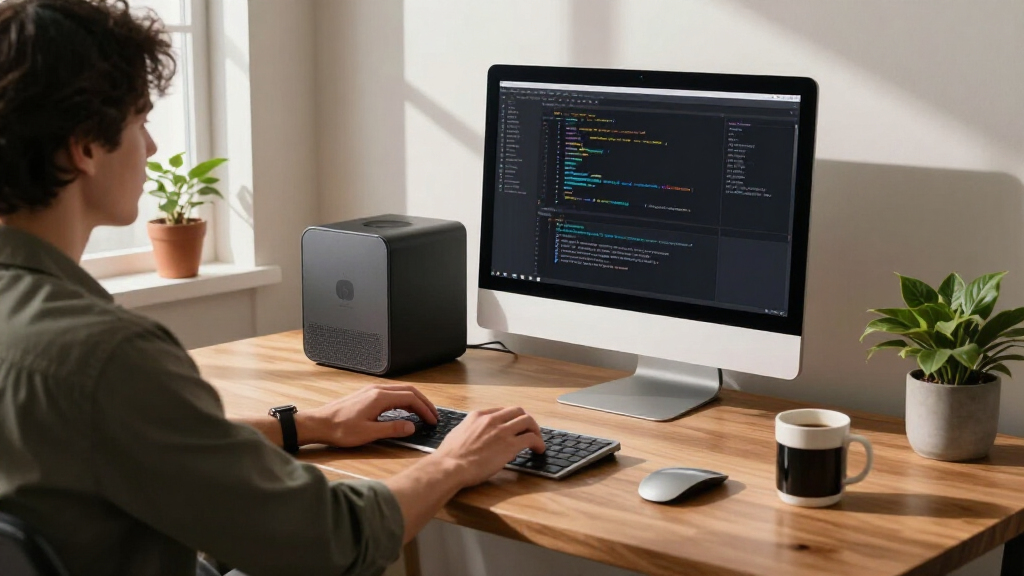
Apple announced the Mac Studio M5 Ultra, capable of holding 512GB of unified memory, enabling local running of frontier-scale AI models. However, performance and practical use cases are nuanced, not a direct replacement for cloud GPU clusters.
Apple has announced a new Mac Studio featuring up to 512GB of unified memory, allowing users to load and run frontier-scale AI models locally. This marks a significant development for AI researchers and small teams seeking to operate large models without relying on cloud infrastructure. The key point is that this machine can hold these large models directly in memory, a capability previously limited to specialized data center hardware.
The Mac Studio M5 Ultra is built by connecting two M5 Max chips via Apple’s UltraFusion interconnect, creating a processor with four dies. It includes a GPU with up to 80 cores and neural accelerators integrated into every GPU core, delivering up to 4.3x faster AI performance than the previous M3 Ultra and nearly 10x over the M1 Ultra in some benchmarks, according to Apple.
The standout feature is the 512GB of unified memory, which allows the GPU to directly address the entire pool. This capacity enables loading large AI models—some previously only feasible in data centers—onto a desktop machine. The machine costs starting at $5,499, with the full 512GB configuration expected to cost around $10,800, due to Apple’s memory pricing. Preorders are open, with availability on September 22, and the high-memory model arriving in late October.
While the hardware’s architecture is innovative, experts emphasize that capacity is not the same as throughput. The machine can load and run large models, but the speed at which it processes tokens or performs inference remains limited by memory bandwidth and compute power. Apple claims significant performance improvements, but real-world benchmarks are awaited to confirm these claims outside controlled tests.
Implications for Local AI Model Deployment
This development is important because it offers a desktop solution capable of running large AI models that previously required cloud-based GPU clusters. For researchers, developers, and privacy-focused users, it means greater control over data and experiments, reducing reliance on external cloud services. However, it does not eliminate the need for cloud infrastructure for high-throughput or multi-user deployment, as the hardware’s speed and bandwidth are still limited compared to data center GPUs.
Apple Mac Studio M5 Ultra with 512GB RAM
As an affiliate, we earn on qualifying purchases.
As an affiliate, we earn on qualifying purchases.
Background on AI Hardware and Apple’s Silicon Advances
Until now, running frontier-scale AI models locally has been confined to expensive, specialized data center hardware with multiple high-end GPUs and large memory pools. Apple’s move to integrate large memory capacity and neural accelerators into a desktop machine represents a shift towards democratizing access to large models. The Mac Studio’s architecture, combining two chips via UltraFusion, is a novel approach that leverages Apple’s silicon design to scale performance and memory capacity. This is part of a broader trend of hardware innovation aimed at enabling AI development outside traditional cloud environments.
“Loading a big model and serving it fast are different achievements, and this machine is dramatically better at the first than the second.”
— Thorsten Meyer
AI model training hardware for Mac
As an affiliate, we earn on qualifying purchases.
As an affiliate, we earn on qualifying purchases.
Limitations of Speed and Practical Use Cases
While the Mac Studio M5 Ultra can load large models, it is not yet clear how well it performs in real-world inference tasks outside of benchmarks. The actual throughput—how many tokens per second it can process—depends heavily on memory bandwidth and compute limits, which are lower than those of data center GPU clusters. Experts emphasize that this machine is suitable for experimentation and small-scale deployment, not for large-scale serving or production environments.
large memory desktop computer for AI
As an affiliate, we earn on qualifying purchases.
As an affiliate, we earn on qualifying purchases.
Awaiting Benchmarks and Software Ecosystem Maturity
Next steps include independent performance testing on real inference workloads to validate Apple’s claims. Software support and optimization for AI workflows on Apple silicon are still evolving, and some workflows may require porting or alternative solutions. Additionally, the high-memory model’s availability and pricing will become clearer as it launches in late October. Monitoring these developments will determine how effectively users can leverage this hardware for large AI models.
As an affiliate, we earn on qualifying purchases.
Key Questions
Can the Mac Studio M5 Ultra run any large AI model?
It can load and run large models that fit within 512GB of unified memory, but real-world performance will vary based on model size and workload complexity.
Is this a replacement for cloud GPU clusters?
Not entirely. While it enables local loading of large models, its speed and bandwidth limitations mean it’s best suited for experimentation or small-scale deployment, not high-volume serving.
When will real-world performance benchmarks be available?
Independent benchmarks are expected after the official release, which is scheduled for September 22, with the high-memory model arriving in late October.
Does this mean I can run AI models privately on my desk?
Yes, for models that fit within the memory capacity, users can run them locally, offering increased privacy and control over data.
What are the limitations of the hardware for AI workloads?
The main limitations are memory bandwidth and compute throughput, which restrict the speed of inference and training compared to dedicated data center hardware.
Source: ThorstenMeyerAI.com
Columbus Day / Indigenous Peoples' Day Picks
long weekend sales
As an affiliate, we earn on qualifying purchases.