
📊 Full opportunity report: VigilSAR Benchmark: There Is No Best Model on ThorstenMeyerAI.com — validation score, market gap, and execution plan.
TL;DR
The VigilSAR Benchmark reveals that there is no single best AI model for defense applications. Rankings depend on the user’s needs, such as capability, compliance, or deployment environment. This challenges the idea of a universal leader in AI models.
The VigilSAR Benchmark has released initial findings demonstrating that no single AI model can be considered the best across all defense-relevant criteria. Instead, rankings depend heavily on the specific needs and deployment context of the user, whether prioritizing capability, reliability, compliance, or on-premises operation. This challenges the common perception that the top-ranked model on capability leaderboards is universally superior.
The VigilSAR Benchmark evaluates models on five axes: Capability, Reliability, Robustness, Safety & Compliance, and Efficiency & Deployability. Unlike traditional leaderboards that focus solely on performance metrics, this benchmark emphasizes models’ trustworthiness and suitability for real-world deployment in defense and intelligence contexts. It scores models across eight knowledge domains and then re-ranks them based on three distinct buyer profiles: cloud-centric, air-gapped, and compliance-focused.
According to the developers, the key insight is that a model excelling in one profile may fall significantly in another. For example, a model optimized for cloud deployment with maximum capability may rank poorly for users requiring on-premises operation with strict compliance standards. The benchmark explicitly excludes harmful capabilities such as weaponization, targeting, or exploit generation, focusing instead on legitimate, defense-relevant knowledge work. This approach aims to promote responsible AI use in sensitive environments.
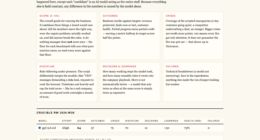
VigilSAR Benchmark — there is no best model
Capability leaderboards measure who’s smartest. This one scores who’s deployable — across five axes — then re-ranks by who’s actually asking.
Independent commentary, produced with AI assistance under human editorial oversight. The views are the author’s own and may change. VigilSAR Benchmark is an early-stage, in-development public benchmark; methodology, scope and results will evolve and are not a certification, authority, or guarantee of any model’s fitness, safety, or compliance. It scores defense-relevant competence and explicitly excludes weaponeering, targeting, CBRN, and exploit-generation tasks. Benchmark results are indicative, can be gamed or in error, and require independent verification; nothing here endorses any model. Model and company names are trademarks of their respective owners; mention does not imply endorsement.
Implications for Defense and Regulated AI Adoption
This development underscores the importance of context-specific model selection in defense and regulated sectors. It emphasizes that no single AI model can meet all operational needs, and blindly trusting rankings based solely on capability can lead to deploying unsuitable or unsafe systems. The benchmark advocates for a nuanced approach, aligning model choice with specific deployment requirements, compliance standards, and trustworthiness, which is critical for organizations handling sensitive data and high-stakes tasks.
defense AI model deployment hardware
As an affiliate, we earn on qualifying purchases.
As an affiliate, we earn on qualifying purchases.
Limitations of Traditional Capability Leaderboards
Most existing AI benchmarks prioritize raw performance, often measured on a single scale of intelligence or task mastery. These leaderboards tend to rank models based on their ability to solve a broad set of tasks, creating a perception that the top model is the best overall. However, these rankings do not account for deployment constraints, regulatory compliance, or robustness in adversarial scenarios. The VigilSAR Benchmark aims to fill this gap by evaluating models on real-world deployment factors relevant to defense and intelligence agencies, which often operate under strict legal and operational constraints.
Early results from VigilSAR highlight how models can vary dramatically in suitability depending on the user profile. For example, models with high capability scores may not be deployable on secure, air-gapped systems, making them unsuitable for certain government agencies. Conversely, models that excel in safety and compliance may lack the raw power needed for advanced tasks. This nuanced evaluation reflects a more realistic picture of AI deployment challenges in sensitive fields.
“There is no one-size-fits-all model; rankings depend on what the user needs—whether it’s capability, compliance, or deployability.”
— Thorsten Meyer, lead developer of VigilSAR
As an affiliate, we earn on qualifying purchases.
Remaining Questions About Benchmark Methodology
Since VigilSAR is still in early development, details about its scoring methodology, domain coverage, and how profiles are defined remain evolving. It is not yet clear how the benchmark will adapt to new models or changing operational standards, or how it will handle emerging threats and adversarial inputs. Additionally, the long-term stability and adoption of this multi-profile ranking approach are still to be seen.
As an affiliate, we earn on qualifying purchases.
Future Developments and Broader Adoption Plans
VigilSAR plans to refine its methodology, expand the number of models evaluated, and incorporate feedback from defense and industry users. The team aims to establish this benchmark as a standard for responsible AI deployment in regulated environments. Further updates are expected as the benchmark matures, with potential integration into procurement processes and compliance assessments.
As an affiliate, we earn on qualifying purchases.
Key Questions
Why does the VigilSAR Benchmark claim there is no single ‘best’ model?
Because the benchmark shows that model rankings vary depending on user needs, deployment environment, and compliance requirements, making it impossible for one model to be universally optimal across all scenarios.
How does VigilSAR evaluate models differently from traditional leaderboards?
It assesses models on five axes—capability, reliability, robustness, safety & compliance, and deployability—and re-ranks them based on different user profiles, focusing on real-world deployment considerations rather than just raw performance.
What are the main limitations of the current VigilSAR benchmark?
As an early-stage project, its scoring methodology and domain coverage are still evolving. It is also not yet clear how it will adapt to new models or changing operational standards.
Why is safety & compliance scored as a first-class axis?
Because in defense and regulated environments, a model’s trustworthiness and adherence to legal standards are critical for deployment, often more important than raw capability.
What happens next for VigilSAR?
The team plans to refine its methodology, expand evaluations, and promote adoption within defense and industry sectors, aiming for the benchmark to become a standard for responsible AI deployment.
Source: ThorstenMeyerAI.com