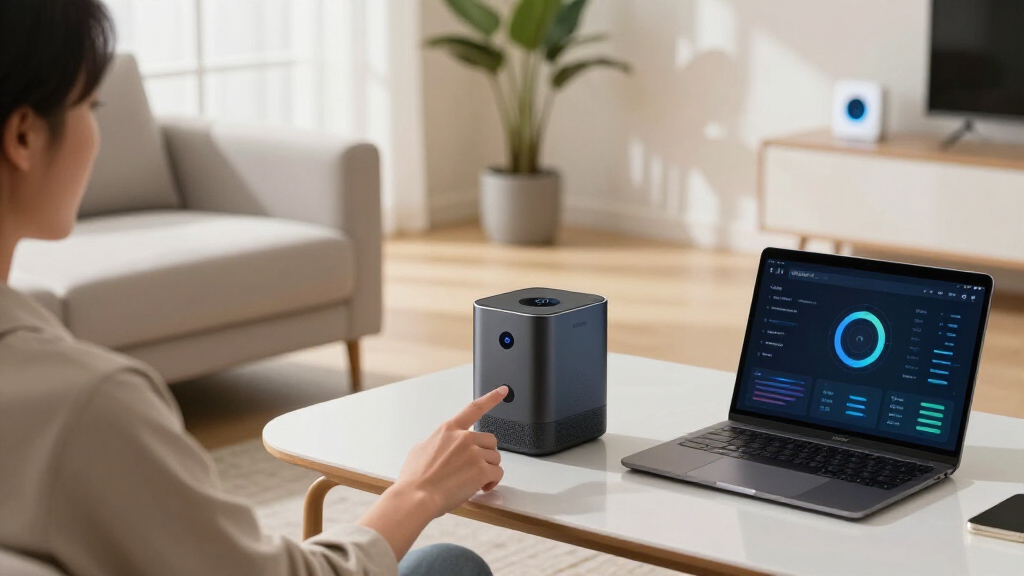

📊 Full opportunity report: LFM2.5-VL-3B: Elevating Vision Capabilities For Faster Edge AI Deployment on ThorstenMeyerAI.com — validation score, market gap, and execution plan.

Get the latest gadgets delivered free with Prime
- Fast, free delivery on millions of items
- Prime Video, Amazon Music and more included
- Member-only deals all year
TL;DR
Developers have introduced LFM2.5-VL-3B, a 3.1B-parameter vision-language model optimized for on-device use. It claims improvements in screen understanding, object grounding, and multi-image analysis, but independent verification is pending.
The developers of LFM2.5-VL-3B have announced a 3.1 billion-parameter vision-language model that runs entirely on local hardware, aiming to accelerate real-time edge AI applications. The model is designed to process documents, screens, and multiple images while supporting tool calling, with potential benefits for privacy, latency, and device autonomy.
The LFM2.5-VL-3B model integrates a SigLIP2 400M NaFlex vision encoder with a pretrained backbone from the LFM2.5-VL-3B text model. It was pretrained on approximately 34 trillion tokens and utilized four times more vision data than previous models, including image-caption pairs, OCR, grounding, and instruction-following datasets. Its vocabulary was doubled to 128,000 tokens, enhancing non-Latin script coverage.
According to the developers, the model underwent supervised fine-tuning, knowledge distillation, Antidoom training, and multi-reward reinforcement learning to improve response speed and accuracy. Developer-reported benchmark results show an average of 69.4 across vision tasks, with scores of 91.1 on DocVQA and 87.9 on RefCOCO grounding. These results are based on internal testing with non-reasoning prompts and have not been independently verified.
In terms of hardware performance, the model can run on devices with about 3 GB of memory, achieving speeds of 228 tokens/sec on an M5 Max, 116 on a Ryzen AI Max+, and 20 on a Galaxy S26 Ultra. For more on AI hardware optimization, see the original analysis. It also demonstrated throughput of approximately 11,000 tokens/sec on a high-end H100 GPU under high concurrency, though real-world performance will depend on specific hardware and deployment settings.
The update emphasizes four key capabilities: digital screen interpretation, object grounding, multi-image analysis, and function calling. Developer tests indicate improved tool use, with scores rising from 26.4 to 59.5 on ToolSandbox and from 20.5 to 32.5 on BFCL V4, aligning with other models like Gemma-4-E2B and Qwen3.5-2B.
However, the developers caution that independent benchmarking and real-world testing are still pending, and some performance claims remain unverified outside their internal evaluations. Compatibility with deployment frameworks like llama.cpp, MLX, vLLM, SGLang, and ONNX is supported, with plans to expand support to Transformers v5.10.1.
Implications for On-Device AI and Edge Applications
The LFM2.5-VL-3B model’s ability to run entirely on local hardware could significantly impact privacy, latency, and device autonomy in AI applications. Its improvements in screen understanding, object grounding, and multi-image analysis enable new possibilities for real-time interface assistance, visual question answering, and industrial automation without reliance on cloud servers. As the model supports function calling and multiple languages, it could facilitate more accessible and secure AI tools across various sectors.
However, the lack of independent benchmarking and detailed deployment data means its real-world performance and safety handling are still uncertain. The potential for broader adoption hinges on further validation and testing across diverse hardware and use cases.
As an affiliate, we earn on qualifying purchases.
Background of Vision-Language Model Development
The announcement follows the development of previous models like LFM2-VL-3B, which focused on vision-language tasks for larger, cloud-based systems. The new model, LFM2.5-VL-3B, emphasizes on-device deployment, reflecting a broader industry trend toward privacy-conscious and low-latency AI tools. Prior advancements have included improvements in image captioning, grounding, and instruction-following, but scaling models for local execution has remained a challenge due to hardware constraints.
The developers report that LFM2.5-VL-3B builds on these prior efforts by integrating a more powerful vision encoder and expanding training data, including more non-Latin scripts, to support diverse applications. The model’s release aligns with industry interest in lightweight yet capable AI models suitable for smartphones, industrial equipment, and embedded systems.
“Our most capable vision-language model you can run on your own hardware.”
— Thorsten Meyer
vision-language model for on-device AI
As an affiliate, we earn on qualifying purchases.
As an affiliate, we earn on qualifying purchases.
Pending Independent Verification and Real-World Testing
It is not yet clear how closely the internal benchmark results and throughput measurements will match independent evaluations or real-world performance. The developers have not provided comprehensive hardware configurations, end-to-end latency data, or safety assessments for tool calling and unfamiliar inputs. Details on dataset diversity, language coverage, and robustness under varied conditions remain limited, leaving questions about the model’s practical reliability and safety.
portable AI hardware for vision processing
As an affiliate, we earn on qualifying purchases.
As an affiliate, we earn on qualifying purchases.
Upcoming Independent Evaluations and Deployment Tests
Further testing by third-party researchers and industry users will clarify the model’s real-world capabilities, safety, and robustness. The developers plan to release support for additional deployment frameworks and expand testing across consumer devices and industrial systems. Monitoring these evaluations will be key to understanding the model’s true performance and potential for widespread adoption.
As an affiliate, we earn on qualifying purchases.
Key Questions
What is LFM2.5-VL-3B?
LFM2.5-VL-3B is a 3.1 billion-parameter vision-language model designed to process text and images, including documents, screens, and multiple-image inputs, for local deployment.
Can it run entirely on local hardware?
Yes, the developers state it can operate fully on-device, fitting within about 3 GB of memory, with performance varying based on hardware configuration.
What improvements does it have over previous models?
The model offers enhanced screen understanding, object grounding, multi-image analysis, and improved function calling support, with higher benchmark scores reported by developers.
Are the performance claims independently verified?
No, the benchmark results are from internal testing; independent validation and real-world testing are still pending.
What applications could benefit from this model?
Potential uses include document extraction, interface assistance, visual question answering, and industrial automation, especially where privacy and latency are critical.
Source: ThorstenMeyerAI.com
Fall Picks
fall essentials
As an affiliate, we earn on qualifying purchases.