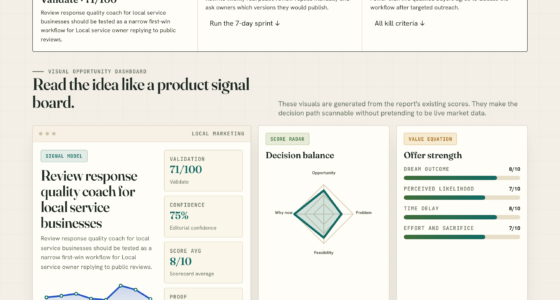

📊 Full opportunity report: The Internal Stakeholder Challenge In AI Projects on ThorstenMeyerAI.com — validation score, market gap, and execution plan.

Get the latest gadgets delivered free with Prime
- Fast, free delivery on millions of items
- Prime Video, Amazon Music and more included
- Member-only deals all year
TL;DR
Despite widespread AI adoption, most enterprise projects fail to deliver measurable ROI due to internal organizational resistance. Success hinges on addressing people, processes, and culture, not just technology.
Despite near-universal adoption of AI workloads in Fortune 500 companies, most projects fail to produce measurable ROI, primarily due to internal organizational challenges rather than technological shortcomings, according to a recent analysis by Thorsten Meyer.
Data shows that 72% to 88% of enterprises now operate AI systems, yet 95% of pilots in sales and marketing deliver no immediate profit impact. The core issue is organizational, not technical: 80% of the effort needed to scale AI involves data engineering, governance, and workflow integration, which are often neglected. Many organizations face internal resistance, driven by fears of job loss and data security concerns, with 29% of employees admitting to sabotaging AI initiatives. Only about 16% of AI pilots scale beyond initial testing, highlighting the difficulty of the last mile—integrating AI into everyday workflows.
Near-universal adoption, near-total value failure. The gap between spend and proof is the defining tension of enterprise AI in 2026.
Why Internal Resistance Undermines AI Success
This situation matters because it shifts the focus from purely technological solutions to organizational change management. Companies that succeed in AI deployment understand that winning internal stakeholders—employees, managers, and executives—is critical. Failure to do so results in wasted investments and unrealized benefits, despite the technology being capable of delivering value.
As an affiliate, we earn on qualifying purchases.
Organizational Barriers and Past AI Deployment Trends
Since 2023, enterprise AI adoption has surged, with over 80% of Fortune 500 companies running AI agents. However, a 2025 report indicated that 42% of AI initiatives were abandoned, citing organizational issues. Studies reveal that most AI failures are rooted in unclear ownership, lack of success criteria, and poor workflow redesign. The core challenge is not the AI models but the internal structures and cultures that inhibit integration.
"Most AI projects fail not because the models don't work but because organizations resist the hard, political work of change."
— Thorsten Meyer
organizational change management tools
As an affiliate, we earn on qualifying purchases.
As an affiliate, we earn on qualifying purchases.
Unresolved Questions About Internal Resistance
While organizational resistance is clearly a major barrier, it is still unclear how best to systematically overcome fears and political obstacles within large enterprises. The effectiveness of specific change management strategies and cultural interventions remains under study. Additionally, the long-term impact of shadow AI tools and internal sabotage on overall AI strategy success is still being evaluated.
As an affiliate, we earn on qualifying purchases.
Next Steps for Improving AI Adoption Inside Companies
Organizations will need to focus on change management, stakeholder engagement, and cultural transformation. Future efforts may include formalized internal AI champions, better communication of benefits, and structured governance models. Industry leaders are expected to develop best practices for integrating AI into daily workflows and addressing employee fears, which could improve success rates beyond the current 16% of projects scaling beyond pilots.
employee resistance management solutions
As an affiliate, we earn on qualifying purchases.
As an affiliate, we earn on qualifying purchases.
Key Questions
Why do most AI projects fail to deliver ROI in enterprises?
Most fail because of organizational issues such as resistance, lack of clear ownership, workflow misalignment, and data governance challenges, not because of the AI technology itself.
What are the main internal barriers to AI adoption?
Internal barriers include employee fears of job loss, data security concerns, siloed data, lack of leadership buy-in, and resistance to changing established workflows.
How can companies improve internal stakeholder engagement?
Effective strategies involve transparent communication, involving employees in AI design, demonstrating clear benefits, and establishing dedicated change management teams.
Is technical capability a limiting factor for AI deployment?
No, the technology can handle enterprise data; the main challenge is organizational resistance and the effort required to redesign processes and culture.
What is the role of external partnerships in AI success?
Partnering with external experts or vendors increases success rates—roughly 67%—by providing guidance on both technical and organizational change aspects, compared to internal-only efforts.
Source: ThorstenMeyerAI.com
Halloween Picks
halloween
As an affiliate, we earn on qualifying purchases.