
TL;DR

Get the latest gadgets delivered free with Prime
- Fast, free delivery on millions of items
- Prime Video, Amazon Music and more included
- Member-only deals all year
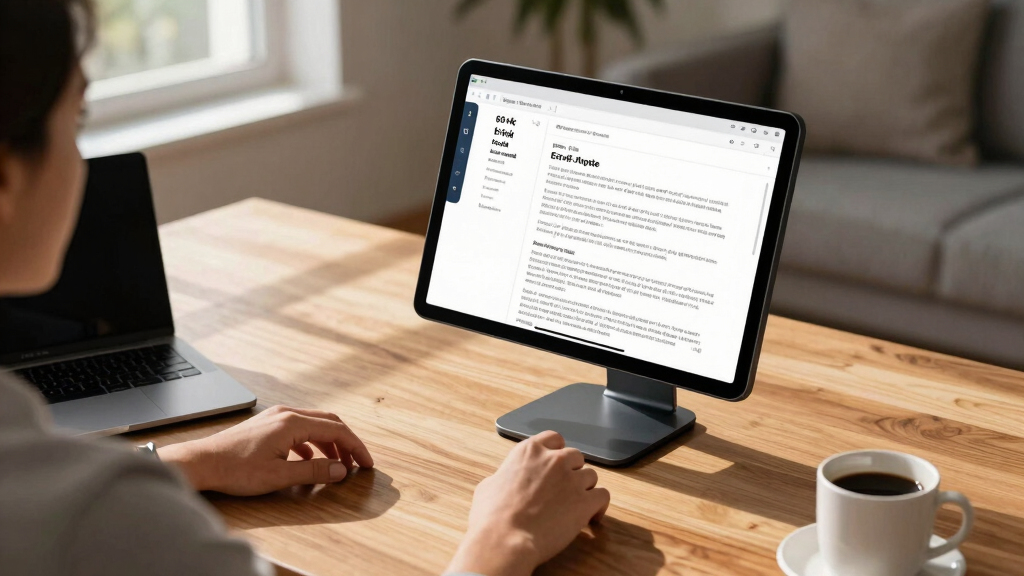
Hackaday reports the creation of a 13.3-inch E-ink monitor capable of a 60 Hz refresh rate, driven by a custom controller. This development challenges the long-held view that E-ink displays are too slow for computer use.
A new E-ink monitor with a 60 Hz refresh rate has been developed, marking a significant breakthrough in the technology’s capabilities. This advancement was achieved through a custom controller design, making E-ink displays viable for computer monitor applications for the first time. The development has been showcased at Hackaday Supercon 2024 and is now available for purchase in monochrome and color versions via Crowd Supply.
The breakthrough was led by an independent developer, who created a custom controller to overcome traditional limitations of E-ink displays. Unlike conventional E-ink screens, which are primarily designed for e-readers with low power and slow refresh rates, this new controller enables a 60 Hz refresh rate on a 13.3-inch display. This is a significant departure from the typical refresh rates of 1-2 seconds associated with standard E-ink screens.
The project originated from a desire to adapt E-ink for portable computing devices, such as laptops. Initial tests demonstrated that fast refresh rates were feasible, prompting further development and optimization. The developer emphasized that the perceived slowness of E-ink was mainly due to controller limitations rather than the technology itself. The new controller leverages more advanced interfaces and processing capabilities, allowing for smoother updates suitable for real-time use.
Following successful testing, the project was presented at Hackaday Supercon 2024, and a fully open-source, user-repairable 13.3-inch E-ink monitor called Modos Flow is now available for purchase. The device supports both monochrome and color displays and is intended for those interested in low-power, high-contrast screens for computing or reading. The development process involved extensive optimization to balance appearance, responsiveness, and power consumption, amidst challenges like vendor delays and technical hurdles.
Impact of 60 Hz E-Ink on Computing
This development challenges the long-standing assumption that E-ink displays are inherently too slow for dynamic use cases like computer monitors. Achieving a 60 Hz refresh rate opens possibilities for low-power, high-contrast screens in portable and embedded computing, potentially reducing energy consumption and eye strain compared to traditional LCDs. It also demonstrates that the perceived limitations of E-ink are primarily controller-based, which could lead to further innovations and broader adoption in various applications.
As an affiliate, we earn on qualifying purchases.
E-Ink’s Traditional Limitations and Recent Advances
E-ink displays have historically been used mainly for e-readers due to their low power consumption, high contrast, and readability in bright light. However, their slow refresh rates—often measured in seconds—have limited their use in interactive or real-time applications. The primary reason for this slow response has been attributed to the controller technology, which was optimized for static content rather than rapid updates.
Recent efforts, including this new development, have demonstrated that these limitations are not inherent to the display technology itself. Instead, they are largely due to controller design and interface constraints. The creation of a custom controller capable of supporting a 60 Hz refresh rate marks a turning point, showing that E-ink can be adapted for more dynamic uses, including monitors, portable devices, and other interactive applications.
“The perceived slowness of E-ink was mainly due to controller limitations rather than the technology itself.”
— an anonymous researcher
color E-ink display for computer
As an affiliate, we earn on qualifying purchases.
As an affiliate, we earn on qualifying purchases.
Remaining Technical and Market Uncertainties
It is not yet clear how the new controller performs in long-term use or under different environmental conditions. Details about power consumption, durability, and compatibility with various operating systems are still emerging. Additionally, whether this technology can be scaled commercially or integrated into mainstream products remains uncertain, as the project is currently limited to a niche market and open-source community testing.
As an affiliate, we earn on qualifying purchases.
Next Steps for Adoption and Development
Further testing and real-world trials are expected to assess the durability, power efficiency, and usability of the 60 Hz E-ink monitor. Manufacturers and developers may explore commercial partnerships or licensing opportunities to bring this technology into mainstream consumer products. Additionally, ongoing community development could refine the controller and expand compatibility, potentially leading to broader adoption in low-power computing and specialized display applications.
As an affiliate, we earn on qualifying purchases.
Key Questions
Can this E-ink monitor be used as a regular computer display?
Yes, the 60 Hz refresh rate makes it suitable for use as a computer monitor, although full compatibility with all systems and software is still being evaluated.
How does the power consumption compare to traditional LCD monitors?
E-ink displays generally consume less power, especially when static, but specific measurements for this new high-refresh-rate version are still pending.
Will this technology be available commercially soon?
The current project is open-source and available through Crowd Supply, but commercial adoption will depend on further development, scaling, and market interest.
Does the high refresh rate affect the display’s contrast or readability?
Initial tests indicate that the display maintains high contrast and readability, but more extensive evaluations are ongoing.
Is color support available in this new E-ink monitor?
Yes, both monochrome and color versions are offered, with the color model supported by the same custom controller technology.
Source: Hackaday
Fall Picks
fall essentials
As an affiliate, we earn on qualifying purchases.