
📊 Full opportunity report: Best Low-Noise PC Cases for Airflow and Sound Dampening on ThorstenMeyerAI.com — validation score, market gap, and execution plan.
TL;DR
This article reviews leading PC cases designed for optimal airflow and sound dampening in 2026. It highlights cases suited for high-power workstations, explaining the trade-offs involved.
Several high-performance PC cases optimized for airflow and sound dampening are now available in 2026, with choices tailored to different workloads and noise preferences. These cases are essential for builders seeking quiet operation without sacrificing cooling efficiency, especially in high-power AI or workstation setups.
The article reviews top PC cases such as the Fractal Design North, Meshify 3, Torrent, and Silent Base 802, highlighting their airflow features, noise dampening capabilities, and suitability for various workloads. It emphasizes that for sustained high loads, cases with open mesh panels and larger fans tend to be both cooler and quieter than sealed, foam-lined silent cases, contrary to common assumptions. The importance of large fans (140mm or 180mm) and unobstructed intake paths is stressed, as these elements enable efficient heat dissipation at lower noise levels. The article also notes that sound-dampening foam can reduce noise but may trap heat, making it less ideal for continuous high loads.Sources such as Thorsten Meyer and industry experts confirm that airflow-focused designs are often more effective for high-power workstations than sealed silent cases, especially when components generate heat continuously. The article provides specific case recommendations based on user priorities, including aesthetics, maximum airflow, silent operation, and value.
Best low-noise PC cases
for airflow & dampening.
Sound dampening and airflow pull in opposite directions — and for a sustained AI load, the choice lands somewhere most people don’t expect. Flip the toggle in Part 2 to see why a sealed “silent” case can end up louder than an open one.
Why Airflow and Noise Control Matter in 2026 PC Builds
Choosing the right PC case affects both thermal performance and noise levels, which are critical for high-performance workstations used in AI, content creation, or gaming. Proper airflow prevents overheating, prolongs component lifespan, and maintains system stability. Conversely, noise dampening enhances user comfort, especially in office or home environments. Understanding the trade-offs helps builders make informed decisions, ensuring their systems operate efficiently and quietly under sustained loads.
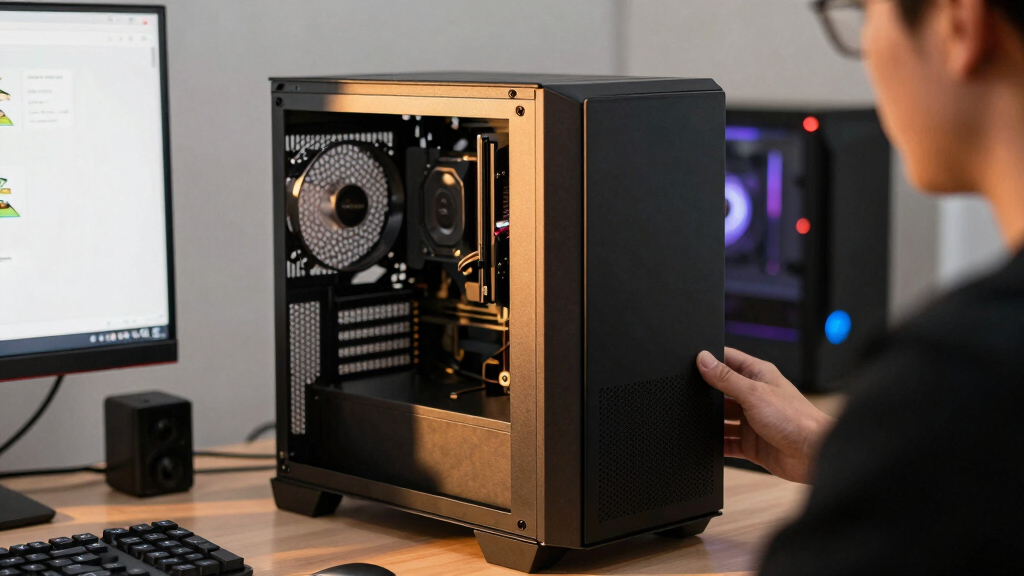
low noise PC case with high airflow
As an affiliate, we earn on qualifying purchases.
As an affiliate, we earn on qualifying purchases.
Current Trends in PC Case Design for High-Performance Builds
Over the past few years, PC case design has shifted from purely aesthetic or gaming-focused models to specialized cases that balance cooling and noise reduction. Industry insights from Thorsten Meyer highlight that traditional silent cases with foam-lined panels often underperform under continuous high loads, as they trap heat and force fans to run faster. Conversely, open mesh designs with large, slow-spinning fans are gaining popularity for their superior thermal management. This shift reflects the increasing demand for high-power workstations capable of sustained operation without thermal throttling or excessive noise.
"For high-power AI workstations, airflow often beats silence — a mesh case with larger fans can be both cooler and quieter than sealed silent cases under sustained loads."
— Thorsten Meyer
sound dampening PC case for workstation
As an affiliate, we earn on qualifying purchases.
As an affiliate, we earn on qualifying purchases.
Uncertainties in Case Selection for Specific Workloads
While general principles favor mesh cases for sustained high loads, the optimal choice can vary depending on specific components, ambient environment, and user preferences. The long-term effectiveness of sound-dampening foam in high-heat scenarios remains debated, and new case models may alter recommendations as technology evolves. Further testing under real-world workloads is needed to refine these insights.
large fan PC case for high performance
As an affiliate, we earn on qualifying purchases.
As an affiliate, we earn on qualifying purchases.
Future Developments in PC Case Design and Cooling Tech
Upcoming case models are expected to incorporate advanced airflow channels, hybrid silent designs, and smarter fan control systems. Manufacturers may also develop materials that better balance sound dampening and heat dissipation. Monitoring reviews and benchmarks in the coming months will help confirm whether these innovations improve on current standards for quiet, high-performance PCs.
As an affiliate, we earn on qualifying purchases.
Key Questions
Are mesh cases always better for high-power workloads?
Generally, yes. Mesh cases with large fans tend to provide better cooling and quieter operation under sustained loads, but specific needs may vary based on components and environment.
Can I get a silent case that still cools effectively?
Silent cases with foam-lined panels can reduce noise but may trap heat, making them less suitable for continuous high loads. They are better for moderate workloads or environments where noise reduction is a priority over maximum cooling.
What fan sizes are recommended for quiet, high-performance PCs?
Fans of 140mm or larger, such as 180mm, are recommended because they move more air at lower RPMs, reducing noise while maintaining cooling efficiency.
How important are dust filters in these cases?
Dust filters are important for maintaining long-term cleanliness and cooling performance, especially in open mesh designs that pull in more dust.
Source: ThorstenMeyerAI.com