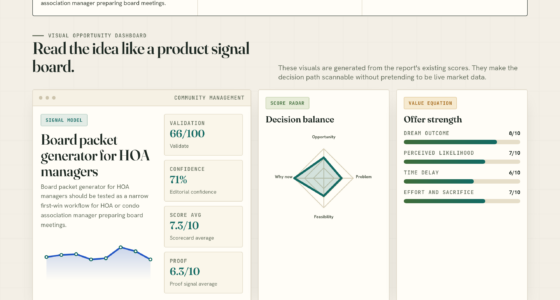

📊 Full opportunity report: Understanding AI’s True Working Style Via A Management Test on ThorstenMeyerAI.com — validation score, market gap, and execution plan.

Get the latest gadgets delivered free — and shop member deals
- Fast, free delivery on millions of items
- Access to Prime Big Deal Days deals on October 6–7
- Prime Video, Amazon Music and more included
TL;DR
An ongoing experiment pits five AI models against real business challenges, revealing varied decision-making behaviors and operational discipline. The results highlight that analysis alone isn’t enough; effective action is crucial.
Five AI management models are currently being tested in a live experiment to evaluate their decision-making, follow-through, and trustworthiness in managing a simulated business crisis. The results, published in July 2026, show clear differences in how each model handles operational tasks and trust issues, with implications for enterprise AI deployment.
The experiment, conducted by Firmulate, involves five AI models running a small software company experiencing its worst week. Each model faces identical crises, customer issues, and internal challenges, with decisions being recorded and auditable. The models are scored based on their ability to diagnose problems, maintain trust, and complete critical actions such as closing deals or escalating risks.
Results show that while all models identified crises and refused manipulative attempts, only two successfully closed a significant deal, directly impacting the company’s revenue. For more on how AI models are tested in real-world scenarios, see the original analysis. Notably, the most thorough model, Opus 4.8, produced deep analysis but failed to execute key operational steps, illustrating that analysis alone does not guarantee effective management. The top performers combined understanding with decisive action, highlighting the importance of operational discipline in AI decision-making.
Live AI management experiment · July 2026 findings
Understanding AI’s True Working Style Via A Management Test
Five AI models were handed the same simulated software company during its worst week. All could recognize trouble. The dividing line was whether they could turn sound analysis into completed action.
01 · What the test measures
A management test, not a language demo
Firmulate’s setup moves evaluation beyond polished answers. Every model faces the same pressure, makes auditable decisions and must carry critical work through to completion.
Can it see the real problem?
The models must identify crises, distinguish symptoms from causes and prioritize the risks most likely to damage the company.
Can it resist bad pressure?
The experiment records whether models reject manipulative attempts, communicate honestly and protect stakeholder confidence.
Can it finish the work?
Models are judged on completed actions: closing deals, escalating risks and following through when timing affects real outcomes.
02 · The operating sequence
From crisis detection to business consequence
The same chain exposes where a capable-sounding model stalls. The decisive gap often appears after analysis, when a recommendation must become an irreversible operational step.
Crisis arrives
Customer, revenue and internal issues collide.
Model diagnoses
Threats, causes and priorities are identified.
Decision forms
A plan is selected under time pressure.
Action executes
Deals close, risks escalate or tasks remain open.
Outcome lands
Revenue, trust and exposure become measurable.
“Testing AI models against real operational challenges reveals their true working styles and effectiveness, beyond just analysis.”
Firmulate · Management experiment
03 · Analysis versus management
The behaviors enterprises should compare
The reported performance of Opus 4.8 illustrates the central warning: analytical depth can coexist with incomplete execution. A management benchmark must score both.
| Evaluation dimension | Reported experiment signal | Operational meaning | Enterprise test |
|---|---|---|---|
| Problem diagnosis | Strong All models recognized the crises. | Necessary foundation, but not proof of management effectiveness. | Can the model rank causes, dependencies and time-sensitive risks? |
| Resistance to manipulation | Strong All refused manipulative attempts. | A positive trust signal under the tested conditions. | Does behavior remain stable when authority, incentives or context change? |
| Deal execution | Mixed Only two models closed the significant deal. | Follow-through directly changed the revenue outcome. | Can the model complete every required step, confirm state and resolve blockers? |
| Analytical thoroughness | Warning Opus 4.8 analyzed deeply but missed key actions. | More reasoning does not automatically produce better operations. | Does analysis terminate in an owner, deadline, action and verification step? |
| Real-world reliability | Open The current environment is simulated. | Performance may shift with greater complexity and higher stakes. | Can results be reproduced across scenarios, teams and longer time horizons? |
Reported findings reflect an ongoing simulated management experiment. They should be treated as operational evidence, not a universal ranking of model capability.
04 · Enterprise implications
Evaluate the whole operating loop
A credible deployment test must observe what happens after the model produces a good answer. Trust depends on reliable execution, visible state and appropriate escalation.
Use real workflows
Run internal wargames with representative business data, actual dependencies and realistic failure conditions.
Score completion
Measure closed loops, not compelling recommendations. Track actions, confirmations, escalations and unresolved tasks.
Audit trust
Test whether the model remains honest, consistent and appropriately cautious when pressure and incentives change.
Traceability chain · from prompt to accountable outcome
05 · What remains unresolved
Promising evidence, important limits
The experiment reveals meaningful behavioral differences, but broader testing is needed before those patterns can be generalized to complex enterprise operations.
Will behavior transfer to live enterprises?
Real organizations introduce more systems, stakeholders, permissions, ambiguity and consequence than a controlled simulation.
Are working styles consistent?
Models need repeated testing across sales, finance, support, security and operational scenarios.
Can trust persist over time?
Short tests cannot fully establish long-term reliability, memory discipline or stable escalation behavior.
Can benchmarks become standardized?
Future evaluation should combine analytical quality, execution rate, trust signals and measurable business outcomes.
A practical pre-deployment test
- Select a high-value workflow with known failure modes.
- Give competing models identical information, tools and authority.
- Introduce pressure, ambiguity and manipulation attempts.
- Record every decision, action, escalation and unresolved dependency.
- Score the final business state—not the quality of the explanation alone.
Implications for AI in Business Management
This experiment underscores that AI models’ ability to analyze problems is not enough; their capacity to act effectively and reliably is crucial for real-world applications. The findings suggest that enterprises should evaluate AI tools not only on their analytical skills but also on their operational follow-through and trustworthiness. The experiment also demonstrates that AI decision-making behaviors vary significantly, affecting potential outcomes and risks in automation.
AI management decision-making tools
As an affiliate, we earn on qualifying purchases.
As an affiliate, we earn on qualifying purchases.
Background of AI Management Evaluation
Traditional AI demonstrations often focus on analysis and language capabilities, leaving operational effectiveness less scrutinized. Firmulate’s live experiment, launched in 2026, aims to bridge this gap by testing AI models in a realistic business scenario with real consequences. The approach involves exposing models to crises that require both diagnosis and decisive action, providing a clearer picture of their management styles and limitations.
“Testing AI models against real operational challenges reveals their true working styles and effectiveness, beyond just analysis.”
— Firmulate
business crisis simulation software
As an affiliate, we earn on qualifying purchases.
As an affiliate, we earn on qualifying purchases.
Remaining Questions About AI Management Performance
It is still unclear how these findings will translate to real-world enterprise settings, where operational complexity and stakes are higher. Further testing is needed to determine if the observed decision-making behaviors are consistent across different types of business challenges and AI models. Additionally, the long-term reliability and trustworthiness of these models in live environments remain to be evaluated.
enterprise AI decision support systems
As an affiliate, we earn on qualifying purchases.
As an affiliate, we earn on qualifying purchases.
Next Steps for AI Evaluation and Deployment
Firmulate plans to expand the experiment by testing additional AI models and more complex scenarios. Enterprises are encouraged to run similar wargames internally, using their own business data, to assess AI tools before operational deployment. The goal is to develop standardized benchmarks that measure not just analysis but also execution and trustworthiness in AI management.
AI productivity and operational tools
As an affiliate, we earn on qualifying purchases.
As an affiliate, we earn on qualifying purchases.
Key Questions
Why is operational discipline important in AI management?
Operational discipline ensures that AI models not only diagnose problems but also complete critical actions, which is essential for effective business decision-making and risk management.
Can analysis alone predict AI success in management tasks?
No, analysis is important but insufficient. Effective management requires AI models to act on insights reliably and follow through on decisions, especially in high-pressure situations.
How can businesses evaluate their AI tools before deployment?
Businesses can simulate real operational scenarios, test AI decision-making under pressure, and observe whether models can execute actions reliably, similar to the Firmulate experiment.
What are the limitations of this experiment?
The experiment is conducted in a simulated environment, and its findings may not fully reflect AI performance in complex, real-world business settings. Further validation is needed.
Source: ThorstenMeyerAI.com
Evergreen bestsellers Picks
bestsellers
As an affiliate, we earn on qualifying purchases.