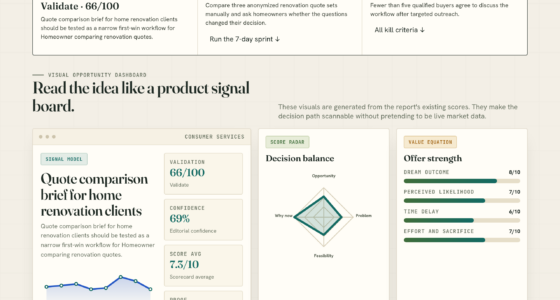

📊 Full opportunity report: When One Agent Isn’t Enough: Claude Now Builds Its Own Team Of Agents On The Fly on ThorstenMeyerAI.com — validation score, market gap, and execution plan.

Get the latest gadgets delivered free with Prime
- Fast, free delivery on millions of items
- Prime Video, Amazon Music and more included
- Member-only deals all year
TL;DR
Claude has launched a new feature called dynamic workflows, enabling it to create and orchestrate multiple sub-agents for complex tasks. This allows the AI to perform high-value, multi-step projects more effectively by simulating a team. The development marks a significant step in autonomous AI orchestration, but it is currently limited to complex, resource-intensive tasks.
Anthropic’s Claude has introduced a new capability called ‘dynamic workflows,’ allowing the AI to autonomously assemble and manage a team of sub-agents tailored to specific complex tasks. This development enhances Claude’s ability to handle high-value projects that involve multiple steps or require specialized skills, marking a significant advance in AI orchestration technology.
The feature, detailed by Thorsten Meyer on his website, enables Claude to generate small JavaScript programs that orchestrate multiple sub-agents, each with a dedicated goal and context window. These sub-agents can operate in isolation, with the system deciding which model to deploy for each task, and can pause and resume as needed. This approach addresses common issues faced by single-agent workflows, such as partial work, bias, and goal drift, by dividing tasks into focused, independent components.
According to the source, this capability is especially useful for complex, high-value tasks like code refactoring, research synthesis, and detailed verification processes. It is built to handle tasks that are too demanding or nuanced for a single agent, using techniques like classify-and-act, fan-out-and-synthesize, adversarial verification, and tournament-style comparisons. The system can also adapt dynamically, creating tailored workflows for each job, which is a departure from static, hand-crafted automation.
Anthropic emphasizes that this feature is resource-intensive, using more tokens and computational power, and is meant for tasks where the benefits outweigh these costs. The company cautions that it is not suitable for simple or low-stakes activities, such as fixing typos. The rollout is currently in the early stages of deployment, with broader adoption expected as the technology matures.
When one agent isn’t enough: Claude now builds its own team on the fly
Skills package what you know; loops decide how far you delegate over time. Dynamic workflows are the third axis — within a single task, Claude writes its own harness and assembles a temporary team of subagents. Think of it as Claude drawing an org chart for one job.
The shift is from prompting a worker to commissioning a team — more output, more cost, and a manager’s judgment required. Reach for a workflow when a task is big, parallel, adversarial, or judgment-heavy — and when you can feel a single agent getting lazy, grading its own homework, or losing the plot. Bound it (token budgets, pilot first) — workflows can spawn hundreds of agents and burn far more tokens. For everything else, don’t hire five people to change a lightbulb.
Implications of Autonomous Agent Team Construction
This development represents a major shift in how AI systems can manage complex projects autonomously, resembling a human team lead orchestrating specialists. It improves the reliability and depth of AI-driven work, especially in environments requiring multi-step reasoning, verification, or parallel processing. For businesses, this could mean more scalable and accurate AI solutions for research, development, and operational workflows.
However, the increased resource demands and complexity raise questions about cost, control, and safety. The ability for Claude to generate and manage its own team introduces new layers of autonomy that need careful oversight, especially in sensitive or mission-critical applications. Overall, this feature pushes AI capabilities closer to autonomous, multi-agent systems capable of handling sophisticated, high-stakes tasks.
As an affiliate, we earn on qualifying purchases.
Evolution of Multi-Agent AI Capabilities
Claude’s dynamic workflows build on previous advancements in AI orchestration, including static multi-agent setups and manual SDK-based configurations. The concept of dividing tasks into specialized agents is not new, but the ability for Claude to generate and adapt these workflows on the fly marks a significant technological leap. This follows earlier efforts to improve AI reasoning, planning, and verification, culminating in a system that mimics human team management more closely.
Prior to this, AI models typically operated within a single context window, limiting their ability to handle complex, multi-faceted projects. The new feature addresses these limitations by enabling the AI to simulate a team environment internally, thus expanding the scope and depth of tasks it can undertake autonomously. The development aligns with broader trends toward more autonomous AI systems capable of self-organization and dynamic task management.
“Claude now writes and runs small JavaScript programs that orchestrate multiple sub-agents, each with a dedicated purpose, enabling complex workflows.”
— Thorsten Meyer
As an affiliate, we earn on qualifying purchases.
Limitations and Risks of Autonomous Workflow Generation
It is not yet clear how broadly this feature will be adopted across different industries or use cases. The current deployment is limited to high-value, resource-intensive tasks, and it remains to be seen how well it performs in real-world, unpredictable environments. Concerns about cost, safety, and control persist, especially regarding the AI’s ability to self-manage complex workflows without human oversight.
Additionally, the long-term implications of AI managing its own teams—such as potential errors, unintended goal drift, or misuse—are still under assessment. The company has issued caveats about the resource demands and the suitability of this feature only for specific, high-stakes applications.
AI automation for complex projects
As an affiliate, we earn on qualifying purchases.
As an affiliate, we earn on qualifying purchases.
Next Steps for Deployment and Oversight
Anthropic is expected to expand the rollout of dynamic workflows gradually, gathering user feedback and performance data. Future updates may include more refined control mechanisms, safety features, and broader integration options. Researchers and clients will closely monitor how well Claude manages complex projects in live settings, especially regarding safety and resource efficiency.
Further development may also explore automating workflow customization further, allowing users to define higher-level goals that Claude translates into tailored agent teams automatically. The company has indicated ongoing efforts to balance autonomy with oversight, ensuring responsible deployment of this advanced capability.
As an affiliate, we earn on qualifying purchases.
Key Questions
How does Claude build its own team of agents?
Claude generates small JavaScript programs, called workflows, that spawn and coordinate multiple sub-agents, each with a specific task or focus, to handle complex projects more effectively.
What types of tasks benefit most from dynamic workflows?
High-value, multi-step projects such as research synthesis, code refactoring, verification routines, and support ticket ranking are prime candidates for this feature.
Is this feature suitable for everyday or low-stakes tasks?
No, Anthropic advises that dynamic workflows are resource-intensive and not intended for simple activities like fixing typos or quick queries.
What are the main risks associated with this technology?
Potential risks include high resource costs, safety concerns related to autonomous decision-making, and the possibility of goal drift or errors in complex workflows.
Source: ThorstenMeyerAI.com
Fall Picks
fall essentials
As an affiliate, we earn on qualifying purchases.