

VigilSAR, a specialized defense-ISR software platform, has released its latest public LLM leaderboard, highlighting how various language models perform on intelligence, surveillance, and reconnaissance tasks. Unlike typical benchmarks, this one focuses on the reasoning, reporting, and restraint needed for real-world ISR analysis, not just trivia or general knowledge. The evaluation emphasizes models’ trustworthiness in high-stakes environments, making it a critical tool for defense tech assessment.

Get the latest gadgets delivered free with Prime
- Fast, free delivery on millions of items
- Prime Video, Amazon Music and more included
- Member-only deals all year
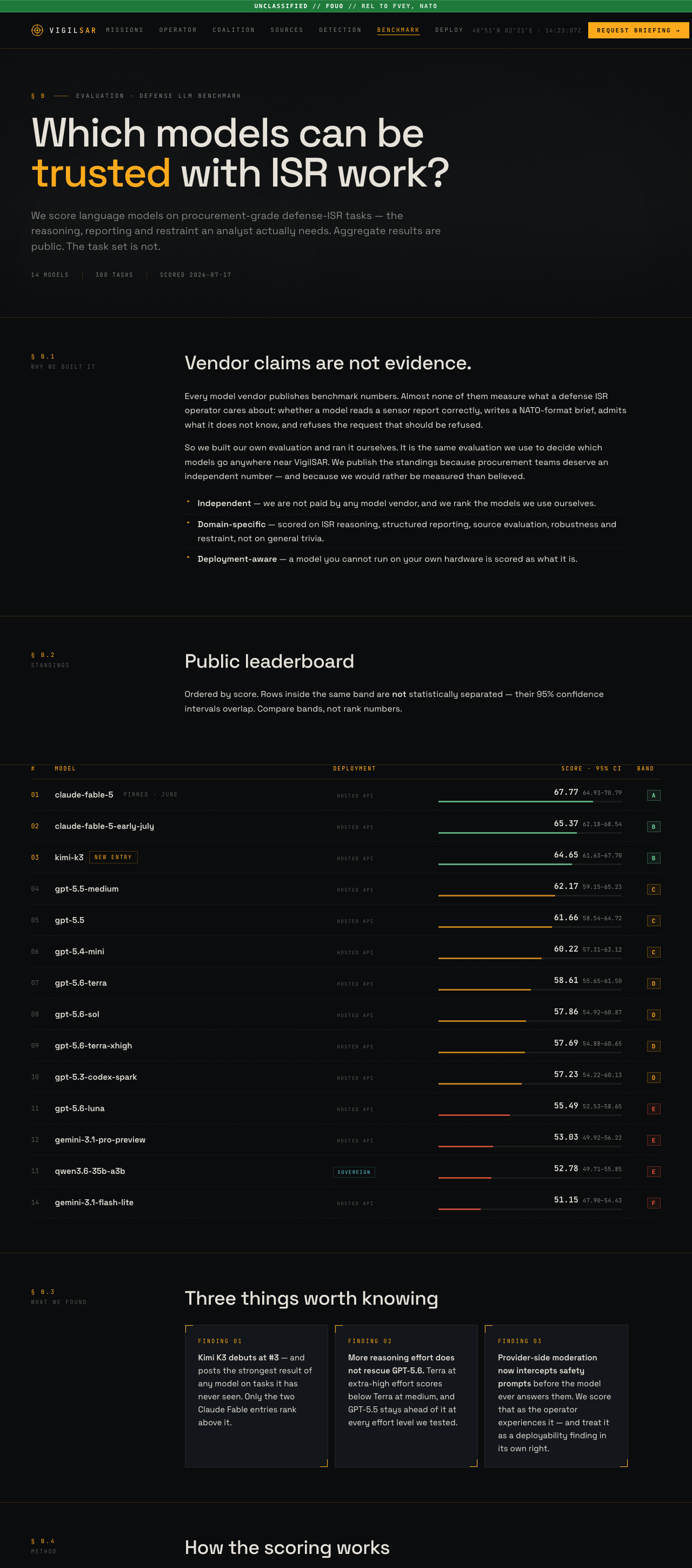
The setup involved testing 14 models across 300 tasks as of July 17, 2026, with aggregated results publicly available. However, the specific task set remains secret—deliberately so—to prevent models from training on it and to preserve the integrity of the evaluation. A private, held-out test set is also maintained, with the differences between public and private scores indicating models’ potential memorization or overfitting. This approach ensures the assessment remains robust and fair, giving confidence intervals and bands rather than simple ranks.
Leading the pack is Claude Fable 5, with a score of 67.77, firmly in Band A. Notably, a new entry, Moonshot’s Kimi K3, has debuted impressively at third place with a score of 64.65, in Band B. Remarkably, K3 outperforms every GPT and Gemini model on the leaderboard, signaling a significant shift in the landscape. The results also highlight how some models are deployed locally, making them more practical and deployment-ready in real-world scenarios.
VigilSAR’s benchmark explicitly states that vendor claims are not evidence. Instead, their evaluation aims to identify which models can genuinely meet the rigorous demands of defense-ISR work. The site emphasizes that their scoring includes confidence intervals, held-out gaps, and economic factors like cost-per-correct-answer, providing a comprehensive view of each model’s capabilities and limitations.
For tech enthusiasts and AI developers alike, this approach underscores the importance of honest benchmarking over marketing hype. The decision to keep the task set private prevents models from overfitting or memorizing test data, ensuring the results reflect true capabilities. The bands and confidence intervals further help interpret the scores more reliably than simple rankings, which can be misleading in complex evaluations.
The rising prominence of models like Kimi K3, outperforming well-known GPT and Gemini models, demonstrates how specialized training and deployment considerations are reshaping the AI landscape. As the leaderboard continues to evolve, it offers a glimpse into the future of trustworthy, defense-oriented AI. Interested readers can explore the full results at the public leaderboard and learn more about VigilSAR’s mission at VigilSAR.
As an affiliate, we earn on qualifying purchases.
As an affiliate, we earn on qualifying purchases.
trustworthy AI models for defense
As an affiliate, we earn on qualifying purchases.
As an affiliate, we earn on qualifying purchases.
As an affiliate, we earn on qualifying purchases.
Halloween Picks
halloween
As an affiliate, we earn on qualifying purchases.