
TL;DR

Get the latest gadgets delivered free with Prime
- Fast, free delivery on millions of items
- Prime Video, Amazon Music and more included
- Member-only deals all year
After two weeks with Tesla’s Hardware 4 and FSD V14, a Tesla owner shares detailed experiences and observations. The new system shows significant improvements but still faces limitations. This development impacts future autonomous driving expectations.
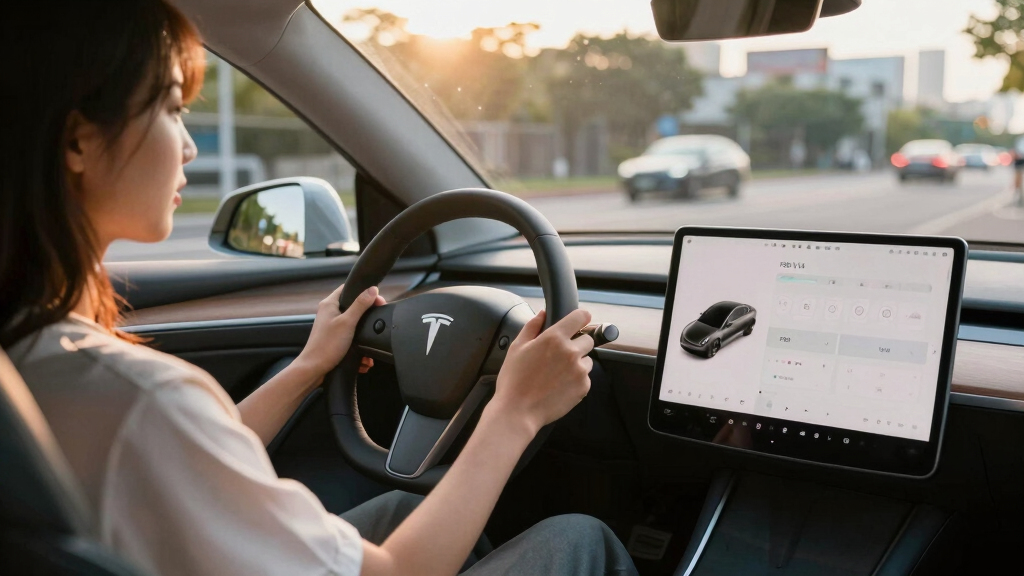
A Tesla owner has completed a two-week evaluation of the company’s latest hardware and software in a 2026 Model Y, revealing notable advances in self-driving capabilities and persistent limitations.
The owner, Fritz Hasler, upgraded from an older Tesla with Hardware 3 to a new Model Y equipped with Hardware 4 and FSD V14. During this period, he observed that FSD V14 can autonomously handle complex tasks such as leaving the garage, navigating parking lots, and driving on public roads with minimal intervention, often accurately following routes with limited corrections.
Confirmed features include the system’s ability to track driving time, handle different speed modes (Sloth, Chill, Standard, Hurry, Mad Max), and manage both starting and ending trips, including parking. Notably, FSD V14 works with bikes on racks, a previous limitation of earlier versions. However, the owner reports ongoing issues, such as GPS inaccuracies, misnavigation at addresses, difficulty finding parking at certain locations, and occasional lane choice errors at intersections.
The owner notes that Tesla’s navigation relies heavily on Google Maps, which can be outdated or inaccurate, leading to misdirected routes. Despite these issues, the overall impression is that FSD V14 demonstrates significant progress but is not yet fully reliable for all scenarios.
Implications of FSD V14’s Real-World Performance
This firsthand account highlights the tangible advancements Tesla has made in autonomous driving technology, indicating a step toward more reliable and capable self-driving systems. The improvements could influence consumer confidence, regulatory discussions, and Tesla’s future software updates. However, the persistent limitations underscore that full autonomy remains a work in progress, with safety and accuracy still requiring refinement.
Tesla Model Y Hardware 4 upgrade kit
As an affiliate, we earn on qualifying purchases.
As an affiliate, we earn on qualifying purchases.
Development Timeline of Tesla’s Autopilot and FSD
Since Tesla introduced Autopilot in 2014, the company has progressively enhanced its self-driving capabilities through hardware and software updates. Hardware 3 was introduced in 2019, followed by Hardware 4 in 2023, which features a more powerful computer and upgraded cameras. FSD V14 was released in 2025 exclusively for HW4 vehicles, promising significant improvements over previous versions. Despite Elon Musk’s repeated promises of achieving Level 4 autonomy, full self-driving has yet to reach that threshold, with ongoing beta testing and incremental improvements.
The owner’s experience reflects Tesla’s recent focus on refining FSD V14, which aims to deliver more accurate and safer autonomous driving, though challenges remain, especially in complex urban environments and with navigation accuracy.
“FSD V14 can handle most driving tasks with minimal intervention, but GPS inaccuracies still cause occasional misnavigation.”
— Fritz Hasler
Tesla FSD V14 compatible accessories
As an affiliate, we earn on qualifying purchases.
As an affiliate, we earn on qualifying purchases.
Remaining Challenges and Unresolved Issues in FSD V14
While the owner reports significant improvements, questions remain about FSD V14’s reliability in complex urban environments, its ability to correctly interpret all road markings, and its performance in areas with outdated or inaccurate map data. It is not yet clear how widespread these issues are or how Tesla plans to address them in future updates.
Tesla GPS navigation enhancement devices
As an affiliate, we earn on qualifying purchases.
As an affiliate, we earn on qualifying purchases.
Next Steps for Tesla’s FSD Development and Deployment
Tesla is expected to continue refining FSD V14 through software updates, addressing navigation inaccuracies and lane decision errors. Public beta testing may expand to more users, and Tesla could introduce additional features or modes to enhance safety and usability. Monitoring real-world performance and collecting user feedback will be critical in moving toward higher levels of autonomy.
Tesla self-driving safety monitor
As an affiliate, we earn on qualifying purchases.
As an affiliate, we earn on qualifying purchases.
Key Questions
How reliable is FSD V14 in everyday driving?
Based on the owner’s experience, FSD V14 performs well in many scenarios but still encounters navigation errors, especially with address accuracy and parking at certain locations. It requires active supervision.
Can FSD V14 handle complex urban environments?
The owner reports that while FSD V14 can manage many urban driving tasks, issues like lane choices at intersections and outdated map data can cause errors, indicating room for improvement.
Does FSD V14 work with all vehicle setups?
FSD V14 is currently available only for vehicles equipped with Hardware 4. It works with bikes on racks, a notable improvement over previous versions.
What are the main limitations of FSD V14 right now?
Major limitations include GPS inaccuracies, map data issues, occasional lane choice errors, and incomplete urban navigation capabilities.
What is Tesla’s plan for achieving full self-driving?
Tesla continues to develop and refine FSD, with incremental software updates. Full Level 4 autonomy remains a goal, but it is not yet available, and regulatory and safety challenges persist.
Source: CleanTechnica
Halloween Picks
halloween
As an affiliate, we earn on qualifying purchases.