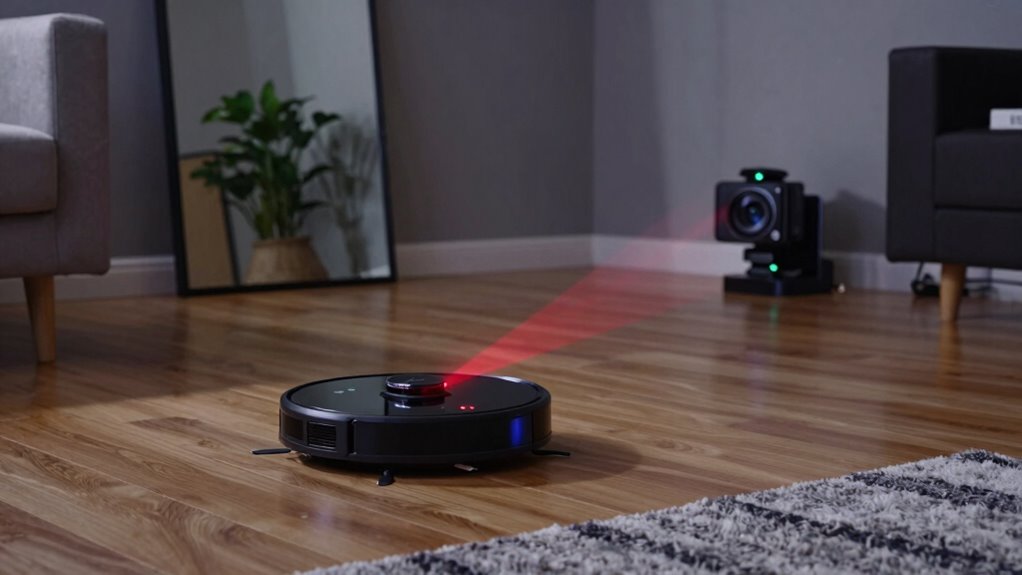

If you’re choosing a robot vacuum, LiDAR offers precise 3D mapping and reliable obstacle detection, especially in low-light or cluttered spaces. Cameras capture visual details and textures, but their performance drops in poor lighting. LiDAR navigation tends to be more accurate and consistent, whereas camera-based systems are more affordable and easier to set up. To discover which system best suits your home and cleaning needs, explore the differences further below.

Get the latest gadgets delivered free with Prime
- Fast, free delivery on millions of items
- Prime Video, Amazon Music and more included
- Member-only deals all year
Key Takeaways
- LiDAR provides highly accurate 3D mapping unaffected by lighting, ideal for complex or cluttered home environments.
- Camera mapping relies on visual data, which is sensitive to lighting conditions, affecting navigation precision.
- LiDAR excels in obstacle detection and consistent performance in low-light or dark settings.
- Camera systems are more affordable and easier to install but may struggle with environmental variability.
- Combining LiDAR and camera data enhances overall navigation accuracy and obstacle avoidance capabilities.
robot vacuum with LiDAR navigation
As an affiliate, we earn on qualifying purchases.
As an affiliate, we earn on qualifying purchases.
How Do LiDAR and Camera Mapping Work in Robot Vacuums?
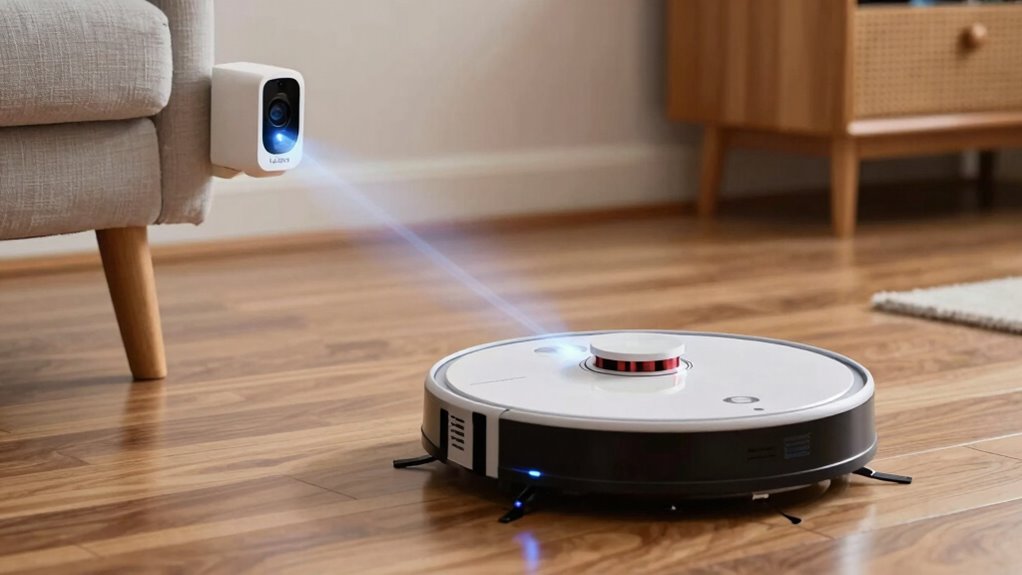
LiDAR and camera mapping are essential technologies that help robot vacuums navigate efficiently. You’ll find these systems rely on robot vacuum sensors to gather environmental data. LiDAR uses laser pulses to create a detailed 3D map of your space, scanning surroundings in real-time. Meanwhile, camera mapping captures visual information, allowing the robot to recognize objects and landmarks. Both methods feed data into navigation algorithms, which process the information to determine the best route. These algorithms interpret sensor inputs to avoid obstacles, optimize cleaning paths, and adapt as the environment changes. By combining precise sensor data with advanced navigation algorithms, robot vacuums can navigate more accurately and efficiently, reducing missed spots and collisions. This seamless integration enhances your vacuum’s overall performance.
As an affiliate, we earn on qualifying purchases.
Benefits of LiDAR Navigation in Robot Vacuums
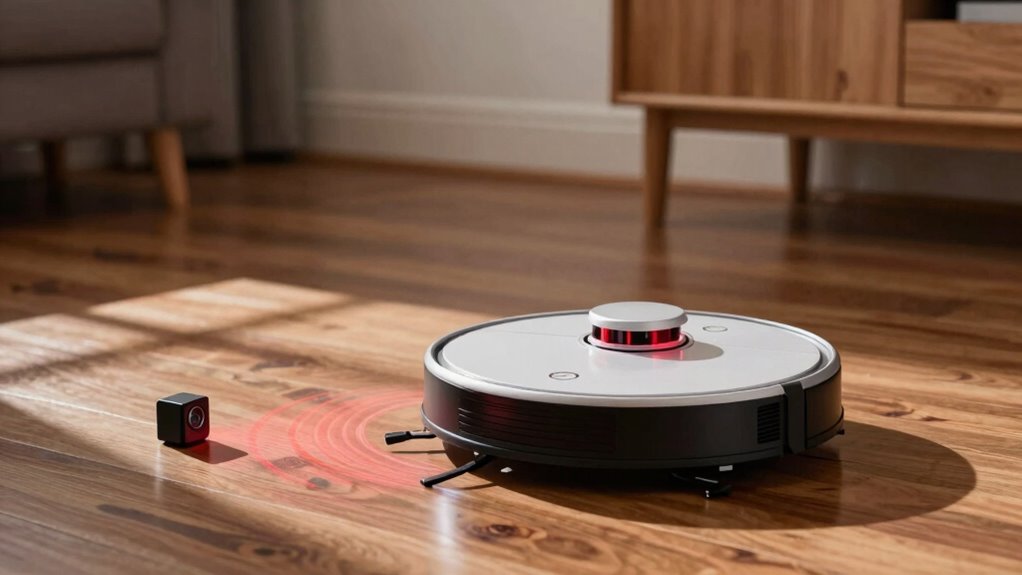
LiDAR navigation offers your robot vacuum superior mapping accuracy, helping it plan the most efficient cleaning routes. It also improves obstacle detection, so your vacuum can avoid furniture and hazards more effectively. With these benefits, you can count on consistent, thorough cleaning every time. Additionally, incorporating advanced mapping technology can further optimize coverage and performance. As a result, LiDAR systems are increasingly regarded as a reliable solution for precise navigation in robotic vacuums. Understanding divorce coping strategies can also help homeowners manage stress and maintain a healthy environment while caring for their space. In regions with unique regional flavors, this technology can adapt to diverse layouts, ensuring thorough cleaning in various home styles. Incorporating landscaping principles can also help design spaces that enhance the effectiveness of navigation systems.
Superior Mapping Accuracy
Because precise mapping is essential for efficient cleaning, robot vacuums with advanced navigation systems deliver considerably better performance. LiDAR technology provides superior mapping accuracy, capturing detailed 3D representations of your space. This high level of mapping precision ensures the vacuum understands room layouts accurately, reducing missed spots and redundant cleaning. Unlike camera-based systems, LiDAR isn’t affected by lighting conditions, maintaining consistent navigation accuracy day or night. You’ll notice smoother, more systematic cleaning paths that adapt seamlessly to complex floor plans. This improved navigation accuracy means fewer errors, less need for manual intervention, and a more thorough clean. Overall, LiDAR’s ability to create precise maps makes your robot vacuum more effective, saving you time and effort while ensuring your entire home gets the attention it needs. Water-cooled mattress pads and dehumidifiers are other examples of innovative technology designed to improve comfort and efficiency in home environments. Additionally, the technology’s resilience to extreme weather conditions ensures reliable operation regardless of environmental challenges, much like how hormesis in herbal wellness promotes resilience and adaptation in the body.
Enhanced Obstacle Detection
Thanks to the precise maps created by advanced navigation systems, robot vacuums can now detect obstacles more effectively. LiDAR sensors provide accurate distance measurements, allowing your vacuum to identify objects with high precision. Proper sensor calibration guarantees consistent obstacle detection, reducing missed items or false alarms. Regular software updates enhance obstacle recognition algorithms, adapting to new environments and types of clutter. These updates optimize sensor performance and improve navigation responses. As a result, your robot can better avoid furniture, cords, and pets, even in complex or cluttered spaces. sensor calibration ensures consistent and reliable obstacle detection over time. Additionally, LiDAR accuracy plays a crucial role in maintaining precise mapping and navigation. For example, side-channel attacks can potentially disrupt sensor data, so securing your device against such threats is important for reliable operation. Incorporating environmental awareness further enhances the robot’s ability to adapt to changing surroundings, making cleaning more efficient and thorough. Overall, these features contribute to smarter, safer, and more reliable cleaning sessions.
Consistent Cleaning Performance
With its precise mapping capabilities, LiDAR navigation enables your robot vacuum to maintain a steady and reliable cleaning performance across various environments. By leveraging advanced navigation algorithms, it adapts seamlessly to different floor types and room layouts, ensuring thorough coverage. This consistency boosts robotic efficiency, reducing missed spots and repeated passes. To visualize, consider this table:
| Room Type | Performance with LiDAR | Coverage Consistency |
|---|---|---|
| Hardwood | Excellent | High |
| Carpet | Reliable | Very High |
| Tile | Precise | Consistent |
| Rugs | Adaptable | Steady |
| Narrow Spaces | Accurate | Uniform |
LiDAR’s dependable navigation ensures your vacuum performs at its best, regardless of environment changes. Additionally, its mapping accuracy minimizes the need for manual adjustments or reprogramming, which is crucial for maintaining consistent cleaning performance over time.
best robot vacuum for cluttered homes
As an affiliate, we earn on qualifying purchases.
As an affiliate, we earn on qualifying purchases.
Why Choose Camera-Based Navigation for Your Robot Vacuum?
Ever wondered what sets some robot vacuums apart from others? Camera-based navigation offers distinct advantages, especially for dynamic households. It provides precise mapping, enabling your vacuum to adapt to changes like rearranged furniture or a robotic pet moving around. This technology also helps maintain accurate cleaning schedules, ensuring your home gets cleaned efficiently. Consider these benefits:
Camera navigation ensures precise mapping, adaptive cleaning, and efficient schedules for a smarter, more responsive vacuum experience.
- Better obstacle detection and avoidance, reducing missed spots.
- Enhanced room recognition for targeted cleaning.
- Improved adaptability to household changes, like new furniture or robotic pets.
- The ability to utilize visual mapping for more detailed and accurate navigation. Additionally, integrating requirements traceability can help manufacturers ensure their products meet strict standards, such as FedRAMP compliance, for quality and security. Incorporating sensor calibration can further enhance the robot’s precision in navigating complex environments. Moreover, implementing real-time data processing allows for immediate adjustments during cleaning, increasing overall efficiency.
If you want a vacuum that learns your home’s layout and adjusts its path accordingly, camera navigation is a smart choice. It offers a higher level of control and customization, making cleaning more effective and less disruptive to your daily routine.
robot vacuum obstacle detection sensors
As an affiliate, we earn on qualifying purchases.
As an affiliate, we earn on qualifying purchases.
How Do Lighting Conditions Impact LiDAR and Camera Performance?
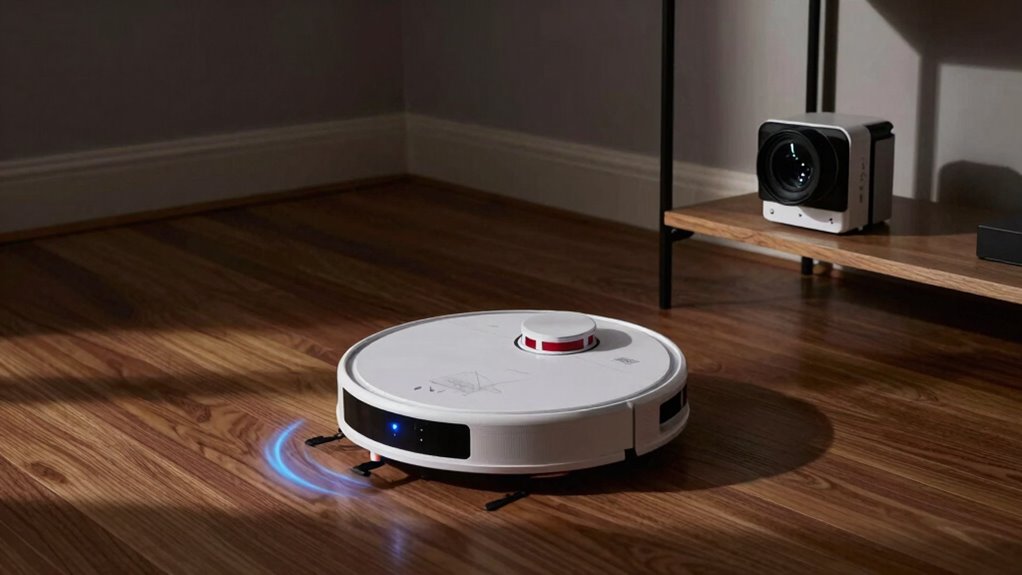
Lighting conditions can considerably affect how your robot vacuum’s sensors perform. LiDAR works well in various lighting, as it doesn’t rely on ambient light, but cameras can struggle in low or overly bright environments. Understanding these differences helps you choose the right navigation system for your home’s lighting.
LiDAR’s Lighting Independence
Have you ever wondered how different lighting conditions affect a robot vacuum’s sensors? LiDAR’s lighting independence means it isn’t impacted by ambient light, maintaining consistent Lidar accuracy regardless of whether it’s day or night. Unlike cameras, LiDAR uses laser pulses to measure distances, so external lighting doesn’t interfere. However, some factors can influence performance:
- Dust or fog can scatter laser signals, reducing accuracy.
- Reflective surfaces may cause false readings.
- Proper camera calibration isn’t necessary, unlike with cameras, which rely on light conditions for accurate image capture.
- Environmental conditions such as atmospheric interference can affect laser signal quality and accuracy.
- The sensor technology in LiDAR systems is designed to operate effectively across a wide range of environmental conditions, enhancing reliability.
- The integration of advanced signal processing further improves LiDAR’s resilience against environmental challenges.
- Additionally, ongoing technological advancements continue to enhance the robustness of LiDAR systems in various environments.
- These innovations ensure that LiDAR remains a dependable navigation tool, even in challenging conditions.
This makes LiDAR a reliable choice for consistent navigation. Its independence from lighting variations ensures precise mapping and obstacle detection, even in total darkness.
Camera Sensitivity to Light
While LiDAR remains unaffected by ambient light, cameras depend heavily on lighting conditions to function properly. Poor lighting can cause images to be underexposed or overexposed, impacting the vacuum’s ability to accurately recognize obstacles and map surroundings. Bright lighting, especially direct sunlight, can create glare and shadows, confusing camera sensors and requiring careful sensor calibration. Conversely, low-light environments may lead to grainy images and reduced detail, hampering navigation. To mitigate these issues, manufacturers often adjust camera settings or incorporate infrared sensors. Proper sensor calibration becomes essential to optimize camera performance across different lighting conditions. Understanding how lighting impacts camera sensitivity helps you select a system that maintains reliability and accuracy, regardless of the ambient light environment. Additionally, awareness of credit card security measures can inform users about data protection during online interactions.
Variable Performance Conditions
Different environmental lighting conditions can significantly influence how LiDAR and camera sensors perform on a robot vacuum. Variations in light impact navigation challenges and sensor reliability. For example:
- Bright sunlight can cause glare, reducing camera clarity and making visual navigation difficult.
- Low-light or dark environments hinder camera sensors but minimally affect LiDAR, which relies on laser signals.
- Sudden lighting changes, like moving between rooms with different illumination, can disrupt camera-based mapping but leave LiDAR performance stable.
Understanding these factors helps you anticipate sensor limitations. While cameras excel in well-lit conditions, LiDAR provides consistent performance regardless of lighting. Recognizing how environmental variables affect robot vacuum sensors ensures better navigation and cleaning efficiency.
Comparing Performance: LiDAR vs Camera in Home Environments
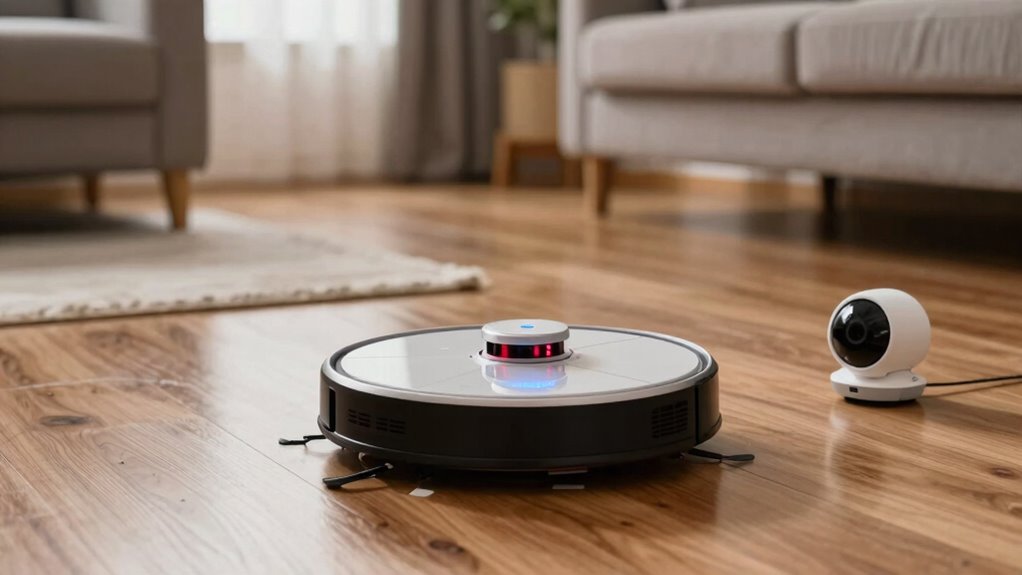
When it comes to steering home environments, LiDAR and camera-based systems each offer distinct advantages and challenges. LiDAR generally provides better robot vacuum efficiency by quickly creating accurate 3D maps, even in low-light conditions. Its precise spatial data enhances navigation system integration, reducing collisions and missed spots. Cameras, on the other hand, excel at recognizing specific objects and textures, helping the vacuum adapt to dynamic environments. However, they can struggle in poor lighting or with reflective surfaces, which hampers consistency. Overall, LiDAR tends to deliver more reliable navigation performance, especially in cluttered or complex spaces. Cameras may be more versatile for detailed mapping but can compromise efficiency if lighting varies. Your choice depends on balancing these strengths for ideal home cleaning.
Cost and Complexity of Robot Vacuum Navigation Tech
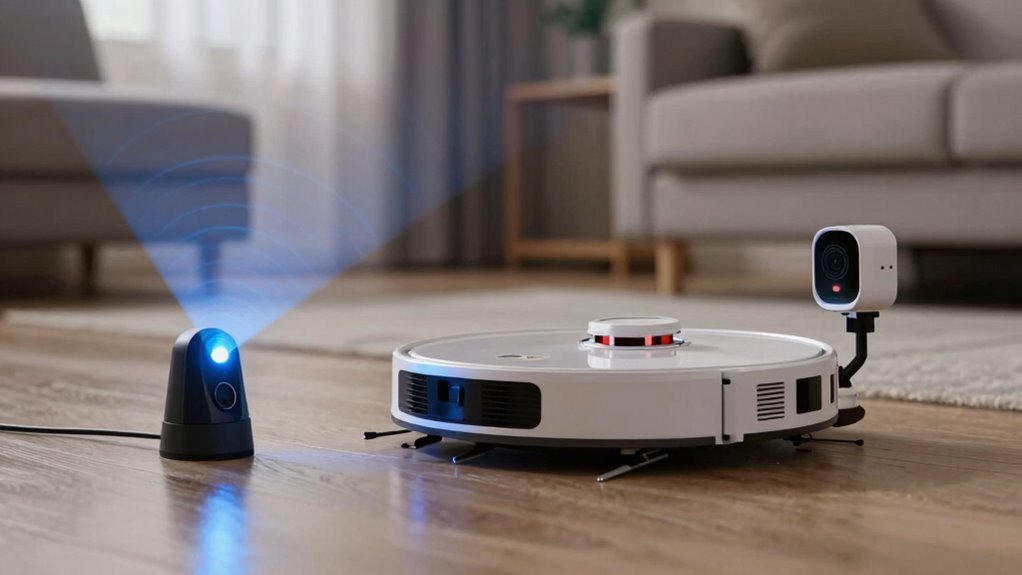
LiDAR systems tend to be more expensive and complex than camera-based options, primarily because of the advanced sensors and processing power they require. When considering the cost comparison, you’ll find that LiDAR units typically come with a higher price tag due to their sophisticated hardware. The complexity analysis reveals that LiDAR systems demand more technical expertise for setup and maintenance, involving calibration and firmware updates. Conversely, camera-based systems are generally more affordable and easier to install, making them suitable for budget-conscious users. Specifically:
- LiDAR units often cost two to three times more than camera modules.
- They require specialized knowledge for troubleshooting and upgrades.
- Their integration involves more intricate software and hardware configurations.
This difference considerably influences your overall investment and ongoing maintenance efforts.
Which Navigation Tech Is Better at Avoiding Obstacles?
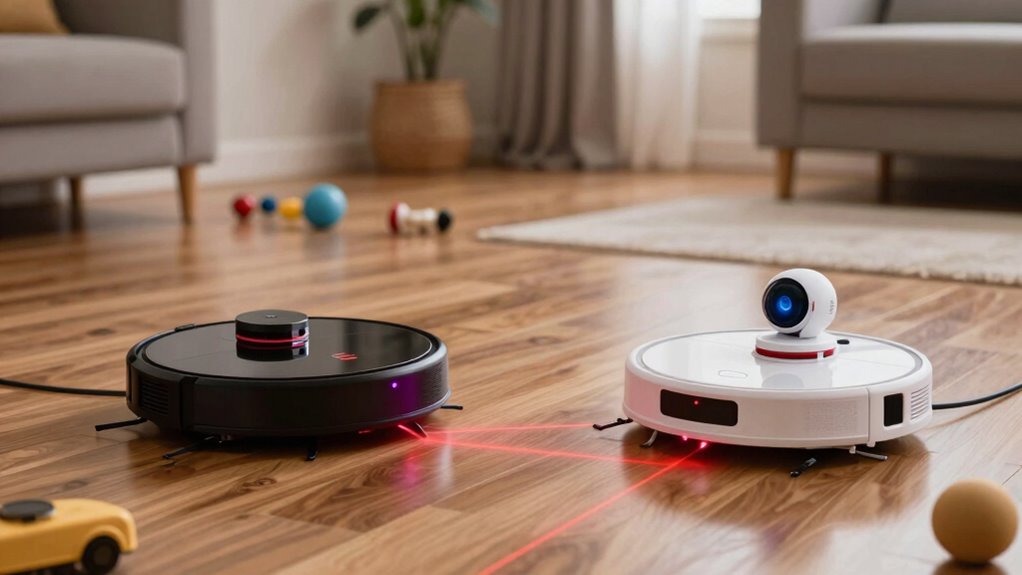
Have you ever wondered which navigation technology is more effective at avoiding obstacles? Both LiDAR and camera-based systems rely on advanced navigation algorithms, but their success depends on how well they interpret their environment. LiDAR uses precise laser sensors and sensor fusion to create accurate 3D maps, allowing it to detect obstacles early and plan safe routes. Cameras, on the other hand, analyze visual data for obstacle recognition, but can struggle in low light or cluttered spaces. When it comes to avoiding surprises, LiDAR’s sensor fusion offers a slight edge by integrating multiple data sources for a thorough view. This integrated approach helps the robot adapt quickly, reducing collisions and ensuring thorough cleaning. Ultimately, LiDAR’s robust sensor fusion makes it more reliable at obstacle avoidance.
Maintenance Tips for LiDAR and Camera Systems

Regular maintenance is key to keeping your robot vacuum’s navigation systems performing at their best. To guarantee peak operation, focus on these essentials:
- Clean the LiDAR or camera lenses regularly to prevent dust and debris from impairing sensor accuracy, which helps maintain battery life by reducing unnecessary power drain.
- Check and empty the dustbin frequently, as a full dustbin can cause the vacuum to work harder, impacting sensor performance and overall efficiency.
- Inspect sensor connections and update firmware when available to prevent glitches and prolong the lifespan of both the sensors and the battery.
How to Choose the Best Navigation System for Your Home
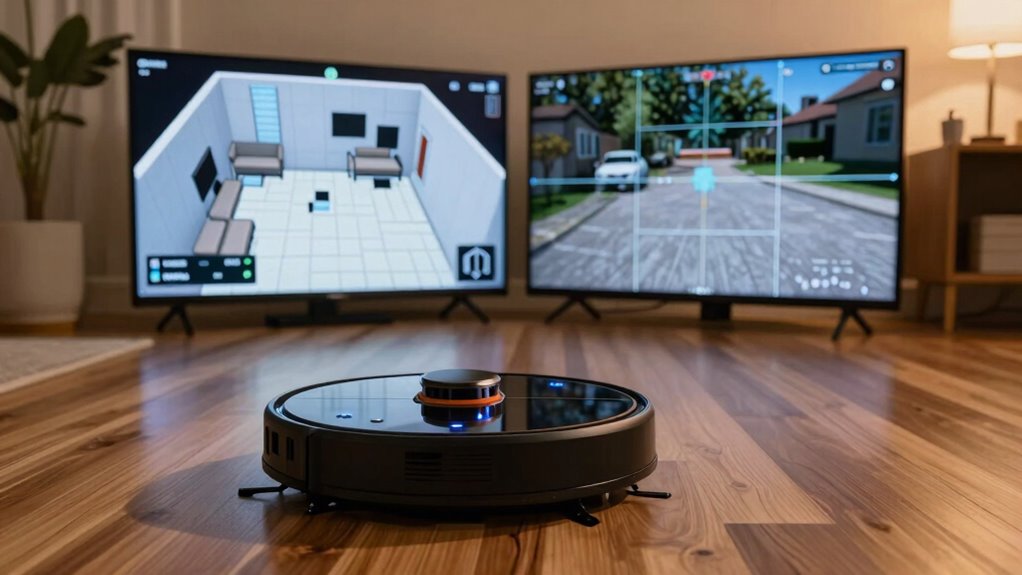
Choosing the right navigation system depends on your home’s layout and your cleaning needs. If your space has a lot of furniture or complex areas, opt for a system like LiDAR, which offers precise mapping and efficient navigation. For homes with simple layouts, camera-based systems might suffice and are often more affordable. Consider how important smart home integration is to you—some systems connect seamlessly with voice assistants and other devices. Battery life also plays a vital role; longer-lasting batteries let your vacuum cover more ground without frequent recharges. Think about the size of your home and your cleaning schedule to match the system’s capabilities with your lifestyle. By evaluating these factors, you can select a navigation system that guarantees thorough cleaning and fits seamlessly into your smart home ecosystem.
Frequently Asked Questions
How Do Robot Vacuums Adapt to Dynamic Household Changes?
You can trust your robot vacuum to adapt to household changes through continuous obstacle detection and real-time mapping. As household layouts shift, the vacuum updates its navigation routes, avoiding new furniture or clutter. Its sensors quickly identify obstacles, ensuring efficient cleaning without getting stuck. This dynamic adjustment lets your vacuum maintain thorough coverage, even when your home’s arrangement changes, keeping your space clean with minimal effort.
Can Lidar or Camera Systems Detect Pet Hair Effectively?
You might find that LiDAR and camera systems aren’t perfect at detecting pet hair, mainly due to sensor limitations. While LiDAR excels at mapping surfaces, it struggles with fine particles like pet hair. Cameras can spot hair more easily, but their effectiveness depends on lighting and camera quality. So, if pet hair is a concern, you might want a vacuum with specialized sensors or a combination of both to guarantee thorough cleaning.
What Is the Typical Lifespan of Lidar and Camera Components?
Lidar sensors usually last around 3 to 5 years, thanks to their rugged sensor durability, but camera components tend to have a shorter lifespan, typically 2 to 3 years, due to more delicate parts. You should expect some component replacement over time, especially if your device faces frequent use or harsh conditions. Regular maintenance can help extend the lifespan of both sensors, ensuring your robot vacuum continues to navigate effectively.
Do Different Floor Types Affect Navigation Accuracy?
Different floor types can impact your robot vacuum’s navigation accuracy. Hard floors like tile or hardwood usually provide clear surfaces for sensors, enhancing navigation. Carpets, especially thick ones, can obscure sensors or LiDAR signals, causing navigation issues. You might notice your vacuum struggles to map or detect obstacles. To improve accuracy, consider adjusting settings or using models designed to handle various floor types better, ensuring thorough cleaning across your home.
Are There Privacy Concerns With Camera-Based Mapping?
Sure, camera-based mapping might make you feel like you’re living in a sci-fi movie, but it does raise serious privacy risks and data security concerns. Your robot could be secretly spying on your messy living room or sensitive conversations, storing images that might end up somewhere they shouldn’t. So, if privacy matters, you might want to think twice before inviting that camera-equipped vacuum into your personal space.
Conclusion
In choosing between LiDAR and camera mapping, consider your home’s layout and lighting. For example, if your space has dim corners, LiDAR’s reliable obstacle detection shines. Conversely, if you prioritize detailed room mapping and have good lighting, cameras might serve you better. Ultimately, understanding your cleaning needs will guide your decision, ensuring your robot vacuum navigates efficiently and keeps your home spotless—whatever tech you choose.
Halloween Picks
halloween
As an affiliate, we earn on qualifying purchases.