
📊 Full opportunity report: StreetComplete Breaks OpenStreetMap Editing Into Tiny Quests on IdeaNavigator AI — validation score, market gap, and execution plan.

Get the latest gadgets delivered free with Prime
- Fast, free delivery on millions of items
- Prime Video, Amazon Music and more included
- Member-only deals all year
TL;DR
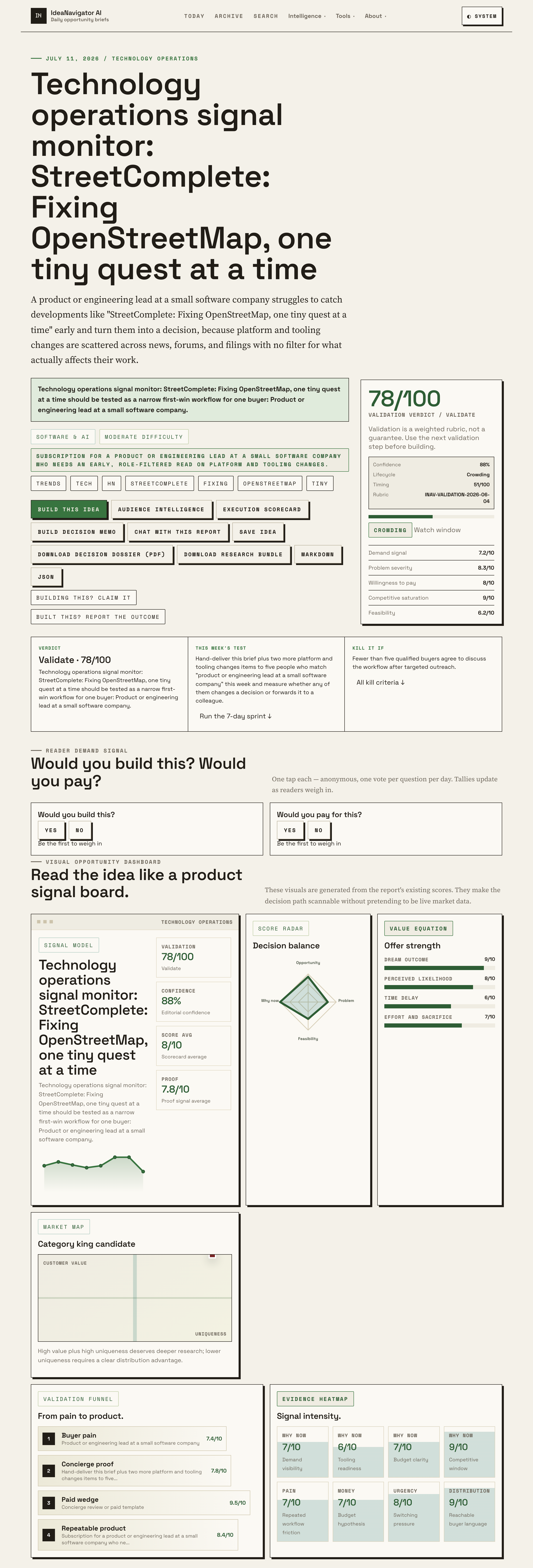
StreetComplete, an open-source Android app, is gaining renewed attention after Hacker News surfaced it with a high relevance signal. The app breaks OpenStreetMap contribution into small, single-question quests, lowering the barrier to crowdsourced map editing.
The open-source Android app StreetComplete is drawing renewed attention for its unusual approach to improving OpenStreetMap: instead of presenting users with a full-featured map editor, it breaks map improvement into tiny, one-question “quests” that anyone can answer in seconds. According to IdeaNavigator AI’s technology operations signal monitor, Hacker News recently surfaced StreetComplete with a signal score of 88 out of 100, placing it among the more notable platform and tooling developments tracked that day.
StreetComplete works by scanning OpenStreetMap data around a user’s location and identifying missing or outdated information — an unmarked opening hours sign, a missing surface type on a footpath, whether a shop has a wheelchair ramp, or the speed limit on a street. The app then displays these gaps as map pins. Tapping a pin opens a single, focused question, usually answerable with a few taps. Each completed answer is uploaded to OpenStreetMap as a structured, attributed edit.
The design deliberately excludes the complexity of a general-purpose map editor. Users cannot redraw geometry, delete features, or engage with the full OpenStreetMap tagging system. That constraint is the core idea: by limiting contributions to simple, on-the-ground observations, the app makes crowdsourced mapping accessible to people who would never open a traditional editor. The app only shows quests for things that can realistically be verified by someone standing at the location, which is intended to improve data quality rather than just volume.
According to IdeaNavigator AI’s monitor, the item surfaced on Hacker News with an 88/100 signal score, and the service characterized it as a candidate for a “narrow first-win workflow” — a small, self-contained tooling development that a product or engineering lead at a small software company could act on quickly. The monitor’s framing is an interpretive claim about relevance, not a statement about the app itself.
Why Gamified Micro-Contributions Matter
StreetComplete is a working example of a pattern that matters well beyond mapping: decomposing a complex contribution task into micro-tasks that require no training. Traditional OpenStreetMap editing demands familiarity with a tagging system of thousands of keys and values, a barrier that excludes most casual contributors. StreetComplete replaces that learning curve with a question a pedestrian can answer on the spot, and the contribution happens as a side effect of answering it.
For product and engineering teams, the renewed attention highlights two transferable lessons. First, contribution friction is a design variable, not a fixed cost — the same pool of potential contributors yields dramatically more output when the ask is made small enough. Second, constraint improves quality: by preventing edits beyond simple field observations, the app channels contributors toward tasks they are actually well positioned to complete. OpenStreetMap data quality in areas with active StreetComplete users tends to reflect those targeted, verified updates, according to the project’s own documentation.
The Hacker News signal also matters because it shows appetite among technical audiences for lightweight tooling shifts over large platform announcements — the reason IdeaNavigator AI flagged the item at 88/100 for role-filtered readers rather than treating it as niche hobbyist software.
Top picks for "streetcomplete break openstreetmap"
As an affiliate, we earn on qualifying purchases.
OpenStreetMap’s Contributor Bottleneck
: “OpenStreetMap is a collaborative, open-licensed map of the world maintained by volunteers since 2004. Its data underpins navigation apps, humanitarian mapping efforts, and countless commercial services. The project’s long-standing challenge is contributor asymmetry: a small number of experienced mappers produce most of the detailed edits, while the majority of registered contributors make only a handful of changes before going inactive. Editors like JOSL and the web-based iD editor give full control but require orientation and practice.
StreetComplete was built to serve the opposite end of that spectrum — people walking through their own neighborhood who notice things about it. The app restricts edits to answering predefined questions about nearby features, and contributions are tagged in OpenStreetMap’s edit history so they can be reviewed like any other change. The current discussion follows the same pattern as previous waves of attention for the app: technical communities rediscover it, and downloads and contribution volume rise. IdeaNavigator AI’s monitor surfaced the latest wave as part of its tracking of platform and tooling changes relevant to product and engineering leads.
What the Signal Does Not Show
Several things remain unclear. The 88/100 signal score comes from IdeaNavigator AI’s own scoring methodology, and the company has not published the underlying Hacker News engagement figures or explained how the score is calculated, so it should be treated as one service’s assessment rather than a neutral measure of importance. It is not yet clear whether the current wave of attention has translated into a measurable increase in StreetComplete downloads or OpenStreetMap contributions — no usage figures have been released alongside the discussion. The IdeaNavigator AI brief also proposes that this item could change decisions for engineering leads, but that is framed as a validation hypothesis to be tested, not a demonstrated outcome.
Additionally, while StreetComplete’s approach is well documented by its developers, claims about its long-term effect on overall OpenStreetMap data quality rest largely on community observation rather than independent analysis.
Testing the Micro-Workflow Thesis
IdeaNavigator AI’s stated next step is validation: its brief recommends hand-delivering the StreetComplete item, along with two other platform and tooling developments, to five people matching the “product or engineering lead at a small software company” profile, then measuring whether any recipient changes a decision or forwards the brief to a colleague. The outcome of that test is not yet known.
For the app itself, the likely near-term pattern is familiar: sustained attention on Hacker News and related forums typically produces a bump in contributions, which will show up in OpenStreetMap’s public edit history over the coming weeks. Readers interested in the underlying approach can observe it directly — StreetComplete is free, open-source, and available for Android, and its quest types and source code are published on the project’s repository.
Key Questions
What is StreetComplete?
An open-source Android app that lets users improve OpenStreetMap by answering small, single-question “quests” about nearby map features — such as a shop’s opening hours or a path’s surface — rather than using a full map editor.
Why is StreetComplete in the news now?
Hacker News recently surfaced the app with a high relevance score — 88/100 according to IdeaNavigator AI’s technology operations signal monitor — drawing renewed attention to its quest-based contribution model.
Can StreetComplete edits damage OpenStreetMap data?
Edits are limited to answering predefined questions about on-the-ground features, and each contribution is recorded in OpenStreetMap’s public edit history, where it can be reviewed like any other change. The app’s design intentionally restricts what users can modify.
Is StreetComplete available on iOS?
Based on the project’s documentation, StreetComplete is an Android app. Availability on other platforms has not been announced.
What is the 88/100 signal score?
It is a relevance score assigned by IdeaNavigator AI’s monitoring service to items it surfaces from feeds like Hacker News. The scoring methodology has not been published, so the figure reflects that service’s own assessment.
Source: IdeaNavigator AI
Halloween Picks
halloween
As an affiliate, we earn on qualifying purchases.