
TL;DR

Get the latest gadgets delivered free with Prime
- Fast, free delivery on millions of items
- Prime Video, Amazon Music and more included
- Member-only deals all year
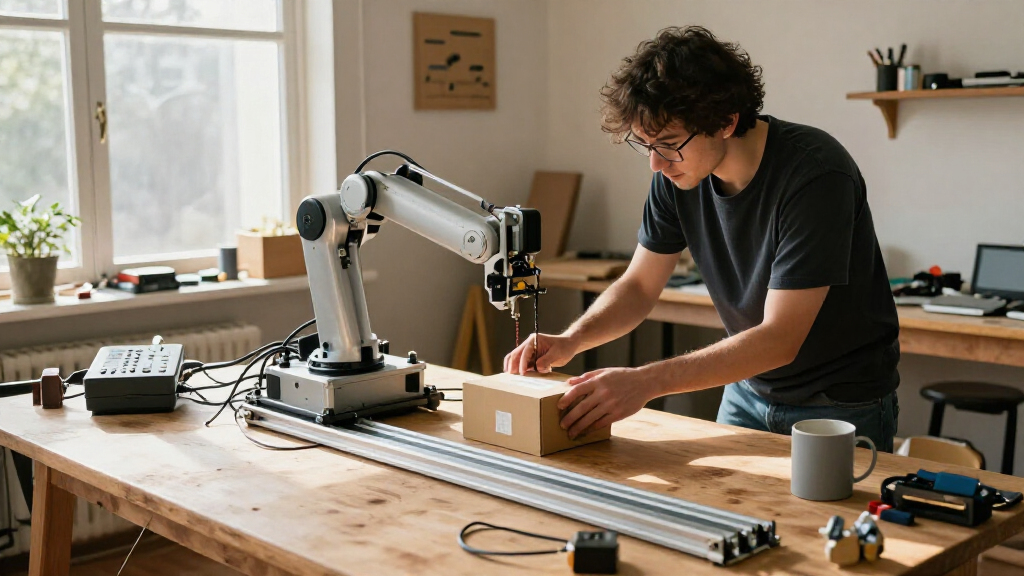
Neufangled Robotics describes Stringman as an open-source, cable-driven robot that moves a gripper through a room from four ceiling-mounted anchors. The company lists a price of $795 and claims an average payload of 1.9 kilograms in a specified room setup; independent performance and safety testing details are not provided in the source material.
Neufangled Robotics is presenting Stringman, an open-source robot that uses four ceiling-mounted cable anchors to move a gripper around a room, with the company listing a price of $795. The design targets tasks such as moving parts between workstations, while avoiding the need for a conventional floor-based mobile robot or a fixed-reach desktop arm.
Stringman’s cables run from anchors mounted near the ceiling corners to a gripper, which the company says can travel through a room-sized work area. Its listed operating range covers rooms with an XY diagonal of 3 to 10 meters and heights of 2.3 to 4 meters. Neufangled says the system can reach cluttered floors from above, although the installation still requires suitable mounting points and room clearance for its lines.
The company lists a 1.9-kilogram average payload and a maximum of up to 2.2 kilograms near the floor. Those figures are tied to the stated system configuration and operating limits, not a general independent benchmark. The manufacturer’s comparison says a seven-actuator, 0.75-meter arm using the same type of motors would average 0.32 kilograms under its assumptions; that calculation excludes the arm’s own link weight.
The published specifications describe a gripper weighing 638 grams, a traverse speed of about 0.4 meters per second, and three cameras: two 1080p anchor cameras and a lower-resolution camera on the gripper. A separate computer runs the controller, while Raspberry Pi boards are used at the gripper and anchors. The maker says setup includes calibration that adapts the system to a room.
A Robot That Uses the Ceiling
Stringman proposes a different trade-off from familiar robots: rather than using wheels or a long articulated arm, it places its motors around the room and suspends the working tool on cables. That could make a large work volume available without putting a robot base on the floor, which may be useful in home laboratories where benches and equipment leave little space for mobile machines.
The price and open documentation may also matter to researchers and hobbyists considering robotic automation. Neufangled says it publishes the mechanical CAD, circuit boards, software, build guide and bill of materials, and identifies the project as OSHWA certified. That gives technically capable users a route to inspect or modify the system rather than relying only on a closed product. It does not, by itself, establish that the device is easy to build, maintain or install in every home.
Practical use depends on room architecture. Anchors need to be attached to structural supports, and the suspended lines remain in the room while the robot is installed. A cable system may keep machinery off the floor, but it introduces overhead hardware and clearance constraints that users must weigh against the reach it offers.
Products Worth Considering

Jackery Explorer 300 Portable Power Station, 292Wh

Anker SOLIX C300 Portable Power Station, 288Wh

EcoFlow Delta 3 Portable Power Station – 1024 Wh, 1800 W
As an affiliate, we earn on qualifying purchases.
How the Cable System Works
The system’s four anchors define a work area, and coordinated cable movement positions the gripper within it. Neufangled’s explanation is that the load is shared across the motors, with capacity varying by position; it says the payload is greatest near the center, where the lines share the load more evenly. The listed payload figures assume a 28-newton line-tension limit and, for the cited average, a seven-by-seven-by-three-meter room.
Installation is not simply placing a robot on a table. The company says anchors can be fixed to wooden studs behind drywall or strapped to structural columns. It recommends a handheld drill and a step ladder for installation. Lines are still present while the system is in use, but the company says they can be parked near the ceiling when idle; anchors can be removed from their cleats without tools.
Neufangled describes the software as capable of running on a local Wi-Fi network, with the interface served locally and AI models running on the owner’s computer. It says data need not leave the network for local operation. The source also describes optional remote access through an account-linked service, making the distinction between local-only use and remote management relevant to buyers.
““Tension is all you need.””
— Neufangled Robotics
Performance and Installation Questions
The specifications and comparisons available here come from Neufangled Robotics. The source does not provide independent testing, a detailed test protocol, or results across different room layouts. Its statement that Stringman has accumulated about 1,000 hours of testing in real homes is a company-reported figure, and does not specify the number of units, test tasks or failure rate.
It is also unclear how the listed price applies to a complete, ready-to-use system, including any shipping, taxes, optional components or computer needed to run the controller. The manufacturer calls out a bill of materials, but the supplied material does not itemize the total build cost or clarify whether all parts are sold together.
Installation suitability and safety remain room-specific. The company says the lines can be made unable to reach some ceiling fans by setting anchor height, but rooms with low objects in the center may not be suitable. The source does not document third-party certification beyond its OSHWA open-source hardware designation, or provide independent assessments of operation around people.
Build Guides and Real-World Use
Readers evaluating Stringman can consult the maker’s build guide, bill of materials, CAD files and software to assess what assembly and installation require. The next practical test is whether the published performance holds across rooms of different sizes, payload positions and layouts, and how much time and expense a typical installation involves.
Neufangled says users can collect training data through the interface and use the system with several robot-learning methods. The company also describes a Python API and an MCP server for connecting it to automated workflows. How well those features work for independent users, and whether the project’s price and payload figures are borne out in broader use, remain open questions.
Key Questions
What is Stringman?
Stringman is a cable-driven robot from Neufangled Robotics. Four anchors mounted near a room’s ceiling corners control a suspended gripper that can move through the defined work area.
How much does Stringman cost?
The company lists the robot at $795, or roughly $800. The available source does not give a full breakdown of taxes, shipping, computer costs or the final cost of every required component.
How much can it carry?
Neufangled lists an average payload of 1.9 kilograms and up to 2.2 kilograms near the floor for its specified setup. These are manufacturer figures, not independent test results.
Does Stringman need a clear room?
It needs anchors secured to suitable structural supports and enough clearance for its cables. The company says lines remain present during operation but can be parked near the ceiling when idle; some rooms with low-hanging objects may not be suitable.
Does it send data to the cloud?
Neufangled says Stringman can run on a local Wi-Fi network, with its interface and AI models hosted locally. The company also describes optional account-based remote access, so users should distinguish that feature from local-only operation.
Source: neufangled.com