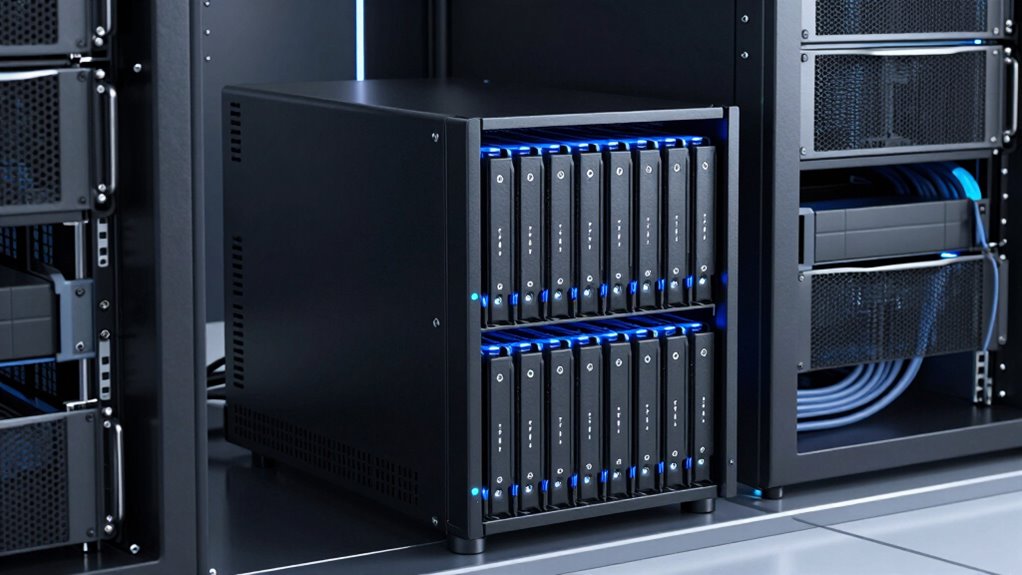

Searching for the best NAS rackmount in 2026 means balancing performance, expandability, and ease of use. The Synology 8 Bay RackStation RS1221+ stands out as the top overall pick for its blend of power and user-friendly features. The QNAP TS-464eU offers excellent performance in a compact form, ideal for smaller setups. Meanwhile, the Buffalo TeraStation 3430RN provides a ready-to-use solution with included drives, perfect for those seeking plug-and-play simplicity. The main tradeoffs involve balancing budget constraints against advanced features and scalability. Continue reading for a detailed breakdown of these options to find the best fit for your needs.

Get the latest gadgets delivered free with Prime
- Fast, free delivery on millions of items
- Prime Video, Amazon Music and more included
- Member-only deals all year
Complete the kit


Key Takeaways
- The top-ranked NAS rackmounts excel in a balance of performance, expandability, and ease of management.
- Diskless models offer flexibility but require additional investment in drives and setup time.
- Compact, short-depth rackmounts are ideal for limited space but may sacrifice some expandability.
- Pre-installed drives simplify setup but often come at a higher initial cost.
- Buyer priorities—such as ease of use, scalability, or budget—strongly influence the best choice among these options.
| Buffalo TeraStation 3430RN 4-Bay 8TB Rackmount NAS with Hard Drives Included |  | Best Overall for Small Business Data Management | Digital Storage Capacity: 8 TB | Hard Disk Interface: Serial ATA-600 | Connectivity Technology: Ethernet | VIEW ON AMAZON | See Our Full Breakdown |
| Synology 8 Bay RackStation RS1221+ (Diskless) |  | Best for High-Performance Small Business Storage | Number of Bays: 8 | Performance: Up to 2,315 MB/s read, 1,147 MB/s write | Form Factor: Rackmount | VIEW ON AMAZON | See Our Full Breakdown |
| QNAP TS-433eU-US Compact 1U Short-Depth Rackmount NAS |  | Best for Space-Constrained Environments | Processor: ARM Cortex-A55 2.0GHz quad-core | RAM: 4GB DDR4 | Network Ports: Dual 2.5GbE | VIEW ON AMAZON | See Our Full Breakdown |
| QNAP TS-464eU 4-Bay 1U Short Depth Rackmount NAS |  | Best for High-Performance Media and Data Sharing | Processor: Intel Quad-core up to 2.9 GHz | RAM: 8GB | Drive Bays: 4 | VIEW ON AMAZON | See Our Full Breakdown |
| QNAP TS-432XeU 4-Bay 1U Short-Depth Rackmount NAS |  | Best for Edge and Small Business Storage | Processor: Alpine Cortex-A57 Quad-core | RAM: 4 GB DDR4 | Number of Bays: 4 | VIEW ON AMAZON | See Our Full Breakdown |
| Synology RackStation RS826+ 4-Bay 1U Rackmount NAS Server (Diskless) |  | Best Overall for High-Performance Office Storage | Drive Bays: 4 | Maximum Drive Bays: 8 | Form Factor: 1U Rackmount | VIEW ON AMAZON | See Our Full Breakdown |
| Synology 4-Bay Rackmount NAS RackStation RS422+ (Diskless), Black |  | Best for Reliable, High-Speed Data Transfer in Space-Conscious Environments | Form Factor: Rackmount | Number of Bays: 4 | Diskless: Yes | VIEW ON AMAZON | See Our Full Breakdown |
| QNAP TS-435XeU-4G-US 4-Bay Short Depth Rackmount NAS |  | Best for Space-Conscious, High-Speed Enterprise Use | Processor: Marvell OCTEON TX2 CN9130 / CN9131 ARMv8 Cortex-A72 | RAM: 4GB DDR4 (expandable to 32GB) | Storage Bays: 4 | VIEW ON AMAZON | See Our Full Breakdown |
| nas rackmount | Form Factor | Network Ports | Processor | RAM |
|---|---|---|---|---|
| Buffalo TeraStation 3430RN 4-B | Rackmount Ethernet NAS Device | — | — | — |
| Synology 8 Bay RackStation RS1 | Rackmount | — | — | — |
| QNAP TS-433eU-US Compact 1U Sh | 1U Short-Depth Rackmount | Dual 2.5GbE | ARM Cortex-A55 2.0GHz quad-core | 4GB DDR4 |
| QNAP TS-464eU 4-Bay 1U Short D | — | Dual 2.5GbE | Intel Quad-core up to 2.9 GHz | 8GB |
| QNAP TS-432XeU 4-Bay 1U Short- | 1U Short-Depth Rackmount | — | Alpine Cortex-A57 Quad-core | 4 GB DDR4 |
| Synology RackStation RS826+ 4- | 1U Rackmount | 4 x 1GbE RJ-45 | — | — |
| Synology 4-Bay Rackmount NAS R | Rackmount | Dual 1GbE, upgradeable to 10GbE | — | — |
| QNAP TS-435XeU-4G-US 4-Bay Sho | Short Depth Rackmount | Dual 2.5GbE, Dual 10GbE | Marvell OCTEON TX2 CN9130 / CN9131 ARMv8 Cortex-A72 | 4GB DDR4 (expandable to 32GB) |
More Details on Our Top Picks
Buffalo TeraStation 3430RN 4-Bay 8TB Rackmount NAS with Hard Drives Included
The Buffalo TeraStation 3430RN stands out for its all-in-one approach, including pre-installed NAS-grade hard drives that simplify setup for small office environments. Compared to the Synology RS1221+, it offers a more straightforward out-of-the-box solution but is limited to 8TB capacity, which may be insufficient for rapidly growing data needs. Its robust security features like 256-bit encryption and two-factor authentication make it a reliable choice for sensitive data. However, it’s primarily designed for small-scale use, not high-end enterprise needs, and requires a rackmount setup that might not fit all environments. This makes it ideal for small businesses needing reliable, secure data storage without complex configurations.
Pros:- Pre-tested NAS-grade hard drives included for immediate deployment
- Strong security features including encryption and two-factor authentication
- Supports cloud integration with popular services
Cons:- Limited to 8TB capacity unless expanded, which could limit growth
- Designed mainly for small office use, not for high-end enterprise environments
Best for: Small businesses seeking a ready-to-use, secure NAS with included drives
Not ideal for: Large enterprises or users needing extensive storage expansion and high performance
- Digital Storage Capacity:8 TB
- Hard Disk Interface:Serial ATA-600
- Connectivity Technology:Ethernet
- Form Factor:Rackmount Ethernet NAS Device
- Hard-Drive Size:3.5 inches
- Item Weight:24.5 pounds
Our verdict“This NAS is best suited for small teams wanting a simple, secure, and reliable data solution with minimal setup.”
Synology 8 Bay RackStation RS1221+ (Diskless)
The Synology RS1221+ excels for organizations that prioritize performance and uptime, offering up to 2,315 MB/s read and 1,147 MB/s write speeds. Unlike the Buffalo model, it’s diskless, so users must acquire drives separately, which adds flexibility but also complexity for beginners. Its high availability clustering ensures maximum uptime, a feature that’s less emphasized in the Buffalo. The shorter rack depth makes it suitable where space is limited, but its complexity might challenge users unfamiliar with Synology’s ecosystem. Overall, this model is ideal for small businesses with demanding workloads and technical expertise.
Pros:- High-speed data transfer with impressive read/write performance
- Supports high availability clustering for maximum uptime
- Compact rack depth fits smaller server rooms
Cons:- Requires separate purchase of drives, increasing initial setup complexity
- May be difficult for users unfamiliar with advanced NAS features
Best for: IT teams or small businesses with existing storage needs who require high performance and uptime
Not ideal for: Beginners or those seeking an all-in-one solution with drives included
- Number of Bays:8
- Performance:Up to 2,315 MB/s read, 1,147 MB/s write
- Form Factor:Rackmount
- Warranty:3 years
- Compatible Devices:Laptop, Desktop
- Depth:298 mm
Our verdict“This NAS is ideal for tech-savvy users needing high-performance storage with high availability features.”
QNAP TS-433eU-US Compact 1U Short-Depth Rackmount NAS
The QNAP TS-433eU-US offers a compact 1U design with a quad-core ARM Cortex-A55 processor, making it suitable for tight rack spaces. Compared to the larger TS-464eU, it sacrifices some performance and expandability for size, with only 4GB of RAM and limited bays. Its dual 2.5GbE ports enable fast file sharing, but the shorter chassis may restrict future upgrades or additional drives. This model makes sense for users who need space-efficient storage without demanding high-performance workloads, but it’s less suited for intensive data processing or expansion.
Pros:- Compact size ideal for space-limited environments
- Fast dual 2.5GbE network ports for quick transfer speeds
- Supports backup for cloud services like Google Workspace
Cons:- Limited RAM may hinder performance under heavy loads
- Chassis size restricts upgrade options and expansion
Best for: Small offices or remote sites needing space-efficient NAS solutions
Not ideal for: Power users or those requiring substantial RAM and extensive storage capacity
- Processor:ARM Cortex-A55 2.0GHz quad-core
- RAM:4GB DDR4
- Network Ports:Dual 2.5GbE
- Chassis Depth:11.51 inches
- Form Factor:1U Short-Depth Rackmount
- Supported Cloud Backup:Google Workspace, Microsoft 365
Our verdict“This NAS is well-suited for users needing a space-efficient device for basic file sharing and backup tasks.”
QNAP TS-464eU 4-Bay 1U Short Depth Rackmount NAS
The QNAP TS-464eU offers a notable upgrade over smaller models like the TS-433eU, thanks to its powerful Intel quad-core CPU up to 2.9 GHz and 8GB RAM. It features M.2 NVMe SSD slots for cache acceleration, which can significantly boost performance for demanding workloads, a feature not available on the more basic models. Its multiple USB 3.2 ports and 4K HDMI output make it a versatile choice for media professionals. Compared to the Buffalo, it provides more flexibility and raw power, but its compact, short-depth chassis limits expansion options and may require technical expertise to optimize. It’s best for users needing high-speed performance in a compact rackmount form.
Pros:- Powerful quad-core processor with high-speed network support
- Supports SSD cache for performance acceleration
- Multiple USB 3.2 ports and HDMI for media use
Cons:- Limited expansion due to short chassis size
- Requires technical knowledge to configure and optimize
Best for: Content creators or small teams needing fast, media-rich storage
Not ideal for: Non-technical users or those seeking a plug-and-play solution with included drives
- Processor:Intel Quad-core up to 2.9 GHz
- RAM:8GB
- Drive Bays:4
- Network Ports:Dual 2.5GbE
- SSD Slots:2 M.2 NVMe
- Video Output:HDMI 1.4b
Our verdict“This NAS is designed for users demanding high performance and media capabilities within a compact rackmount form.”
QNAP TS-432XeU 4-Bay 1U Short-Depth Rackmount NAS
The QNAP TS-432XeU is tailored for edge locations and small businesses needing reliable, high-speed data access. Its Annapurna Labs Alpine Cortex-A57 quad-core processor and 4GB DDR4 RAM provide solid performance, while the 10GbE/2.5GbE/SFP+ connectivity ensures rapid data transfer. Unlike the larger TS-464eU, its compact design limits expansion and RAM capacity, making it less suitable for intensive workloads. The emphasis on high-speed connectivity makes it ideal for remote sites or edge computing where quick access and data protection are priorities. For users with modest storage needs but demanding network performance, this model offers a practical compact solution.
Pros:- Compact 1U short-depth design fits small rack spaces
- High-speed 10GbE and SFP+ ports for rapid data transfer
- Supports snapshots and remote access for data security
Cons:- Limited RAM for intensive applications
- No mention of included drives or extensive upgrade options
Best for: Edge locations or remote offices requiring fast, reliable network connectivity
Not ideal for: Heavy workloads or environments needing extensive expansion and high RAM
- Processor:Alpine Cortex-A57 Quad-core
- RAM:4 GB DDR4
- Number of Bays:4
- Connectivity:10GbE/2.5GbE/SFP+
- Form Factor:1U Short-Depth Rackmount
- Features:Snapshots, Remote Access
Our verdict“This NAS is best for small, remote, or edge setups demanding fast network access and reliable storage within a compact form.”
Synology RackStation RS826+ 4-Bay 1U Rackmount NAS Server (Diskless)
The Synology RS826+ stands out for its impressive read/write speeds exceeding 2,000 MB/s, making it ideal for demanding office environments. Its ability to expand from 4 to 8 drive bays provides flexibility for growing storage needs, surpassing models like the QNAP TS-435XeU in capacity. The inclusion of a PCIe 3.0 slot allows for network upgrades, which is a key advantage over simpler rackmounts. However, it’s a complex setup for novices, and the absence of included disks means additional costs. Compared with the Synology RS422+, it offers higher performance but less straightforward network upgrade options. This NAS makes the most sense for businesses prioritizing speed and scalability but with some technical expertise.
Pros:- Exceptional read/write speeds ideal for data-intensive tasks
- Expandable from 4 to 8 drive bays for future growth
- Versatile networking options with PCIe expansion slot
Cons:- Requires additional disks, increasing initial setup costs
- Complex configuration process for beginners
- Limited to 4 bays without expansion unit
Best for: IT professionals or small businesses needing high-speed, expandable storage with robust network options
Not ideal for: Home users or small offices with limited technical skills or smaller storage needs
- Drive Bays:4
- Maximum Drive Bays:8
- Form Factor:1U Rackmount
- Network Ports:4 x 1GbE RJ-45
- Expansion Slot:PCIe 3.0
- Supported Expansion:10GbE/25GbE NICs, M.2 NVMe SSDs
Our verdict“This model suits tech-savvy users seeking high performance and scalability in a rackmount form factor.”
Synology 4-Bay Rackmount NAS RackStation RS422+ (Diskless), Black
The Synology RS422+ is tailored for users who need dependable data transfer speeds over 600 MB/s and a compact rackmount footprint. Its dual 1GbE ports are easily upgradeable to 10GbE, offering future-proof network performance. Compared to the QNAP TS-435XeU, it provides a straightforward, space-efficient design without sacrificing transfer rates. Yet, since it’s diskless, you’ll need to purchase drives separately, which can increase initial costs, especially for larger capacities. Its limited bays may not meet the needs of those requiring large storage pools, but its speed and upgrade flexibility make it suitable for small to medium-sized offices focused on fast data access.
Pros:- High-speed data transfer exceeding 600 MB/s
- Space-efficient rackmount design
- Flexible network upgrade options including 10GbE
Cons:- No included drives, adding to initial costs
- Limited to 4 bays, restricting total storage capacity
- Requires technical knowledge for optimal setup
Best for: Small businesses or remote teams needing quick, reliable network storage with easy setup
Not ideal for: Users requiring extensive direct-attached storage or large capacity in a single device
- Form Factor:Rackmount
- Number of Bays:4
- Diskless:Yes
- Sequential Read/Write Speed:601/516 MB/s
- Network Ports:Dual 1GbE, upgradeable to 10GbE
- Depth:327.5 mm
Our verdict“Ideal for users prioritizing fast, reliable network storage in a compact, rackmount form with upgrade potential.”
QNAP TS-435XeU-4G-US 4-Bay Short Depth Rackmount NAS
The QNAP TS-435XeU excels in tight spaces thanks to its short depth design, making it perfect for environments with limited rack space. Its quad-core ARM Cortex-A72 processor paired with 4GB DDR4 RAM (expandable to 32GB) offers notable multitasking performance, especially with dual 10GbE ports and dual M.2 NVMe slots for caching. While the 4-bay capacity is comparable to other models like the Synology RS422+, its space-saving form factor comes with a higher price and a steeper learning curve for setup. The device’s enterprise features and high-speed networking are ideal for demanding environments, but it might be overkill for smaller or less technical users.
Pros:- Compact, space-efficient design suitable for tight racks
- High-speed dual 10GbE networking ports
- Expandable RAM up to 32GB for demanding multitasking
- Dual M.2 NVMe slots for caching or additional storage
Cons:- Limited to 4 drive bays, may restrict large data pools
- Higher price point for enterprise features
- Requires technical skills for optimal configuration
Best for: Small IT teams or enterprises needing compact, high-speed NAS with expandability and advanced features
Not ideal for: Home users or small offices with limited technical experience or lower storage requirements
- Processor:Marvell OCTEON TX2 CN9130 / CN9131 ARMv8 Cortex-A72
- RAM:4GB DDR4 (expandable to 32GB)
- Storage Bays:4
- Network Ports:Dual 2.5GbE, Dual 10GbE
- SSD Slots:2 M.2 PCIe Gen 3 x1 NVMe
- Form Factor:Short Depth Rackmount
Our verdict“This NAS is best suited for technical users seeking a space-efficient, high-performance device with advanced networking and expandability.”

How We Picked
Each NAS rackmount was evaluated based on performance, build quality, expandability, and ease of setup. We prioritized models that offer reliable operation in a rackmount form factor, with features suited to both small business and enterprise environments. Cost-effectiveness and future-proofing—such as support for additional drives or expandability—were also key criteria. The ranking reflects a blend of these factors, aiming to guide buyers toward options that balance value and capability for different use cases.| nas rackmount | Processor |
|---|---|
| Buffalo TeraStation 3430RN 4-B | — |
| Synology 8 Bay RackStation RS1 | — |
| QNAP TS-433eU-US Compact 1U Sh | ARM Cortex-A55 2.0GHz quad-core |
| QNAP TS-464eU 4-Bay 1U Short D | Intel Quad-core up to 2.9 GHz |
| QNAP TS-432XeU 4-Bay 1U Short- | Alpine Cortex-A57 Quad-core |
| Synology RackStation RS826+ 4- | — |
| Synology 4-Bay Rackmount NAS R | — |
| QNAP TS-435XeU-4G-US 4-Bay Sho | Marvell OCTEON TX2 CN9130 / CN9131 ARMv8 Cortex-A72 |
Factors to Consider When Choosing Nas Rackmount
Choosing the right NAS rackmount involves assessing several critical factors beyond raw specs. First, determine your storage needs—whether you require high capacity, fast data access, or both. Consider compatibility with existing hardware and network infrastructure, ensuring your setup can support the NAS’s performance capabilities. Think about scalability—will you need to add more drives or features down the line? Budget is also a key factor, but investing in slightly more capable hardware often pays off in future-proofing. Lastly, ease of setup and management can save significant time and frustration, especially if you’re not a storage expert.Performance and Throughput
Performance benchmarks like data transfer speeds and CPU power are vital for demanding environments such as video editing or high-volume backups. A more powerful CPU and multiple network interfaces can significantly improve data flow but often come at a higher price. Consider whether your network infrastructure can support higher speeds—for example, 10GbE ports—if you need fast access across multiple users or devices.
Expandability and Scalability
Look for models that support additional drives or expansion units if future growth is anticipated. Some rackmounts allow you to swap or upgrade drives without downtime, which is a big plus for maintaining uptime. Smaller, short-depth units may limit expandability, so evaluate your long-term storage needs carefully before choosing a compact design.
Ease of Use and Management
User-friendly management interfaces and setup procedures can make a big difference, especially for users without extensive IT backgrounds. Some brands offer extensive app ecosystems or cloud management options, which simplify ongoing maintenance. Avoid overly complex setups if you prefer a straightforward, plug-and-play experience.
Cost and Total Investment
While diskless models lower initial costs, you’ll need to budget for drives and other accessories. Pre-installed drives increase upfront expense but save setup time. Consider the total cost of ownership, including potential future upgrades, when comparing options. Sometimes paying more upfront yields better long-term value through enhanced reliability and features.
Physical Space and Form Factor
Measure your rack space carefully, especially if using a compact or short-depth model. These units are designed to fit into limited spaces but may restrict expansion options. Ensure that your rack supports the unit’s height, depth, and weight, and check for features like quiet operation if noise is a concern.
Frequently Asked Questions
Is it better to buy a diskless NAS or one with drives included?
Choosing between a diskless NAS and one with drives depends on your level of technical expertise and budget. Diskless models typically cost less initially but require you to select and install drives, which offers more customization and potentially better value. Pre-installed drives provide a ready-to-use solution, saving setup time but often at a higher initial cost. Consider your comfort with hardware setup and whether you want to optimize your storage configuration or prefer a plug-and-play experience.
How important is network interface speed for NAS performance?
Network interface speed directly impacts how quickly data moves between your devices and the NAS. For small offices or home use, Gigabit Ethernet might suffice, but for larger environments or high-throughput tasks, 10GbE or higher speeds are increasingly valuable. Upgrading network hardware to support these speeds can maximize the benefits of a high-performance NAS, especially when working with large files or multiple users simultaneously.
Should I prioritize a compact, short-depth rackmount or a larger model?
Compact, short-depth models are ideal for limited rack space or tight environments, but they often offer fewer bays and less expandability. Larger models provide more storage capacity and flexibility but require more space and power. Your decision should weigh current needs against future growth, ensuring the chosen model can accommodate both your immediate requirements and potential upgrades.
Are premium features like multiple LAN ports worth the extra cost?
Features like multiple LAN ports enable link aggregation and network redundancy, which can improve performance and reliability in busy environments. If your network setup can benefit from these capabilities, investing in a NAS with such features makes sense. However, for small setups or casual use, these extras might not justify the additional expense, so evaluate your actual network demands carefully.
What should I look for in terms of RAID support?
RAID support is fundamental for data redundancy and performance. Ensure the NAS supports the RAID levels you need, such as RAID 5 or RAID 6, for a good balance of safety and capacity. Some models offer flexible RAID configurations and hot-swappable drives, which simplify maintenance and upgrades. Proper RAID support can protect your data against drive failures, a critical consideration for business or important personal data.
Conclusion
For small businesses or tech-savvy users seeking maximum performance and expandability, the Synology RS1221+ offers an excellent balance of power and user-friendly management. Budget-conscious buyers or those just starting out may prefer the Buffalo TeraStation 3430RN for its ready-to-use setup and included drives. Users with space constraints or a need for rapid deployment should consider the QNAP TS-464eU for its compact size and solid performance. Overall, your choice should align with your current storage needs, future growth plans, and technical comfort level, ensuring a reliable, scalable solution tailored to your environment.
As an affiliate, we earn on qualifying purchases.Halloween Picks
halloween