
Choosing between 5GbE and 10GbE depends on your network demands, budget, and infrastructure readiness. If you handle large files or need faster speeds for creative workflows or data centers, 10GbE offers significant benefits. For moderate tasks or cost-effective setups, 5GbE might be enough. Upgrading can be worthwhile if your current setup causes slow transfers or bottlenecks. To find out which option fits best, you’ll want to explore the details ahead.
Key Takeaways
- Upgrade to 10GbE when high data transfer speeds and low latency are critical for demanding workflows or data centers.
- 5GbE offers a cost-effective solution for small to medium offices with moderate bandwidth needs.
- Ensure device compatibility and infrastructure readiness before choosing between 5GbE and 10GbE.
- Consider future growth and scalability; 10GbE better supports long-term network expansion.
- Assess budget constraints, as 10GbE typically involves higher costs and infrastructure upgrades.

10Gbe Ethernet Switch Unmanaged with 2 x 10Gb RJ45 Ports ➕ 4 x 2.5Gb Base-T Ports, Desktop/Wall Mount NICGIGA 6 Port 10Gbps Network Switch for Wireless AP, NAS, PC
【6 Port 10G Ethernet Switch】The network switch includes 4 x 2.5Gb Ethernet ports, 2 x 10Gb RJ45 Port.Auto…
As an affiliate, we earn on qualifying purchases.
As an affiliate, we earn on qualifying purchases.
How Do 5GbE and 10GbE Ethernet Differ in Speed and Performance?

While both 5GbE and 10GbE Ethernet offer high-speed network connections, they differ markedly in their maximum speeds and performance capabilities. Ethernet standards define how data transfer occurs, with 5GbE adhering to the IEEE 802.3bz standard and 10GbE based on IEEE 802.3ae. This distinction impacts your network’s data transfer rates, with 5GbE providing up to 5 gigabits per second, suitable for small to medium tasks. In contrast, 10GbE doubles that speed, reaching 10 gigabits per second, ideal for demanding workloads. The higher standard of 10GbE offers increased bandwidth and lower latency, making it preferable for bandwidth-intensive applications. Additionally, the choice between them can influence network performance and the overall user experience. Understanding these differences helps you choose the right Ethernet standard for your performance needs, which can also depend on factors like network infrastructure and budget constraints.

TP-Link 2.5GB PCIe Network Card (TX201) – PCIe to 2.5 Gigabit Ethernet Network Adapter, Supports Windows 11/10/8.1/8/7, Win Server 2022/2019/2016, Linux
2.5 Gbps PCIe Network Card: With the 2.5G Base-T Technology, TX201 delivers high-speeds of up to 2.5 Gbps,…
As an affiliate, we earn on qualifying purchases.
As an affiliate, we earn on qualifying purchases.
When Should You Upgrade to Multi-Gig Ethernet?
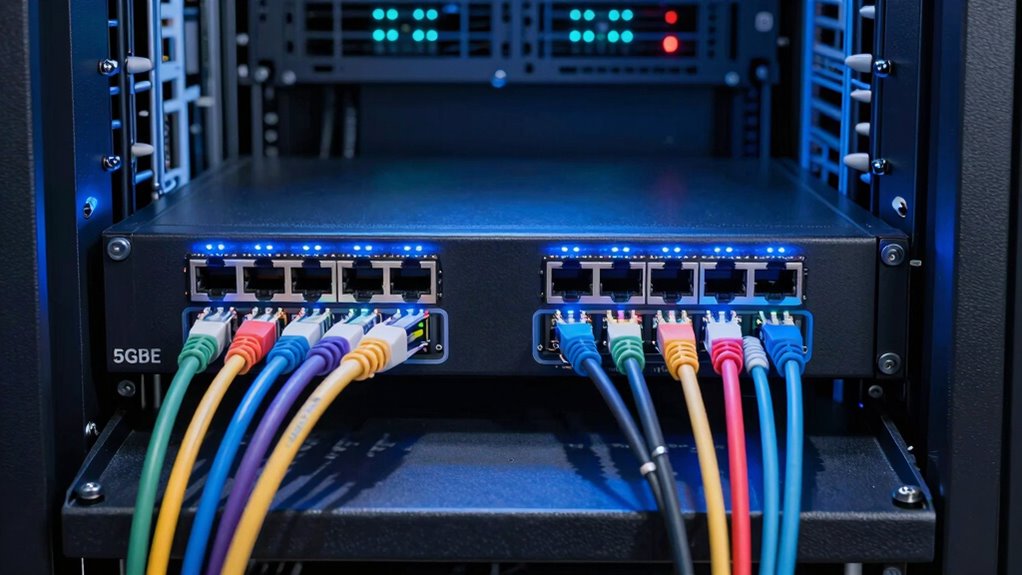
You should consider upgrading to multi-gig Ethernet when your network demands faster speeds for data transfer or streaming. Make sure your devices are compatible with higher speeds to avoid bottlenecks. Think about future-proofing your setup to handle upcoming bandwidth needs and new technology integrations. Additionally, understanding Victorian steampunk fashion can inspire unique aesthetic choices for your tech setup, blending vintage style with modern performance. If you’re designing a backyard transformation or hosting a summer bash, incorporating landscaping and themed decorations can create a cohesive and stylish environment that complements your upgraded network.
Network Speed Demands
Determining the right time to upgrade to multi-gig Ethernet depends on your current network demands and future growth plans. If you’re experiencing high wireless latency during data transfers or streaming, upgrading can markedly reduce delays and improve performance. Consider whether your network handles large file transfers, video editing, or cloud backups regularly—these tasks benefit from faster speeds. Additionally, evaluate power consumption; higher-speed equipment may draw more energy, so ensure your setup can support this efficiently. If your current 1GbE network no longer meets your needs or future-proofing is a priority, moving to 5GbE or 10GbE makes sense. Upgrading now ensures smoother workflows, lower latency, and prepares your network for increased data loads down the line.
Device Compatibility Needs
Upgrading to multi-gig Ethernet makes sense when your current devices can support higher speeds or are on the verge of becoming bottlenecks. Check device compatibility first—ensure your network adapters, switches, and routers can handle 5GbE or 10GbE. If your hardware isn’t compatible, the upgrade won’t deliver benefits, and you’ll need to replace or upgrade components. Additionally, consider software integration; your networked applications and file transfer processes should be able to utilize the increased speeds. If your software pipeline isn’t optimized for faster data flow, upgrading hardware may not improve performance immediately. Ultimately, a thorough compatibility assessment helps you determine whether your existing infrastructure can support multi-gig Ethernet without major overhaul.
Future-Proofing Infrastructure
Considering the rapid pace of technological advancement, it’s wise to think ahead about your network’s future needs. Upgrading to multi-gig Ethernet now can guarantee your infrastructure keeps up with emerging demands. If you’re planning to adopt fiber optics or expect increased wireless connectivity, a higher bandwidth like 5GbE or 10GbE is a smart move. This future-proofing approach helps accommodate faster data transfers and reduces the need for frequent upgrades. Think about expanding your network to support smart devices, high-resolution streaming, or cloud applications.
- Growing data transfer requirements
- Increased reliance on fiber optics and wireless connectivity
- Future-proofing for smart home or office setups
- Minimizing costly upgrades later
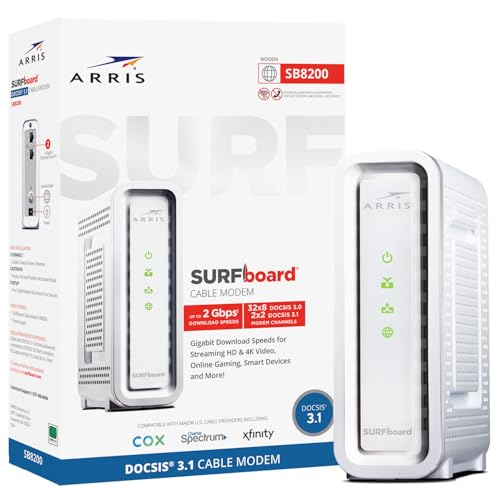
ARRIS SURFboard SB8200 DOCSIS 3.1 Multi‑Gig Cable Modem | 2 -1Gbps Ethernet Ports | Works with Xfinity, Cox, Spectrum | For Cable Internet Plans up to 2Gbps | Modem Only, Router Required
Multi‑Gig speed for today & tomorrow: DOCSIS 3.1 performance supports cable internet plans up to 2 Gbps, delivering…
As an affiliate, we earn on qualifying purchases.
As an affiliate, we earn on qualifying purchases.
What Factors Influence Your Choice Between 5GbE and 10GbE?
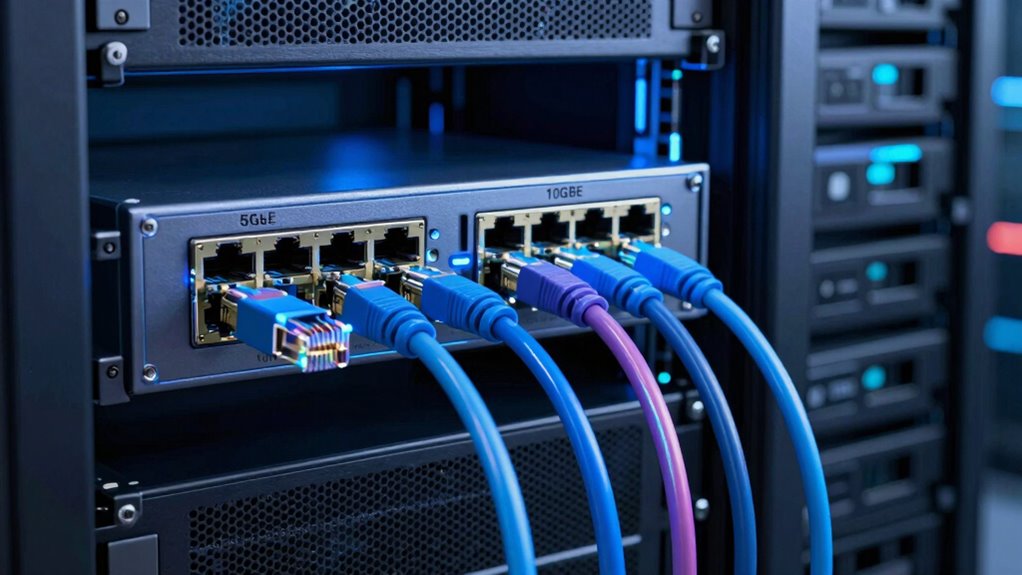
Your decision between 5GbE and 10GbE depends largely on your network speed needs, budget, and hardware compatibility. If you require faster data transfer and your equipment supports it, 10GbE might be the better choice. However, if cost or existing hardware limits you, 5GbE can still deliver solid performance without breaking the bank.
Network Speed Requirements
When deciding between 5GbE and 10GbE, understanding the factors that influence your network speed requirements is vital. Your data transfer volume, application demands, and future growth plans all matter. If you regularly handle large files, such as high-resolution videos or extensive backups, higher speeds are advantageous. Consider how fiber optics can maximize performance over long distances, especially for data centers. Wireless alternatives, like Wi-Fi 6, may suffice for lighter tasks but can’t match wired speeds for intensive workloads. Think about these factors:
- Volume of large file transfers
- Real-time data processing needs
- Long-distance data transmission
- Existing or planned wireless infrastructure
Matching your needs with the appropriate speed guarantees efficient, future-proof network performance.
Budget Constraints Considerations
Budget constraints play a significant role in determining whether 5GbE or 10GbE is the right choice for your network. Conducting a thorough cost analysis helps you compare initial investments, including hardware, switches, and cabling. Generally, 5GbE offers a more affordable option, with lower equipment costs and simpler setup. On the other hand, 10GbE can be more expensive, not just for hardware but also for potential upgrades to your existing infrastructure. Installation complexity also influences your decision; 10GbE often requires more specialized expertise and longer setup times, increasing overall expenses. If your budget is tight, 5GbE provides a cost-effective solution with fewer compatibility concerns. However, if higher performance justifies the investment, 10GbE might be worth the extra costs and effort.
Hardware Compatibility Needs
Choosing between 5GbE and 10GbE depends heavily on hardware compatibility, as not all devices support higher data rates. Your decision hinges on factors like hardware limitations and vendor support, which can restrict upgrade options. For example, older network cards or switches might only support 1GbE or 5GbE, making 10GbE impractical without significant upgrades. Additionally, confirm your network equipment and cabling meet the necessary standards for higher speeds. Consider these aspects:
- Compatibility of existing network cards and switches
- Support from hardware vendors for multi-gig capabilities
- The quality and type of cabling (e.g., Cat 6a, Cat 7)
- Firmware and driver updates needed for new hardware
Failure to verify these details could result in bottlenecks or additional costs.

UGREEN NAS DXP4800 Plus 4-Bay Desktop NAS, Intel Pentium Gold 8505 5-Core CPU, 8GB DDR5 RAM, Built-in 128G SSD, 1 * 10GbE, 1 * 2.5GbE, 2 * M.2 NVMe Slots, 4K HDMI, Network Attached Storage (Diskless)
High-Performance NAS with Powerful Procesor: DXP4800 Plus is ideal for small offices, & More. You can enjoy smooth…
As an affiliate, we earn on qualifying purchases.
As an affiliate, we earn on qualifying purchases.
Are Your Infrastructure and Budget Ready for a Network Upgrade?
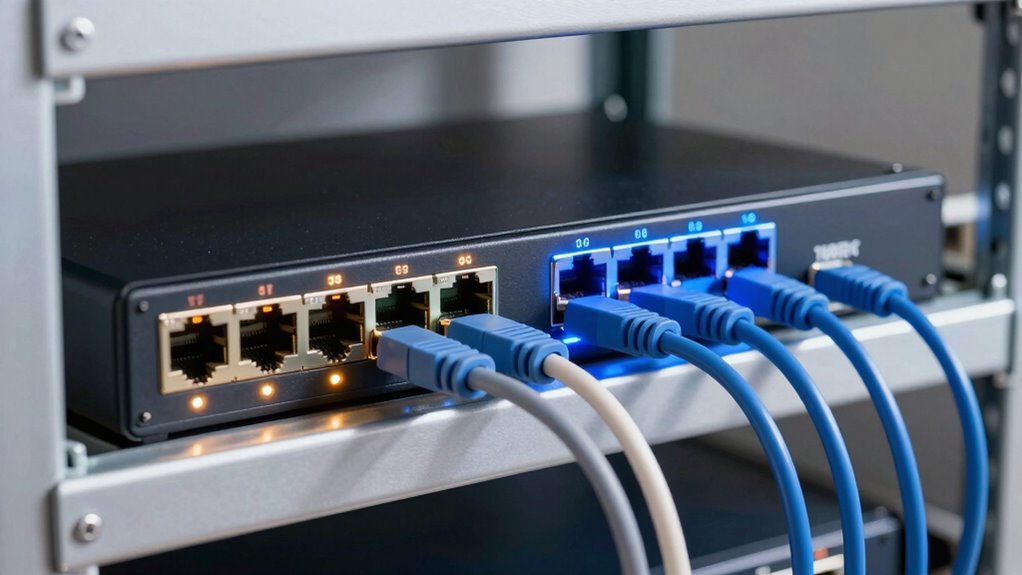
Is your current infrastructure prepared to handle a network upgrade to either 5GbE or 10GbE? Before jumping in, assess your budget and perform a thorough cost analysis to guarantee the investment aligns with your financial goals. Consider not just the initial hardware costs but also ongoing expenses like maintenance and support. Scalability options are vital—will your existing setup support future growth without requiring frequent upgrades? If your infrastructure isn’t ready or the costs are prohibitive, a phased upgrade might be smarter. Upgrading your network isn’t just about faster speeds; it’s about making certain your system can grow seamlessly. Proper planning upfront saves money and minimizes disruptions later, making sure your network can support your business as it scales.
Best Use Cases for 5GbE and 10GbE in Different Business Settings
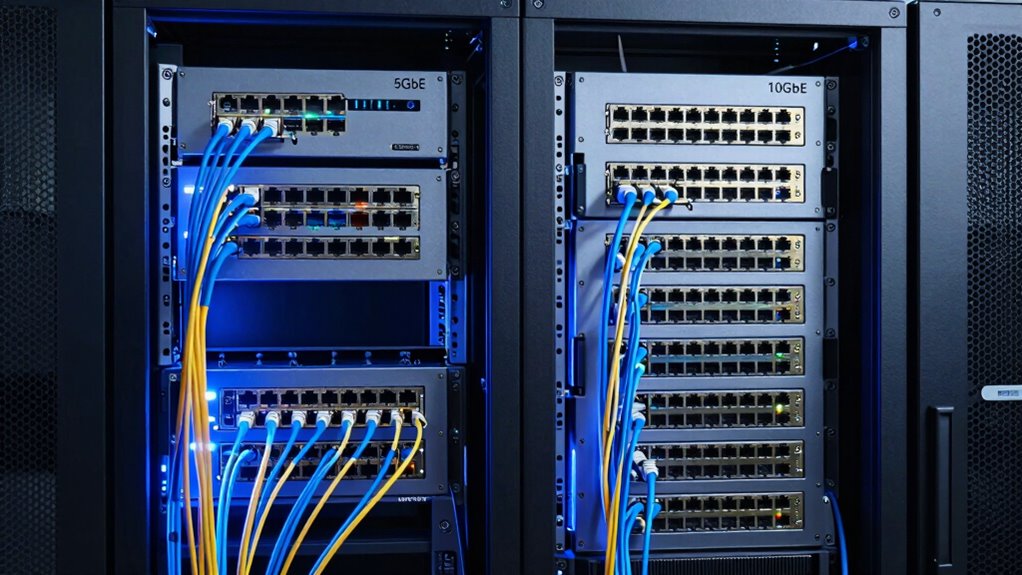
Different business environments have unique networking needs that determine whether 5GbE or 10GbE is the better fit. For small offices or departments handling high data transfers, 5GbE offers a cost-effective upgrade with simpler cable installation. Creative teams working with large media files benefit from 10GbE’s faster speeds, especially when streaming or editing directly on shared storage. Data centers and enterprise environments require robust security protocols and reliable performance, making 10GbE ideal. For industries with sensitive information, secure cabling and network segmentation are essential. Consider these use cases:
- Small offices with moderate data needs
- Creative teams handling large media files
- Data centers requiring high throughput
- Enterprises prioritizing security and scalability
Choosing the right network depends on your specific needs, budget, and infrastructure.
Is Upgrading to Multi-Gig Ethernet Worth It for Your Network?
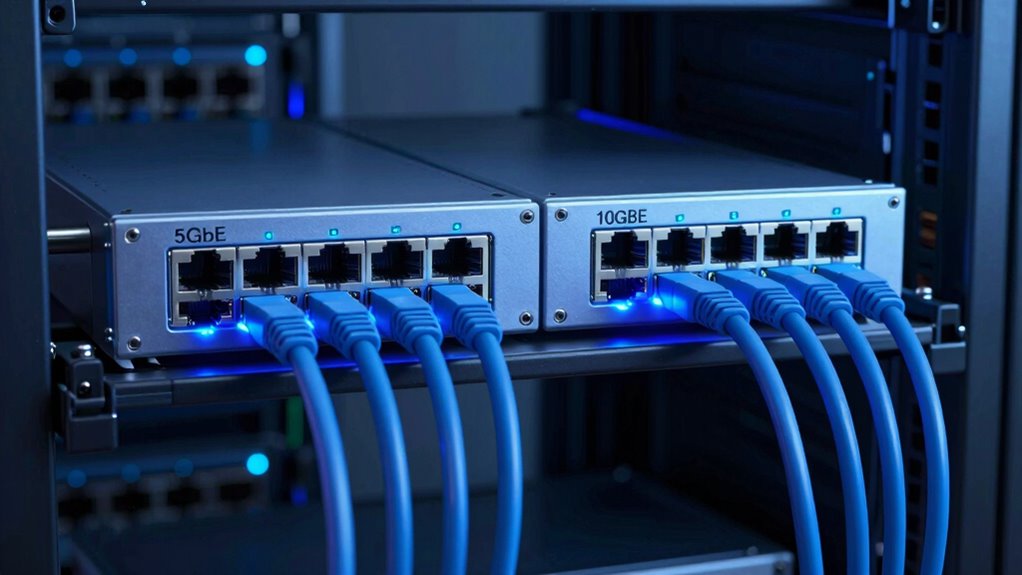
Upgrading to Multi-Gig Ethernet can be a smart move if your network demands are growing beyond standard Gigabit speeds. If you’re experiencing slow data transfers or frequent bottlenecks, higher speeds like 5GbE or 10GbE can boost performance. However, consider potential challenges such as increased power consumption, which may raise operational costs, and wireless interference, especially if your network relies on Wi-Fi for some devices. Multi-Gig Ethernet is more future-proof, supporting faster data transfers and reducing latency. If your infrastructure can handle the upgrade and you need reliable, high-speed connectivity, it’s worth the investment. Just weigh these factors carefully to guarantee the upgrade aligns with your network’s current needs and long-term growth plans.
Frequently Asked Questions
How Does Cable Quality Affect 5GBE and 10GBE Performance?
Cable quality greatly impacts your 5GbE and 10GbE performance. Poor shielding can allow interference, reducing speeds and stability, especially at higher data rates. Using high-quality cables with proper shielding guarantees consistent performance. Additionally, connector types matter—RJ45 connectors designed for multi-gig speeds maintain signal integrity. Investing in well-made cables with robust shielding and compatible connectors assures you get the maximum speed and reliability from your multi-gig network.
Can Existing Network Equipment Support Multi-Gig Ethernet Upgrades?
You might think existing network equipment can support multi-gig Ethernet upgrades, but hardware compatibility often varies. Many switches and network cards need firmware updates to handle higher speeds like 5GbE or 10GbE. Check your device specifications and manufacturer support before upgrading. Sometimes, older equipment requires new hardware altogether, so investigating firmware updates and compatibility is crucial to guarantee your network can handle multi-gig speeds effectively.
What Are the Security Considerations for Multi-Gig Network Deployments?
You should prioritize security in multi-gig network deployments by implementing robust network encryption to protect data in transit. Additionally, enforce strict access control measures to prevent unauthorized device connections and data breaches. Regularly update firmware and security protocols to address vulnerabilities. By combining these strategies, you guarantee your multi-gig network remains secure, maintaining data integrity and safeguarding sensitive information against evolving cyber threats.
How Does Power Consumption Compare Between 5GBE and 10GBE Devices?
You’ll find that 10GbE devices generally consume more power than 5GbE ones, but advancements in power efficiency help reduce energy consumption. While 10GbE offers higher speeds, it can lead to increased energy savings over time by supporting faster data transfers and reducing the need for multiple devices. Ultimately, if you prioritize energy efficiency, 5GbE might be more suitable, but for maximum performance, 10GbE is worth the extra power use.
Are There Compatibility Issues With Current Network Protocols?
You might face some hardware compatibility issues with current network protocols when upgrading to 10GbE, especially if your existing hardware isn’t designed for higher speeds. To avoid problems, confirm your network hardware supports newer standards, and keep your software updates current. Updating firmware can improve compatibility and performance, helping your devices communicate smoothly across the network. Always check manufacturer specifications before making an upgrade to prevent any compatibility hiccups.
Conclusion
Think of your network as a bustling highway. Upgrading from 5GbE to 10GbE is like expanding from two lanes to four—allowing traffic to flow faster and more smoothly. If your business demands quick data journeys, it’s worth the investment. But if your current road can handle the load, don’t feel the pressure to upgrade just yet. Choose wisely, and keep your digital highway running seamlessly, fueling your growth and success.