
Among these wireless gaming mice, I’d name the Razer Viper V3 HyperSpeed the best overall for players who want a focused, lightweight design, while the Logitech G305 LIGHTSPEED stands out as a straightforward value pick and the Razer Basilisk V3 Pro offers more controls and premium features. The main tradeoffs are clear: lighter, simpler mice favor quick movement, while larger feature-rich models add buttons and comfort at the cost of weight and bulk. Battery type, wireless modes, and hand fit can matter as much as sensor specifications. The list also includes several versions of the G305, making it easy to compare color options without mistaking them for different hardware. Read on for the full breakdown and advice on choosing by grip, games, and setup.

Get the latest gadgets delivered free with Prime
- Fast, free delivery on millions of items
- Prime Video, Amazon Music and more included
- Member-only deals all year
Complete the kit



Key Takeaways
The Viper V3 HyperSpeed is the strongest all-around fit for players who prioritize a light, streamlined shape over a large button layout.
The G305 appears in four colors but is one mouse design; choose among the white, blue, lilac, and black versions by appearance, not expected performance differences.
The Basilisk V3 Pro and G502 Lightspeed favor control and extra inputs, while the Viper V3 HyperSpeed and ATTACK SHARK X3 better suit players seeking a more movement-focused feel.
Battery approaches vary widely: some options use replaceable batteries, while rechargeable models trade convenient charging for less dependence on spare cells.
Tri-mode and programmable-button claims do not automatically make a mouse a better gaming pick; check whether the connection options and extra controls fit your games and desk habits.
| ATTACK SHARK X3 Lightweight Wireless Gaming Mouse, White |  | Best for Lightweight Tri-Mode Flexibility | Weight: 49 g | Connectivity: Bluetooth 5.2, 2.4 GHz wireless, USB wired | Sensor: PixArt PAW3395 optical | VIEW LATEST PRICE | See Our Full Breakdown |
| Redragon M810 PRO Wireless RGB Gaming Mouse |  | Best for Programmable Controls | Connectivity: 2.4 GHz wireless, USB-C | Sensor: PAW3325 optical | Maximum sensitivity: 12,000 DPI | VIEW LATEST PRICE | See Our Full Breakdown |
| Logitech G305 LIGHTSPEED Wireless Gaming Mouse, White |  | Best for Long Battery Life | Connectivity: USB wireless | Sensor: HERO optical | Sensitivity: 200–12,000 DPI | VIEW LATEST PRICE | See Our Full Breakdown |
| Logitech G305 LIGHTSPEED Wireless Gaming Mouse, Blue |  | Best for Right-Handed Everyday Play | Connectivity: USB wireless | Sensor: HERO optical | Sensitivity: 200–12,000 DPI | VIEW LATEST PRICE | See Our Full Breakdown |
| Redragon M656 Wireless Optical Gaming Mouse |  | Best for Basic Programmable Wireless Control | Connectivity: 2.4 GHz wireless | Sensor: PixArt PAW3104 optical | DPI settings: 1,000 / 1,500 / 2,000 / 2,400 / 4,000 | VIEW LATEST PRICE | See Our Full Breakdown |
| Logitech G305 LIGHTSPEED Wireless Gaming Mouse, Lilac |  | Best for Long Battery Life | Connectivity: LIGHTSPEED wireless | Sensor: HERO optical | Sensitivity: 200–12,000 DPI | VIEW LATEST PRICE | See Our Full Breakdown |
| Lacolain Rechargeable Wireless Gaming Mouse |  | Best for Everyday Multi-Device Use | Connectivity: 2.4 GHz wireless | Wireless range: Up to 10 m (33 ft) | Sensor: Optical | VIEW LATEST PRICE | See Our Full Breakdown |
| Razer Basilisk V3 Pro Wireless Gaming Mouse |  | Best Premium Customization | Connectivity: 2.4 GHz wireless, Bluetooth, and USB | Sensor: Focus Pro 30K optical | Maximum sensitivity: 30,000 DPI | VIEW LATEST PRICE | See Our Full Breakdown |
| Razer Viper V3 HyperSpeed Wireless Gaming Mouse |  | Best Lightweight Battery-Powered Pick | Connectivity: USB wireless | Sensor: Focus Pro optical | Maximum sensitivity: 30,000 DPI | VIEW LATEST PRICE | See Our Full Breakdown |
| Logitech G703 LIGHTSPEED Wireless Gaming Mouse |  | Best for Grip and Optional Wireless Charging | Connectivity: LIGHTSPEED wireless | Sensor: HERO 25K optical | Maximum sensitivity: 25,600 DPI | VIEW LATEST PRICE | See Our Full Breakdown |
| Logitech G502 Lightspeed Wireless Gaming Mouse | 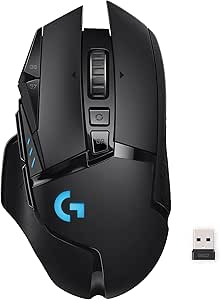 | Best for Button-Heavy Games | Connectivity: LIGHTSPEED wireless | Sensor: HERO optical sensor | Maximum sensitivity: Up to 25,600 DPI; product data also lists 16,000 DPI | VIEW LATEST PRICE | See Our Full Breakdown |
| Logitech G305 LIGHTSPEED Wireless Gaming Mouse, Black |  | Best for Long Battery Life | Connectivity: LIGHTSPEED wireless with USB receiver | Sensor: HERO optical | Sensitivity: 200–12,000 DPI | VIEW LATEST PRICE | See Our Full Breakdown |
| Razer Orochi V2 Wireless Gaming Mouse, 950 Hr Battery, Black |  | Best Compact Travel Pick | Connectivity: Razer HyperSpeed wireless and Bluetooth | Sensor: Razer 5G Advanced optical sensor | Sensitivity: 18,000 DPI listed in the product description; product information also lists 16,000 DPI maximum | VIEW LATEST PRICE | See Our Full Breakdown |
| AULA SC620 Tri-Mode Wireless Gaming Mouse, 12,000 DPI, 7 Programmable Buttons, RGB |  | Best for Multi-Device Flexibility | Connectivity: 2.4GHz wireless, Bluetooth 5.3, and wired USB | Device storage: Up to 4 devices | Sensor: Optical | VIEW LATEST PRICE | See Our Full Breakdown |
| Razer Basilisk V3 X HyperSpeed Wireless Gaming Mouse |  | Best for Custom Controls and RGB | Connectivity: Razer HyperSpeed wireless and Bluetooth | Controls: 9 programmable controls | Sensor: 5G Advanced optical sensor | VIEW LATEST PRICE | See Our Full Breakdown |
| wireless gaming mice | Connectivity | Sensor | Weight | Battery life |
|---|---|---|---|---|
| ATTACK SHARK X3 Lightweight Wi | Bluetooth 5.2, 2.4 GHz wireless, USB wired | PixArt PAW3395 optical | 49 g | Up to 200 hours |
| Redragon M810 PRO Wireless RGB | 2.4 GHz wireless, USB-C | PAW3325 optical | 4 ounces | Up to 45 hours in eco mode |
| Logitech G305 LIGHTSPEED Wirel | USB wireless | HERO optical | 99 g | Up to 250 hours |
| Logitech G305 LIGHTSPEED Wirel | USB wireless | HERO optical | 99 g | Up to 250 hours |
| Redragon M656 Wireless Optical | 2.4 GHz wireless | PixArt PAW3104 optical | 2.88 ounces | — |
| Logitech G305 LIGHTSPEED Wirel | LIGHTSPEED wireless | HERO optical | 99 g (3.4 oz) | — |
| Lacolain Rechargeable Wireless | 2.4 GHz wireless | Optical | 90 g | Over 21 days per full charge |
| Razer Basilisk V3 Pro Wireless | 2.4 GHz wireless, Bluetooth, and USB | Focus Pro 30K optical | — | Up to 150 hours over Bluetooth; up to 110 hours over HyperSpeed wireless |
| Razer Viper V3 HyperSpeed Wire | USB wireless | Focus Pro optical | 82 g | — |
| Logitech G703 LIGHTSPEED Wirel | LIGHTSPEED wireless | HERO 25K optical | 95 g | Up to 35 hours |
| Logitech G502 Lightspeed Wirel | LIGHTSPEED wireless | HERO optical sensor | — | Up to 60 hours |
| Logitech G305 LIGHTSPEED Wirel | LIGHTSPEED wireless with USB receiver | HERO optical | 99 g | Up to 250 hours |
| Razer Orochi V2 Wireless Gamin | Razer HyperSpeed wireless and Bluetooth | Razer 5G Advanced optical sensor | Under 60 g excluding battery | Up to 950 hours on Bluetooth; up to 425 hours on HyperSpeed with a AA lithium battery |
| AULA SC620 Tri-Mode Wireless G | 2.4GHz wireless, Bluetooth 5.3, and wired USB | Optical | 67 g | — |
| Razer Basilisk V3 X HyperSpeed | Razer HyperSpeed wireless and Bluetooth | 5G Advanced optical sensor | — | Up to 285 hours on HyperSpeed; up to 535 hours on Bluetooth |
More Details on Our Top Picks
ATTACK SHARK X3 Lightweight Wireless Gaming Mouse, White
At 49 g, the ATTACK SHARK X3 is the lightest-feeling choice in this group on paper, a clear contrast with the 99 g Logitech G305. That lower weight can make rapid repositioning feel less effortful, while its PixArt PAW3395 sensor and up to 26,000 DPI offer a higher sensitivity ceiling than the G305’s 12,000 DPI. Its Bluetooth, 2.4 GHz, and wired modes also make it easier to move between devices than either Logitech G305, which uses a USB wireless receiver.
The tradeoff is that the claimed 200-hour battery life is a stated maximum, and changing button assignments or settings requires software. I’d choose it for a low-weight, rechargeable setup; players who prefer the G305’s AA-powered simplicity may find the X3 less convenient to maintain.
Pros:- 49 g weight supports quick repositioning
- Bluetooth, 2.4 GHz, and wired connectivity provide flexible device and play modes
- PAW3395 sensor offers up to 26,000 DPI
- Rechargeable battery is rated for up to 200 hours
Cons:- The up-to-200-hour battery figure is a manufacturer-stated maximum
- Button and setting customization requires software
Best for: Players seeking a very light mouse with Bluetooth and 2.4 GHz options for switching between a gaming PC and other devices.
Not ideal for: Buyers who want a mouse that works without configuration software or prefer a replaceable AA battery over a rechargeable design.
- Weight:49 g
- Connectivity:Bluetooth 5.2, 2.4 GHz wireless, USB wired
- Sensor:PixArt PAW3395 optical
- Maximum sensitivity:26,000 DPI
- Polling rate:1000 Hz
- Battery life:Up to 200 hours
- Buttons:Programmable
- Hand orientation:Ambidextrous
- Dimensions:4.67 × 2.4 × 1.56 in
Our verdict“Choose the ATTACK SHARK X3 if low weight and three connection modes matter more than software-free setup.”
Redragon M810 PRO Wireless RGB Gaming Mouse
The Redragon M810 PRO puts eight programmable buttons at the center of its appeal, giving players more room for macros and game-specific commands than the six-button Logitech G305. Its 2.4 GHz connection and 1000 Hz polling rate suit wireless PC play, while five listed DPI steps make sensitivity changes straightforward. Customizable RGB lighting adds a visual feature the G305 does not offer.
This is a better fit for right-handed players who want extra controls than for anyone prioritizing a light, travel-friendly shape: at 4 ounces, it is heavier than the 49 g ATTACK SHARK X3. Battery life is listed as up to 45 hours in eco mode, so the figure depends on that setting. I’d pick it for button-heavy games, but skip it if ambidextrous handling or the longest listed battery life is the priority.
Pros:- Eight programmable buttons support macros and additional commands
- 2.4 GHz wireless connection with a 1000 Hz polling rate
- RGB lighting can be customized
- Rechargeable battery is rated for up to 45 hours in eco mode
Cons:- Right-hand orientation limits suitability for left-handed players
- The stated 45-hour battery life applies to eco mode
- At 4 ounces, it weighs more than the ATTACK SHARK X3
Best for: Right-handed players of MMOs or action games who want eight programmable buttons and customizable lighting.
Not ideal for: Players seeking an ambidextrous or especially lightweight mouse, or those who want long battery life without relying on eco mode.
- Connectivity:2.4 GHz wireless, USB-C
- Sensor:PAW3325 optical
- Maximum sensitivity:12,000 DPI
- Polling rate:1000 Hz
- Programmable buttons:8
- Battery life:Up to 45 hours in eco mode
- Weight:4 ounces
- Hand orientation:Right
- Lighting:RGB
Our verdict“Pick the M810 PRO if extra programmable controls and RGB matter more than low weight or ambidextrous use.”
Logitech G305 LIGHTSPEED Wireless Gaming Mouse, White
The white Logitech G305 is the practical battery-life pick: its HERO sensor spans 200–12,000 DPI, and the 1 ms LIGHTSPEED connection is aimed at responsive wireless play. Logitech rates its single AA battery for up to 250 hours, which gives it a different upkeep tradeoff from rechargeable models such as the Redragon M810 PRO: replace the battery when needed rather than recharge, but keep a spare available. Built-in receiver storage also helps when packing the mouse for a laptop setup.
At 99 g, it is notably heavier than the 49 g ATTACK SHARK X3, and its six programmable buttons offer fewer assignments than the M810 PRO’s eight. The listed wireless range is just 1.0 meter, so I’d check that against the intended desk layout. It suits players who value battery endurance and a simple receiver-based connection over tri-mode flexibility or minimum weight.
Pros:- HERO optical sensor supports 200–12,000 DPI
- LIGHTSPEED connection has a 1 ms response time
- One AA battery is rated for up to 250 hours
- Six programmable buttons and built-in receiver storage
Cons:- Requires a replaceable AA battery rather than charging by cable
- At 99 g, it is heavier than the ATTACK SHARK X3
- Listed wireless range is 1.0 meter
Best for: PC and Mac players who want a receiver-based wireless mouse with long stated battery life and easy-to-pack receiver storage.
Not ideal for: Players who want a rechargeable mouse, Bluetooth connectivity, a very light design, or more than six programmable buttons.
- Connectivity:USB wireless
- Sensor:HERO optical
- Sensitivity:200–12,000 DPI
- Response time:1 ms
- Battery:1 AA battery
- Battery life:Up to 250 hours
- Weight:99 g
- Buttons:6 programmable
- Hand orientation:Ambidextrous
Our verdict“Choose the white G305 if long stated battery life and receiver storage matter more than rechargeable power or low weight.”
Logitech G305 LIGHTSPEED Wireless Gaming Mouse, Blue
The blue G305 shares the white G305’s HERO sensor, 1 ms LIGHTSPEED connection, and up-to-250-hour AA battery rating, so the buying distinction is not performance on the supplied specs but color and stated fit. This listing identifies it as right-handed, whereas the white G305 is listed as ambidextrous; buyers who want that orientation should check the shape against their grip. Six programmable buttons keep the control layout more restrained than the eight on the Redragon M810 PRO, which may suit players who prefer fewer assigned commands.
The AA power source avoids routine charging but means keeping replacement batteries on hand. At 99 g, it also gives up the lighter feel of the ATTACK SHARK X3, and its listed range is 1.0 meter. I’d choose this blue version for a straightforward receiver-based setup and its specified right-hand orientation, not for extra connectivity modes or a rechargeable battery.
Pros:- LIGHTSPEED wireless connection has a 1 ms report rate
- HERO sensor offers sensitivity from 200 to 12,000 DPI
- AA battery is rated for up to 250 hours
- Receiver storage supports easy transport
Cons:- Requires a replaceable AA battery
- Right-hand orientation is less flexible than the ambidextrous white G305 listing
- Listed wireless range is 1.0 meter
Best for: Right-handed players who want a simple LIGHTSPEED receiver mouse, six programmable buttons, and a blue finish.
Not ideal for: Left-handed buyers, players seeking a rechargeable or tri-mode mouse, and anyone prioritizing a lighter design than the 99 g G305.
- Connectivity:USB wireless
- Sensor:HERO optical
- Sensitivity:200–12,000 DPI
- Report rate:1 ms
- Buttons:6 programmable
- Weight:99 g
- Battery:1 AA battery
- Battery life:Up to 250 hours
- Hand orientation:Right
Our verdict“Choose the blue G305 if you want a right-handed LIGHTSPEED mouse with long stated battery life and do not need rechargeable power.”
Redragon M656 Wireless Optical Gaming Mouse
The Redragon M656 offers a simpler wireless gaming setup than the M810 PRO: it has seven programmable buttons, five DPI settings from 1,000 to 4,000, and a 2.4 GHz receiver. That lower sensitivity ceiling and 500 Hz polling rate make it a more modest spec choice than the ATTACK SHARK X3, whose sensor reaches 26,000 DPI and whose polling rate is 1000 Hz. Still, the M656 provides macro support and adjustable sensitivity for players who want configurable controls without needing the higher sensor range.
Its single AA battery is not included, so it needs a separate purchase before play, and the supplied details do not state a battery-life figure. Red LED lighting is limited compared with the M810 PRO’s customizable RGB, while right-handed shaping excludes some users. I’d consider it for basic receiver-based gaming and button customization, but not for high polling rates or advanced wireless flexibility.
Pros:- Seven programmable buttons support macros
- Five DPI settings range from 1,000 to 4,000
- 2.4 GHz wireless connection lists a 10-meter range
- Energy-saving sleep mode helps manage battery use
Cons:- Requires one AA battery, which is not included
- 500 Hz polling rate is lower than the 1000 Hz options in this group
- Red LED lighting offers less customization than the M810 PRO’s RGB
Best for: Right-handed PC players who want programmable buttons, simple DPI presets, and a 2.4 GHz connection.
Not ideal for: Players seeking high polling rates, a rechargeable battery, RGB customization, or a mouse that works for left-handed use.
- Connectivity:2.4 GHz wireless
- Sensor:PixArt PAW3104 optical
- DPI settings:1,000 / 1,500 / 2,000 / 2,400 / 4,000
- Polling rate:500 Hz, adjustable across 3 levels
- Buttons:7 programmable
- Battery:1 AA battery, not included
- Weight:2.88 ounces
- Hand orientation:Right-handed
- Lighting:Red LED
Our verdict“Pick the M656 for basic wireless play with programmable controls, but choose a higher-polling rechargeable option for a more feature-rich setup.”
Logitech G305 LIGHTSPEED Wireless Gaming Mouse, Lilac
The G305 makes sense for players who want a straightforward wireless mouse without frequent charging. Its included AA battery lasts up to 250 hours, and the small receiver stores inside the mouse for easier packing. Compared with the rechargeable Lacolain, the G305 offers a much higher sensitivity ceiling and a faster specified 1 ms report rate, but it trades USB-C convenience for replaceable-battery operation. At 99 g, it is portable, though not as light as the 82 g Razer Viper V3 HyperSpeed. Six programmable buttons and an ambidextrous shape suit a range of grips, while the 12,000 DPI HERO sensor covers ordinary gaming needs. Its listed wireless range is only 1 meter, so I would not choose it for playing far from the receiver.
Pros:- Up to 250 hours of gameplay from one included AA battery
- 1 ms LIGHTSPEED report rate
- Six programmable buttons and ambidextrous design
- Receiver storage makes it easier to carry
Cons:- Uses a replaceable AA battery rather than USB-C charging
- Listed wireless range is 1 meter
- Heavier than the 82 g Razer Viper V3 HyperSpeed
Best for: PC and Mac players who want a compact, ambidextrous wireless mouse with long battery life and programmable controls.
Not ideal for: Players who prefer rechargeable USB-C mice, need a long listed wireless range, or prioritize an especially low mouse weight.
- Connectivity:LIGHTSPEED wireless
- Sensor:HERO optical
- Sensitivity:200–12,000 DPI
- Report rate:1 ms
- Buttons:6 programmable
- Weight:99 g (3.4 oz)
- Battery:1 included AA; up to 250 hours of gameplay
- Design and color:Ambidextrous; Lilac
- Compatibility:PC and Mac
Our verdict“Choose the G305 if you want long battery life and simple portable wireless gaming, but skip it if USB-C charging or minimal weight matters more.”
Lacolain Rechargeable Wireless Gaming Mouse
The Lacolain is the practical pick for buyers who want USB-C charging and broad device compatibility more than high-end gaming sensitivity. Its stated battery life exceeds 21 days per charge, and it can keep working while plugged in—handy if charging slips your mind. Compared with the Logitech G305, it is rechargeable and lists a longer 10-meter range, but its 1,600 DPI ceiling and three fixed settings offer far less room to tune sensitivity. The 90 g ambidextrous body and six buttons make it usable for casual play and general computing across PCs, consoles, phones, and tablets. Optional lighting can be switched off, though this is a less performance-focused choice than the Razer Viper V3 HyperSpeed for players seeking a high-sensitivity sensor.
Pros:- USB-C charging and operation while charging
- Listed 10-meter wireless range
- Over 21 days of battery life per full charge
- Ambidextrous shape with optional, switchable LED lighting
Cons:- Maximum sensitivity is limited to 1,600 DPI
- Only three DPI settings are offered
- Back and forward buttons make a slight click
Best for: Casual gamers who switch among compatible PCs, consoles, phones, or tablets and want USB-C charging with basic controls.
Not ideal for: Competitive players who need high DPI sensitivity, more precise adjustment, or a clearly specified high-performance gaming sensor.
- Connectivity:2.4 GHz wireless
- Wireless range:Up to 10 m (33 ft)
- Sensor:Optical
- DPI settings:800, 1,200, and 1,600
- Buttons:6
- Weight:90 g
- Battery and charging:USB-C; usable while charging
- Battery life:Over 21 days per full charge
- Compatibility:Gaming consoles, PCs, smartphones, and tablets; Chrome OS, Linux, macOS, and Windows
Our verdict“Pick the Lacolain for rechargeable, flexible everyday use, not for gaming that calls for fine sensitivity control or a high-performance sensor.”
Razer Basilisk V3 Pro Wireless Gaming Mouse
The Basilisk V3 Pro is the feature-rich choice here, built for players who want to tailor controls and lighting rather than keep the mouse simple. Its 11 programmable buttons, tilt scroll wheel, and 13-zone Chroma RGB give it a broader control setup than the six-button Logitech G703 or the Viper V3 HyperSpeed. The Focus Pro 30K sensor and three connection options add flexibility for different play and work setups. That breadth comes with a right-handed design, so left-handed players should look elsewhere. Battery life also depends on the connection: the listing gives up to 150 hours over Bluetooth and 110 hours over HyperSpeed wireless. An 8 kHz polling rate needs a separately sold dongle or dock, which adds an extra purchase for buyers seeking that feature.
Pros:- 11 programmable buttons and a tilt scroll wheel
- 13-zone Chroma RGB lighting customization
- 2.4 GHz, Bluetooth, and USB connectivity
- Focus Pro 30K sensor is listed to track on glass
Cons:- Right-handed shape does not suit left-handed users
- 8 kHz polling requires a separately sold dongle or dock
- Battery life varies by connection and polling rate
Best for: Right-handed PC and Mac gamers who want extensive button remapping, customizable RGB, and wireless or wired connection choices.
Not ideal for: Left-handed players, buyers who want a lightweight minimalist mouse, or anyone who expects 8 kHz polling without an extra accessory.
- Connectivity:2.4 GHz wireless, Bluetooth, and USB
- Sensor:Focus Pro 30K optical
- Maximum sensitivity:30,000 DPI
- Buttons:11 programmable
- Lighting:13-zone Chroma RGB
- Battery life:Up to 150 hours over Bluetooth; up to 110 hours over HyperSpeed wireless
- Hand orientation:Right-handed
- Wireless range:10 m
- Compatibility:PC and Mac; Windows and macOS
Our verdict“Choose the Basilisk V3 Pro if you want extensive customization and multiple connection modes, and accept its right-handed fit and accessory-dependent 8 kHz polling.”
Razer Viper V3 HyperSpeed Wireless Gaming Mouse
The Viper V3 HyperSpeed combines a 30,000 DPI sensor with an 82 g body, making it a stronger fit for players who want a lighter competitive-style mouse than the 99 g Logitech G305. Its ambidextrous design and six buttons keep the layout straightforward, while on-mouse DPI controls let you adjust sensitivity without relying solely on software. The included AA battery is rated for up to 280 hours, but that long runtime comes with the tradeoff of replacing batteries instead of charging over USB-C. Compared with the rechargeable Lacolain, the Viper offers a much higher sensor ceiling and a lighter build, though the Lacolain lists wider device compatibility. The supplied specifications name Windows 11 and PC/Mac compatibility, so buyers should check their own setup rather than assume broader operating-system support.
Pros:- Lightweight 82 g design
- Focus Pro sensor with up to 30,000 DPI sensitivity
- Up to 280 hours from one included AA battery
- On-mouse DPI controls and ambidextrous design
Cons:- Requires an AA battery rather than rechargeable USB-C charging
- Six buttons provide fewer controls than the 11-button Basilisk V3 Pro
- Listed operating-system compatibility specifies Windows 11
Best for: PC and Mac players seeking a lightweight ambidextrous mouse with high sensor sensitivity and long battery life.
Not ideal for: Gamers who want USB-C charging, more than six buttons, or clearly specified compatibility beyond the listed systems.
- Connectivity:USB wireless
- Sensor:Focus Pro optical
- Maximum sensitivity:30,000 DPI
- Weight:82 g
- Buttons:6
- Design:Ambidextrous
- Battery:1 included AA; up to 280 hours
- Dimensions:5 × 2.51 in
- Compatibility:PC and Mac; Windows 11 listed
Our verdict“Choose the Viper V3 HyperSpeed for a light, high-sensitivity mouse with extended AA-battery runtime, but skip it if rechargeable power or extra buttons are priorities.”
Logitech G703 LIGHTSPEED Wireless Gaming Mouse
The G703 suits players who prefer a shaped, right-hand-oriented feel and want a wireless mouse that can join Logitech’s POWERPLAY charging setup. Its rubber side grips and 95 g weight favor secure handling over the lighter, ambidextrous Razer Viper V3 HyperSpeed. The HERO 25K sensor reaches 25,600 DPI, and six programmable buttons provide enough control for many gaming setups without the Basilisk V3 Pro’s larger button array. The compromise is battery endurance: up to 35 hours is considerably shorter than the G305’s stated 250 hours, and RGB use can affect runtime. POWERPLAY can reduce charging interruptions, but the charging system is sold separately. I’d favor this over the Basilisk when grip and a simpler button layout matter more than extensive customization.
Pros:- HERO 25K sensor with sensitivity up to 25,600 DPI
- LIGHTSPEED wireless connectivity
- Rubber side grips and six programmable buttons
- Compatible with POWERPLAY wireless charging
Cons:- Up to 35 hours of battery life is shorter than the G305’s stated runtime
- POWERPLAY charging system is sold separately
- RGB lighting can affect battery life
Best for: Right-handed PC gamers who value rubber side grips, programmable controls, and the option to use Logitech POWERPLAY wireless charging.
Not ideal for: Players who want long battery life without an extra charging system, an ambidextrous shape, or a lighter mouse.
- Connectivity:LIGHTSPEED wireless
- Sensor:HERO 25K optical
- Maximum sensitivity:25,600 DPI
- Weight:95 g
- Optional weight:10 g
- Buttons:6 programmable
- Battery life:Up to 35 hours
- Lighting:LIGHTSYNC RGB
- Charging compatibility:POWERPLAY wireless charging system, sold separately
Our verdict“Choose the G703 if you want grippy, programmable wireless control and may add POWERPLAY charging, but look elsewhere for longer standalone battery life.”
Logitech G502 Lightspeed Wireless Gaming Mouse
The G502 Lightspeed makes the most sense for players who want many commands within reach, not the lightest mouse in their setup. Its 11 programmable buttons suit MMO skills, streaming shortcuts, and complex game controls better than the six-button G305 or Orochi V2. LIGHTSPEED wireless and a 1,000 Hz polling rate provide a responsive connection, while the adjustable weights let you tune its substantial feel rather than accept a fixed balance. The hyper-fast scroll wheel also adds utility beyond gaming.
The tradeoff is its feature-rich, right-handed design: buyers seeking a compact, simple mouse may prefer the lighter Orochi V2. Battery life reaches up to 60 hours, but wireless charging requires a separately sold POWERPLAY system. The supplied product data gives conflicting maximum DPI figures, so I would not choose it based on a specific sensitivity ceiling.
Pros:- Eleven programmable buttons support game commands and custom macros.
- LIGHTSPEED wireless with a 1,000 Hz polling rate is suited to responsive play.
- Six adjustable weights allow a more personalized feel.
- Hyper-fast scroll wheel adds utility for both gaming and desktop use.
Cons:- Its feature-rich, right-handed form is less suited to compact setups and left-handed users.
- POWERPLAY wireless charging requires a separately sold charging system.
- The product data lists conflicting maximum sensitivity figures.
Best for: Right-handed players who need many programmable commands for MMO, strategy, or multi-action games and want adjustable mouse weight.
Not ideal for: Travelers and players who prioritize a compact, lightweight mouse, or buyers who want wireless charging without a separate system.
- Connectivity:LIGHTSPEED wireless
- Sensor:HERO optical sensor
- Maximum sensitivity:Up to 25,600 DPI; product data also lists 16,000 DPI
- Polling rate:1,000 Hz (1 ms)
- Programmable buttons:11
- Battery life:Up to 60 hours
- Hand orientation:Right-handed
- Adjustable weights:6
- Lighting:LIGHTSYNC RGB, 16.8 million colors
Our verdict“Choose the G502 Lightspeed if you want extensive controls and adjustable weight more than a compact, lightweight shape.”
Logitech G305 LIGHTSPEED Wireless Gaming Mouse, Black
The Logitech G305 is a straightforward pick for players who want fast wireless response without charging between sessions. Its HERO sensor tracks up to 12,000 DPI, and the 1 ms LIGHTSPEED report rate makes it a simpler competitive option than the multi-mode AULA SC620, which trades simplicity for wired and Bluetooth connections. At 99 g, it is lightweight compared with the button-heavy G502 Lightspeed, though it is not in the under-60 g class of the Orochi V2 before a battery is installed.
The main distinction is power: one included AA battery can last up to 250 hours, but you will replace batteries rather than recharge the mouse. Six programmable buttons keep the layout uncomplicated, and the receiver stores inside the mouse for transport. Its listed wireless range is just 1 meter, so buyers who need more distance should check that limitation against their setup.
Pros:- LIGHTSPEED wireless supports a 1 ms report rate.
- HERO optical sensor offers sensitivity from 200 to 12,000 DPI.
- Up to 250 hours of battery life from one included AA battery.
- Receiver storage and 99 g weight suit a portable setup.
Cons:- Uses a replaceable AA battery rather than a rechargeable battery.
- The listed wireless range is 1 meter.
- Six programmable buttons offer fewer controls than the G502 Lightspeed or Basilisk V3 X.
Best for: Players who want a simple, ambidextrous wireless mouse with a fast report rate and long runtime between AA battery changes.
Not ideal for: Gamers who require a rechargeable mouse, many programmable controls, or a longer listed wireless range.
- Connectivity:LIGHTSPEED wireless with USB receiver
- Sensor:HERO optical
- Sensitivity:200–12,000 DPI
- Report rate:1 ms
- Programmable buttons:6
- Battery life:Up to 250 hours
- Battery:1 included AA battery
- Weight:99 g
- Hand orientation:Ambidextrous
Our verdict“Pick the G305 if long AA-battery runtime and uncomplicated LIGHTSPEED performance matter more than rechargeability or extra controls.”
Razer Orochi V2 Wireless Gaming Mouse, 950 Hr Battery, Black
The Razer Orochi V2 stands apart for portability: its compact shape weighs under 60 g without a battery, making it a better fit for a laptop bag or quick, low-effort movements than the larger G502 Lightspeed. For competitive sessions, HyperSpeed wireless offers a low-latency alternative to Bluetooth; Bluetooth can stretch claimed battery life to as much as 950 hours, while HyperSpeed reaches up to 425 hours with a AA lithium battery. That mode choice gives it more flexibility than the single-wireless-mode G305.
The 18K DPI sensor and switches rated for up to 60 million clicks add capable gaming hardware, but the headline weight excludes the battery. It accepts either AA or AAA, so the actual balance and runtime depend on the battery chosen. Its compact, right-handed listing may not suit every hand or grip, and buyers wanting more controls should look to the G502 Lightspeed’s 11-button layout rather than this mouse’s six.
Pros:- Compact design weighs under 60 g before a battery is installed.
- HyperSpeed wireless and Bluetooth offer gaming and efficiency-focused modes.
- Claimed battery life reaches up to 950 hours on Bluetooth or 425 hours on HyperSpeed with a AA lithium battery.
- 18K DPI optical sensor and switches rated for up to 60 million clicks.
Cons:- Actual weight and runtime vary with AA or AAA battery choice.
- Six buttons provide fewer programmable controls than the G502 Lightspeed.
- Compact shape may feel small for players who prefer a larger mouse.
Best for: Laptop gamers and frequent travelers who want a compact mouse with a low-latency gaming mode and an efficient Bluetooth option.
Not ideal for: Players who need a larger hand-filling shape, more than six buttons, or a rechargeable battery and fixed weight.
- Connectivity:Razer HyperSpeed wireless and Bluetooth
- Sensor:Razer 5G Advanced optical sensor
- Sensitivity:18,000 DPI listed in the product description; product information also lists 16,000 DPI maximum
- Buttons:6
- Battery life:Up to 950 hours on Bluetooth; up to 425 hours on HyperSpeed with a AA lithium battery
- Battery options:1 AA or AAA battery
- Weight:Under 60 g excluding battery
- Switches:2nd Gen Razer Mechanical Mouse Switches, rated up to 60 million clicks
- Hand orientation:Ambidextrous shape stated in product description; product information lists right-handed
Our verdict“Choose the Orochi V2 if portability and long battery runtime across two wireless modes matter more than a larger shape or extra buttons.”
The AULA SC620 is the connection-flexibility pick: it supports 2.4GHz wireless, Bluetooth 5.3, and wired USB, with storage for up to four devices. That makes it more adaptable across computers and other supported devices than the single-mode G305, while a wired option provides a fallback the Orochi V2 does not list. Its seven programmable buttons, including a dedicated fire button, also give it one more control than the Orochi V2’s six.
At 67 g, it is a light option, and its listed 12,000 DPI maximum and 1,000 Hz polling rate cover common gaming needs. The catch is operating-system support: Bluetooth is unavailable on Windows, and driver features depend on AULA software. Compared with the more established Logitech and Razer options here, buyers should be comfortable checking which connection modes and customization features work with their own devices before choosing it.
Pros:- Three connection modes support wired use and wireless flexibility.
- Can store up to four devices.
- Seven programmable buttons include a dedicated fire button.
- 67 g body, 12,000 DPI maximum, and 1,000 Hz polling rate.
Cons:- Bluetooth mode is unavailable on Windows.
- Driver-based features depend on AULA software and operating-system support.
- The product data does not specify battery runtime.
Best for: Gamers who switch among supported devices and want wired, 2.4GHz, and Bluetooth connection options plus a dedicated fire button.
Not ideal for: Windows users who require Bluetooth, or buyers who want all customization to work without installing a manufacturer driver.
- Connectivity:2.4GHz wireless, Bluetooth 5.3, and wired USB
- Device storage:Up to 4 devices
- Sensor:Optical
- Maximum DPI:12,000
- DPI levels:800, 1,600, 3,200, 4,800, 8,000, and 12,000
- Polling rate:1,000 Hz
- Programmable buttons:7
- Weight:67 g
- Compatibility:Windows, Mac, Linux, and Android; Bluetooth unavailable on Windows
Our verdict“Choose the SC620 if multi-device connections and a wired fallback are your priorities and its Windows Bluetooth limitation fits your setup.”
Razer Basilisk V3 X HyperSpeed Wireless Gaming Mouse
The Razer Basilisk V3 X HyperSpeed suits players who want a fuller right-handed shape, programmable controls, and customizable lighting in one wireless mouse. Its nine programmable controls offer more command options than the Orochi V2’s six, while the 18,000 DPI optical sensor gives it a higher listed sensitivity than the G305’s 12,000 DPI ceiling. HyperSpeed wireless is aimed at gaming response; Bluetooth extends the claimed runtime for less demanding use.
Battery life reaches up to 285 hours on HyperSpeed or 535 hours on Bluetooth, using one included AA battery. Those figures vary by mode and use, and the mouse is battery-powered rather than rechargeable. The right-handed shape also rules it out for left-handed buyers. Compared with the G502 Lightspeed, it has fewer programmable controls and no adjustable weights listed, but it offers Bluetooth and a long claimed runtime without a separate charging system.
Pros:- Nine programmable controls provide more command options than the Orochi V2.
- HyperSpeed wireless and Bluetooth support different use priorities.
- Claimed battery life reaches up to 285 hours on HyperSpeed or 535 hours on Bluetooth.
- 18,000 DPI optical sensor and customizable Chroma RGB lighting.
Cons:- Right-handed shape does not suit left-handed users.
- Uses an included AA battery rather than a rechargeable battery.
- Battery life varies by connection mode and usage.
Best for: Right-handed players who want programmable controls, Chroma RGB, and a choice between gaming-focused wireless and Bluetooth.
Not ideal for: Left-handed gamers, buyers who want a rechargeable mouse, or players who need adjustable weights and the G502 Lightspeed’s larger button count.
- Connectivity:Razer HyperSpeed wireless and Bluetooth
- Controls:9 programmable controls
- Sensor:5G Advanced optical sensor
- Maximum sensitivity:18,000 DPI
- Switches:Gen-2 mechanical switches, rated for up to 60 million clicks
- Battery life:Up to 285 hours on HyperSpeed; up to 535 hours on Bluetooth
- Battery:1 included AA battery
- Hand orientation:Right-handed
- Lighting:Razer Chroma RGB
Our verdict“Pick the Basilisk V3 X if you want a right-handed, control-rich mouse with RGB and Bluetooth, and are comfortable using an AA battery.”
How We Picked
I compared these wireless gaming mice on factors that shape daily play: reported weight and shape, sensor and control features, connection options, battery approach, programmable inputs, and practical versatility. I gave more weight to a balanced combination of gaming-focused design and usability than to headline DPI figures or RGB alone. Since the lineup includes repeated G305 color variants, I treated those as one hardware option for ranking purposes rather than counting color as a performance advantage.
The order reflects each model’s fit for a distinct buyer, not a claim that every player needs the same shape or feature set. A streamlined mouse ranks higher as an all-round gaming choice when its design is focused and easy to match to different play styles; larger models earn their place for buyers who value extra controls or a more substantial shape. Where a product’s listing emphasizes features without establishing clear advantages over the alternatives, I position it as a specialized or budget-oriented option rather than assume it outperforms better-known designs.
| wireless gaming mice | Hand orientation |
|---|---|
| ATTACK SHARK X3 Lightweight Wi | Ambidextrous |
| Redragon M810 PRO Wireless RGB | Right |
| Logitech G305 LIGHTSPEED Wirel | Ambidextrous |
| Logitech G305 LIGHTSPEED Wirel | Right |
| Redragon M656 Wireless Optical | Right-handed |
| Logitech G305 LIGHTSPEED Wirel | — |
| Lacolain Rechargeable Wireless | — |
| Razer Basilisk V3 Pro Wireless | Right-handed |
| Razer Viper V3 HyperSpeed Wire | — |
| Logitech G703 LIGHTSPEED Wirel | — |
| Logitech G502 Lightspeed Wirel | Right-handed |
| Logitech G305 LIGHTSPEED Wirel | Ambidextrous |
| Razer Orochi V2 Wireless Gamin | Ambidextrous shape stated in product description; product information lists right-handed |
| AULA SC620 Tri-Mode Wireless G | — |
| Razer Basilisk V3 X HyperSpeed | Right-handed |
Factors to Consider When Choosing Wireless Gaming Mice
Before choosing from this lineup, I’d start with fit and routine rather than the largest sensor number on the box. A mouse can have impressive specifications yet feel awkward if its shape, weight, or battery setup does not match how you play. These factors help separate genuine advantages from features that may go unused.
Match Shape and Size to Your Grip
Shape affects control every time you lift, reposition, or make a small aim correction, so hand fit should come before extra software features. Palm grip often feels more natural on a fuller shell, while fingertip and claw users may prefer a more compact or streamlined body. Compare the listed dimensions with a mouse you already find comfortable, and check where the side buttons sit relative to your thumb. A common mistake is buying by weight alone: a light mouse can still feel unstable if its shape does not support your grip. If you cannot try the model in person, prioritize a familiar silhouette over an unfamiliar design with more advertised features.
Choose Weight for Your Games and Control Style
Lower weight can make rapid turns and repeated lifts feel easier, especially in games that call for broad arm movements. A heavier mouse may feel steadier to players who use small wrist movements or want a more substantial shell. Do not treat the lightest listed figure as an automatic win; balance, glide, and how you hold the mouse also affect control. Extra buttons, larger shells, and battery choices can add bulk, so feature-rich models often involve a real handling tradeoff. If possible, compare the complete mouse weight with its battery installed rather than relying on a bare-shell figure.
Understand Battery Type and Charging Habits
Replaceable-battery designs let you swap in a fresh cell instead of waiting for a recharge, but they require keeping spares available and add weight to the mouse. Rechargeable options reduce the need for disposable batteries, though they need regular charging and may be inconvenient if they run low mid-session. Long battery-life claims are most useful when the conditions behind them resemble your own use, including lighting and wireless mode. A frequent mistake is comparing battery figures without checking whether they refer to different connection modes or usage patterns. Choose the approach that fits your routine, not just the longest number.
Pick Connectivity for Your Setup
Wireless mice can connect through a dedicated 2.4 GHz receiver, Bluetooth, or both, and those modes serve different needs. A gaming receiver is usually the better choice for responsive play, while Bluetooth can help when switching between a gaming PC and a laptop or tablet. Tri-mode flexibility only helps if you will use more than one connection; otherwise, it may add features without changing your experience. Check how the receiver connects to your computer and whether your desk setup leaves it close enough to the mouse. If you play competitively, prioritize the gaming connection and receiver placement over the convenience of extra modes.
Pay for Controls You Will Actually Use
Extra buttons can help with macros, push-to-talk, or commands in games that rely on many inputs, but they can also crowd the thumb area and add complexity. A simple layout is often easier to manage in fast shooters, where accidental presses can disrupt aim. Before paying for a large button count, list the commands you would assign and decide whether you can reach them without shifting your grip. RGB lighting is mainly a style choice and can affect battery use, so it should not outweigh fit or connection quality. Software support and onboard profile options matter if you move between computers or want settings to remain consistent.
Treat DPI and Sensor Numbers as Starting Points
A high maximum DPI figure does not by itself make a mouse more accurate or better for gaming. Many players use a much lower sensitivity, and consistent tracking at the settings you prefer matters more than an unusually large ceiling. Compare sensor features alongside shape, lift-off behavior, and the ability to set comfortable sensitivity steps. The common mistake is choosing the largest number in a listing while ignoring whether the mouse’s form and controls suit the games you play. Consider DPI as range and flexibility, not a ranking of real-world skill or performance.
Frequently Asked Questions
Are the four Logitech G305 color options different mice?
The white, blue, lilac, and black entries are color versions of the Logitech G305 LIGHTSPEED, not four distinct designs in this roundup. I would choose among them based on appearance and availability rather than expecting a different shape or control layout. Check the exact listing for any bundle or regional differences before ordering. If you want a substantially different fit or feature set, compare another model rather than another G305 color.
Should I choose a rechargeable mouse or one with a replaceable battery?
Choose rechargeable if you prefer plugging in or charging a mouse on a routine and want to avoid keeping spare cells. A replaceable-battery model suits players who would rather swap a battery and keep playing, though the battery can contribute to overall weight. Check the connection and charging details of the exact model, since battery setup can shape how convenient it is for your desk. Neither approach is automatically better: the right choice depends on whether charging time or maintaining spare batteries is more disruptive to you.
Is a mouse with more programmable buttons better for gaming?
More buttons help when your games use many abilities, macros, or commands that you want close to your thumb. They are less useful if you mainly play shooters with a small set of inputs, and a crowded layout can make accidental presses more likely. Large control-focused models such as the Basilisk V3 Pro and G502 Lightspeed make more sense for command-heavy play than for someone seeking the simplest possible shell. Decide which commands you would assign before treating a higher button count as an advantage.
Do I need Bluetooth as well as a gaming wireless receiver?
Bluetooth is useful if you plan to switch the mouse between a gaming computer and another compatible device. For a dedicated gaming setup, a low-latency gaming receiver is usually the connection to prioritize, so Bluetooth may offer little practical benefit. Check whether a model actually supports the modes you need instead of assuming every wireless mouse does. Also consider receiver placement: keeping the gaming receiver near the mouse can be more useful than having extra connection options you rarely use.
Should I choose the lightest mouse I can find for competitive games?
Not automatically. A lighter mouse can make repeated lifts and quick movements feel easier, but a shape that does not match your grip may reduce comfort and control. Players who prefer a fuller shell or a more substantial feel may be better served by a heavier design, even in competitive games. Compare weight with the mouse’s size, balance, and battery setup rather than treating one specification as decisive. If possible, try a similar shape before committing to an unfamiliar lightweight design.
Conclusion
For most players seeking one wireless mouse for varied gaming, I’d start with the Razer Viper V3 HyperSpeed for its focused, streamlined approach. The Logitech G305 LIGHTSPEED is my value-minded pick for buyers who want a simpler option, while the Razer Basilisk V3 Pro is the premium choice for players who want a fuller feature set and additional controls. Beginners may find the G305 easiest to understand and compare, with four color choices that do not change the basic design. For command-heavy games, look at the Basilisk V3 Pro or G502 Lightspeed; for a compact alternative, consider the Orochi V2. Match the final choice to your grip, battery preference, and actual button needs rather than buying on a specification headline alone.