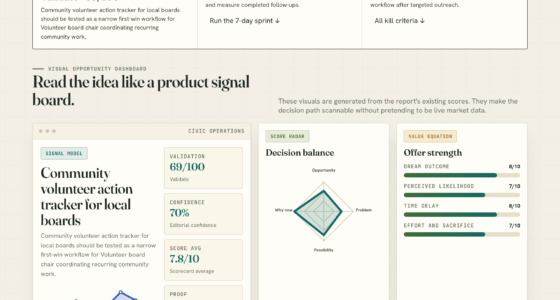

📊 Full opportunity report: Build, Rent, or Quantize: Cutting Your Memory Bill Without Cutting Capability on ThorstenMeyerAI.com — validation score, market gap, and execution plan.
TL;DR
AI developers face rising memory costs; three main strategies—building, renting, and quantizing—offer solutions. Quantization, especially, reduces memory needs significantly at minimal quality loss, lowering expenses across deployment options.
Recent advancements in AI model optimization reveal that quantization techniques can significantly reduce memory requirements, offering a third, underutilized lever alongside building and renting. This approach enables cost-effective deployment of large models without sacrificing capability, a development that could reshape AI infrastructure strategies.
Part 9 of a five-day series on the 2026 memory crunch emphasizes that, while building hardware or renting cloud resources are common solutions, quantization offers a powerful alternative to lower memory costs. Weight quantization reduces model parameters from 16-bit to 4-bit, shrinking memory by nearly 4× with only about 5% quality loss, making it a popular choice among local users.
Additionally, modern techniques like FP8 KV-cache compression, exemplified by Google’s TurboQuant announced in March 2026, compress the key-value cache to roughly 3 bits, halving memory use at long contexts with minimal impact on accuracy. These methods are not yet fully integrated into major inference frameworks but are expected to become standard soon.
Experts note that quantization is a leverage, not a magic wand. Pushing below Q4 quality often results in noticeable degradation, especially in reasoning and coding tasks. Currently, the best practical stack combines Q4 weight quantization with FP8 cache compression, enabling models to run in less memory and on cheaper hardware, or to serve more users on existing infrastructure.
Build, rent, or quantize
Memory got expensive everywhere — to buy and to rent. Most people argue build-vs-rent and miss the cheapest lever: shrink how much memory the work needs in the first place. Cut the bill without cutting capability.
For steady, high-utilization, private work. ~½ the lifetime cost of cloud. Right-size, used 3090s, or Apple unified memory. Capital up front.
For elastic, spiky, uncertain work. Can’t buy half a cluster for two weeks. But the bill creeps up — rent defensively: reserve, right-size, monitor.
Make the model need less memory — modern compression does it at little quality cost. The one move that lowers the bill in both venues.
★ the underused multiplierThe mistake the squeeze punishes hardest is solving a memory problem by buying more memory, when you could have needed less. Build when ownership pays, rent when flexibility pays — and quantize always, because shrinking the requirement is the only lever that makes both cheaper at once, and the only one that’s nearly free. The first question is never “build or rent” — it’s “how little memory can this take?” Next: when does cheap memory come back?
Implications of Quantization for AI Deployment Costs
These developments are significant because they allow AI practitioners to reduce hardware costs and increase efficiency without sacrificing model performance. As memory becomes more expensive and scarce, quantization offers a practical solution to extend existing hardware capabilities and reduce reliance on costly cloud resources.
This shift could democratize access to large models, enable more experimentation, and accelerate AI deployment in resource-constrained environments, potentially changing the economics of AI infrastructure.
AI model quantization hardware
As an affiliate, we earn on qualifying purchases.
As an affiliate, we earn on qualifying purchases.
Memory Costs Rising and Optimization Strategies
The ongoing 2026 memory crunch has driven up costs for AI hardware, with prices for high-VRAM GPUs and cloud instances increasing due to supply shortages. Previous parts of the series detailed the high costs of building and renting, especially as cloud prices rise and hardware availability tightens.
In response, AI developers are increasingly adopting quantization techniques—such as weight compression and KV-cache reduction—to stretch existing hardware. Google’s March 2026 announcement of TurboQuant, which compresses caches to 3 bits, exemplifies this trend. These methods are still emerging but are gaining traction as practical solutions to the memory bottleneck.
“Quantization reliably shifts you one rung down the hardware ladder at modest-to-zero quality cost, which in this market is worth a great deal.”
— Thorsten Meyer, series author
GPU memory optimization tools
As an affiliate, we earn on qualifying purchases.
As an affiliate, we earn on qualifying purchases.
Limitations and Future of Quantization Techniques
While quantization offers promising savings, it is not a universal solution. Pushing weights below Q4 quality can lead to noticeable degradation, especially in reasoning and coding tasks. TurboQuant is not yet integrated into major frameworks, and community forks are experimental. The full impact and adoption timeline remain uncertain.
AI model weight quantization kit
As an affiliate, we earn on qualifying purchases.
As an affiliate, we earn on qualifying purchases.
Upcoming Integrations and Industry Adoption Milestones
Expect major inference frameworks to incorporate TurboQuant and similar techniques later in 2026. Further research will clarify the limits of quantization, and increased adoption could make low-memory, high-capability models more accessible. Monitoring updates from AI vendors and open-source communities will be key to understanding how quickly these methods become standard.
FP8 cache compression hardware
As an affiliate, we earn on qualifying purchases.
As an affiliate, we earn on qualifying purchases.
Key Questions
How much can quantization reduce memory requirements?
Weight quantization (Q4) can reduce model size by approximately 4×, and cache compression techniques like TurboQuant can halve memory use for long contexts, leading to significant savings.
Does quantization affect model accuracy?
When applied carefully, quantization—especially Q4 weight compression and FP8 cache—retains about 95% of full-precision quality. Pushing below Q4 can cause noticeable performance drops in reasoning and coding tasks.
Is TurboQuant widely available now?
As of mid-2026, TurboQuant is not yet integrated into major inference frameworks. Community forks exist, and official support is expected later in the year, with full adoption likely in 2027.
Can quantization replace building or renting hardware?
Quantization is a cost-saving lever that works alongside building and renting strategies. It does not eliminate the need for hardware but allows existing resources to be used more efficiently.
Source: ThorstenMeyerAI.com