

In the realm of wide-area motion imagery (WAMI), maintaining accurate object identities across frames is a critical challenge, especially in complex surveillance scenes. The latest public benchmark from Corvus ISR compares two tracker models on a synthetic scene with perfect ground truth, providing a clear picture of their performance in a stressful environment.

Get the latest gadgets delivered free with Prime
- Fast, free delivery on millions of items
- Prime Video, Amazon Music and more included
- Member-only deals all year
The baseline model, v1, employs a simple greedy nearest-neighbour association with fixed velocity predictions and a 2-second coasting window. This straightforward approach represents the existing standard, but its limitations become evident under challenging conditions. In contrast, v2 introduces an advanced confirmed-track auction mechanism with three-tier auction association, velocity-consistency gating, and noise-scaled reservation pricing—significantly improving tracking robustness.
Results from the benchmark show a substantial reduction in identity switches—a crucial metric that counts every change in the assigned identity of a ground-truth object. Under a baseline scenario with 150 movers at 2fps, switches decreased from 2,042 to 1,183, marking a 42.1% improvement. Similar gains were seen with denser scenes (400 movers), dropping from 14,032 to 8,040 switches, a 42.7% reduction. These numbers reflect a meaningful step forward in how well the tracker preserves object identities over time.
It’s important to note that the benchmark’s metrics are stringently defined; each identity change—including fragmentations and re-acquisitions—is counted, making the results a true reflection of tracker robustness. The detection rate itself remains identical for both models since it depends solely on sensor properties, not the tracking algorithm.
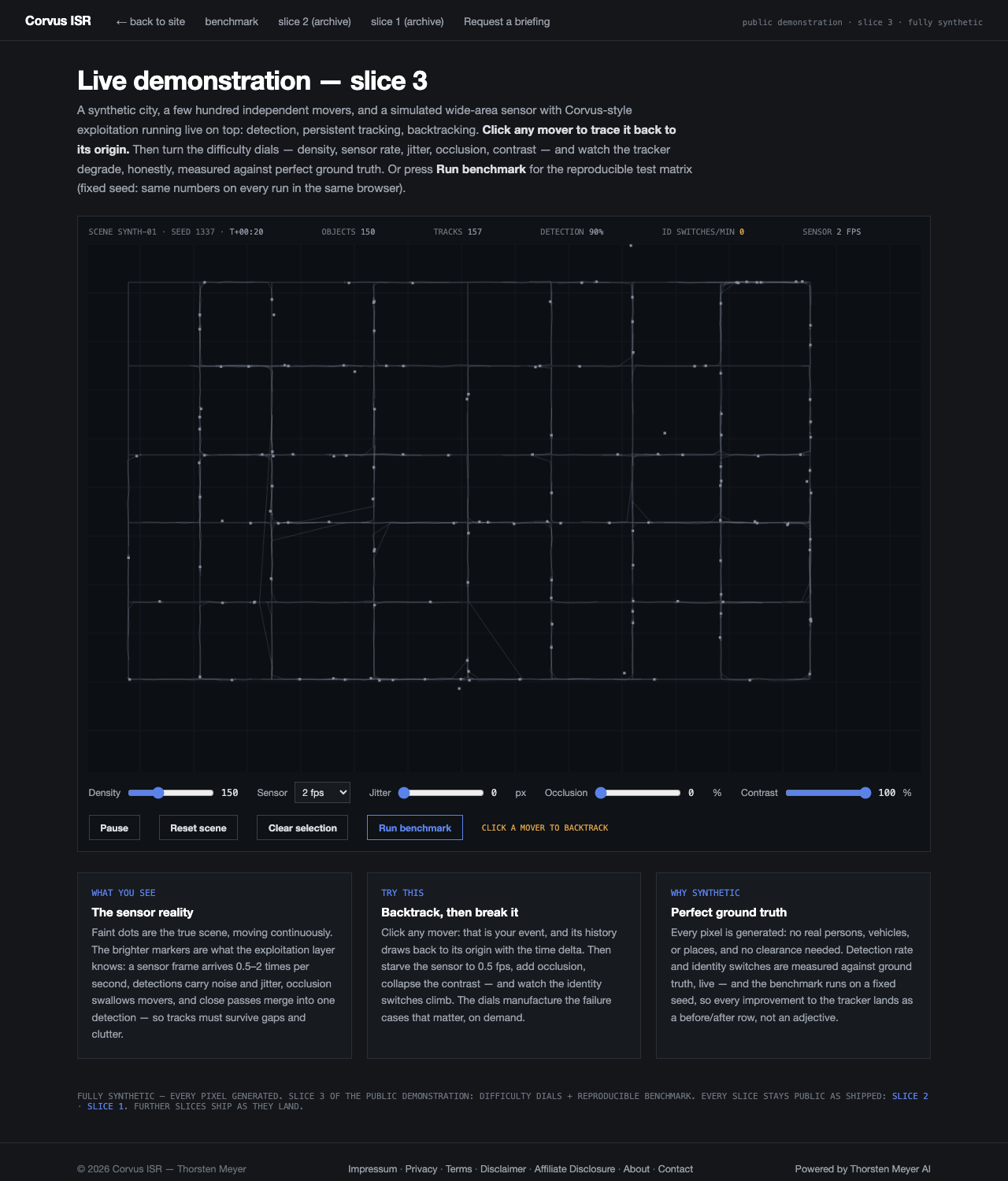
Despite these improvements, both models still make thousands of identity errors per minute under stress, highlighting the ongoing difficulty of perfect multi-object tracking. The benchmark is published openly to promote transparency: «Vendors who show only successes ask for faith; a published failure matrix asks for measurement.» This synthetic scene, with pixel-perfect ground truth, serves as a strict testing ground, pushing every future tracker to be evaluated publicly against the same data.
On the engineering side, the v2 tracker runs at an average of approximately 1.2 milliseconds per sensor tick at a scene density of 400 objects—well within real-time constraints. You can see for yourself how it performs by visiting the live demo and pressing ‘Run benchmark’—no sign-up or NDA required. Built by an AI executor and independently reviewed, v2 demonstrates that cutting-edge tracking can operate in real-time right in your browser, all in a fully synthetic environment with no real-world data involved.
As an affiliate, we earn on qualifying purchases.
real-time object tracker for surveillance
As an affiliate, we earn on qualifying purchases.
As an affiliate, we earn on qualifying purchases.
wide-area motion imagery (WAMI) tracking system
As an affiliate, we earn on qualifying purchases.
As an affiliate, we earn on qualifying purchases.
As an affiliate, we earn on qualifying purchases.
Halloween Picks
halloween
As an affiliate, we earn on qualifying purchases.