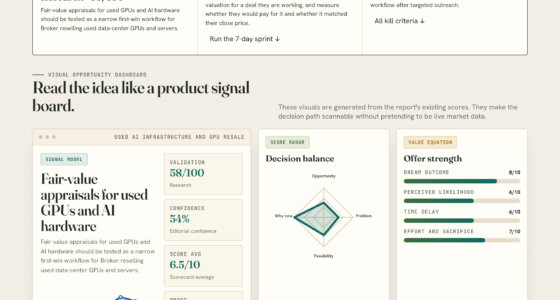

📊 Full opportunity report: Five Levers, Many Hands on ThorstenMeyerAI.com — validation score, market gap, and execution plan.

Get the latest gadgets delivered free with Prime
- Fast, free delivery on millions of items
- Prime Video, Amazon Music and more included
- Member-only deals all year
TL;DR
Countries are responding to AI-driven labor disruptions using five main policy levers. These responses vary widely based on existing social and economic structures, amid deep uncertainty about the future of work.
Countries worldwide are deploying five primary policy tools—income floors, ownership schemes, work and time adjustments, skills transition, and institutional guardrails—to manage the profound disruptions caused by AI automation in the labor market. These responses are shaped by each country’s existing social, economic, and political context, reflecting a global experiment in reshaping work amid deep uncertainty.
The post-labor transition, once a future forecast, is now a daily reality, with significant job losses among young workers in AI-exposed roles and widespread corporate layoffs. Experts estimate that hundreds of millions of jobs could be affected over the next decade, prompting governments to adopt various policy responses. These responses are centered around five key levers: income support measures such as universal basic income and guaranteed income pilots; ownership initiatives like citizen dividends and social wealth funds; work and time policies including job guarantees and shorter workweeks; skills and transition programs focused on reskilling workers; and institutional guardrails regulating AI and automation.
While some countries, especially those with strong welfare states, favor income and institutional measures, others emphasize skills development or ownership schemes. The diversity in responses stems from each nation’s existing institutions, political culture, and economic priorities, illustrating a complex landscape of adaptation. Experts caution that the ultimate impact of AI on employment remains uncertain, with debates ongoing about whether automation will primarily reallocate or displace jobs, and how income and ownership schemes can mitigate adverse effects.
Five Levers, Many Hands
The disruption is real — but nobody knows how far it goes. That uncertainty is exactly why the world’s responses look nothing alike. Strip away the branding and almost every one is built from the same five tools.
Independent commentary, produced with AI assistance under human editorial oversight. The views are the author’s own and may change. This is analysis, not policy, economic, investment, or legal advice. Figures reflect publicly reported estimates and studies as of mid-2026 and may change; the labor-market outlook is genuinely uncertain and contested. This phase maps differing approaches and endorses none. Country, institution, and program names are referenced for analysis and imply no affiliation.
Implications of Divergent Policy Responses to AI Disruption
The way nations deploy these five levers will influence the future of work, income inequality, and economic stability. Countries with proactive, comprehensive policies could better cushion workers from disruption, while less coordinated responses risk deepening inequality and social unrest. The divergence highlights the importance of policy design amid unresolved debates about AI’s long-term impact on employment and income distribution.
universal basic income pilot program
As an affiliate, we earn on qualifying purchases.
As an affiliate, we earn on qualifying purchases.
Global Responses to AI-Induced Labor Market Changes
The transition to AI-driven automation is no longer a distant forecast but a present-day reality, with evidence of job displacement, especially among young workers in entry-level roles. For more context, see The last six months in LLMs in five minutes. Major institutions like Goldman Sachs estimate hundreds of millions of jobs at risk, and surveys from the World Economic Forum indicate that many employers are planning to reduce headcount while reskilling their remaining workforce. Historically, technological change has often led to labor reallocation rather than outright displacement, but the rapid pace and broad scope of AI introduce unprecedented uncertainty. Countries are experimenting with a variety of policies, reflecting their unique social and economic structures, as part of a global adaptive process.
“The post-labor transition is now a daily occurrence, not a distant forecast, with governments responding through a set of five key policy tools.”
— Thorsten Meyer
As an affiliate, we earn on qualifying purchases.
Unresolved Questions About AI’s Long-Term Impact
It remains unclear how broadly and deeply AI will displace jobs versus reallocate them, and whether current policy measures will be sufficient to prevent widening inequality. The ultimate endpoint of this transition is still a matter of debate among economists and policymakers, with evidence still emerging and no consensus yet established.
shorter workweek productivity tools
As an affiliate, we earn on qualifying purchases.
As an affiliate, we earn on qualifying purchases.
Future Policy Experiments and Monitoring Outcomes
Countries will continue experimenting with different combinations of the five levers, aiming to find effective strategies for managing AI’s impact. Monitoring these efforts and their outcomes will be crucial in shaping global best practices and understanding the long-term effects on employment, income distribution, and social stability. Insights can be found in Five times AI hallucinations embarrassed governments. International cooperation and data sharing may become increasingly important as the transition unfolds.
reskilling online courses for AI automation
As an affiliate, we earn on qualifying purchases.
As an affiliate, we earn on qualifying purchases.
Key Questions
What are the five main policy tools countries are using to respond to AI-driven labor changes?
The five levers are income floors (like UBI), ownership schemes (such as citizen dividends), work and time policies (like job guarantees), skills and transition programs (reskilling initiatives), and institutional guardrails (regulation and protections).
Why do responses to AI differ so much across countries?
Responses vary based on each country’s existing social, economic, and political structures. Welfare states tend to favor income and institutional measures, while market-oriented countries emphasize skills and ownership schemes.
What are the main uncertainties about AI’s impact on employment?
It is still unclear whether AI will mainly reallocate jobs or displace them, and whether current policies will be sufficient to prevent increased inequality or social unrest.
What should we expect in the coming years regarding policy responses?
Countries will likely continue experimenting with different mixes of the five levers, aiming to find effective ways to manage the transition. Monitoring these efforts will be key to understanding long-term outcomes.
Source: ThorstenMeyerAI.com
Halloween Picks
halloween
As an affiliate, we earn on qualifying purchases.