📊 Full opportunity report: How To Evaluate Your Workflow For Automation Potential on IdeaNavigator AI — validation score, market gap, and execution plan.

Get the latest gadgets delivered free with Prime
- Fast, free delivery on millions of items
- Prime Video, Amazon Music and more included
- Member-only deals all year
TL;DR
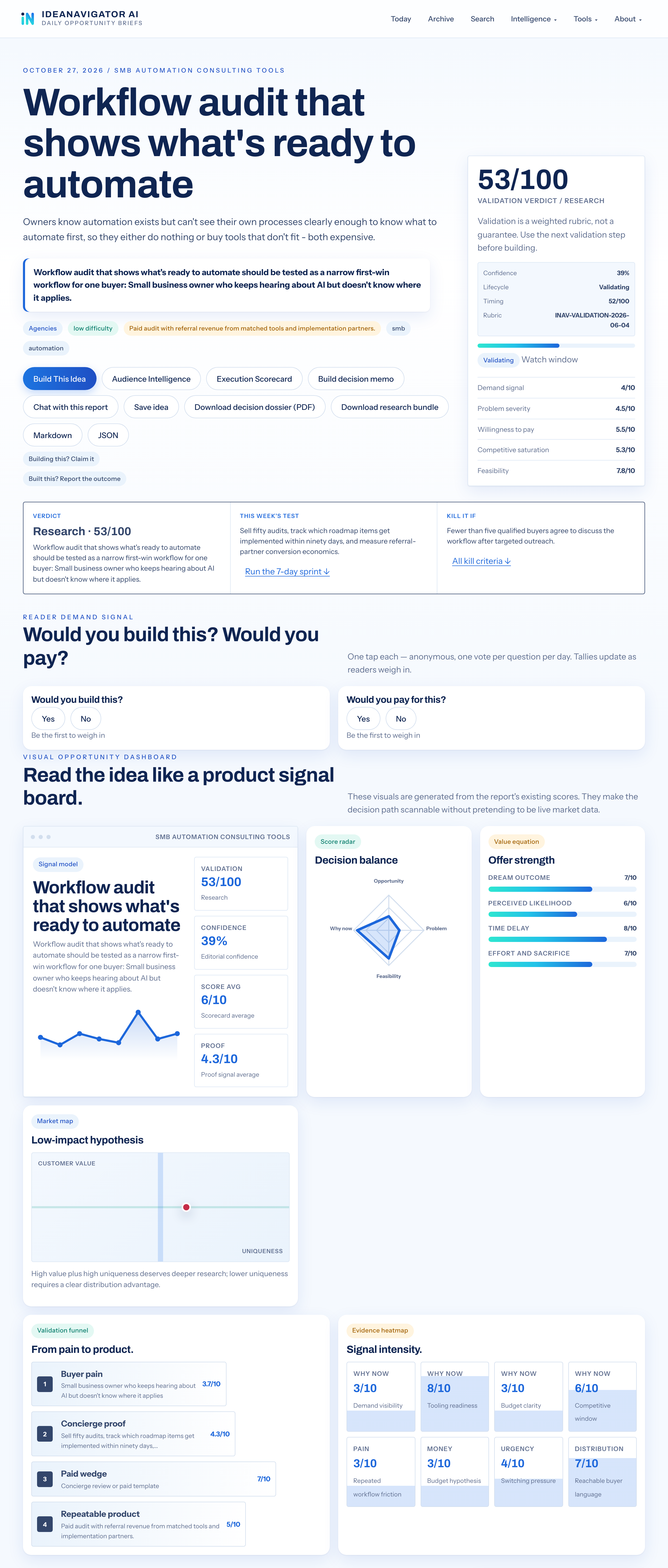
A proposed workflow-audit service would interview small-business owners, map their processes and rank possible automation projects by readiness, expected return and difficulty. The concept remains a business proposal, not a reported launch or validated product; its suggested test is to sell 50 audits and track implementation and referral results.
IdeaNavigator AI’s business concept for a workflow-audit service for small businesses proposes interviewing owners about their operations, mapping recurring processes and ranking possible automation projects by readiness, expected return and difficulty. The concept addresses owners who hear about AI tools but are unsure where they fit; it provides no evidence that the service has launched or that its projected demand has been tested.
In the IdeaNavigator AI proposal, the minimum viable product is a guided operational interview that turns an owner’s account of day-to-day work into a process map. The proposed audit would score individual steps for automation readiness, potential return on investment and implementation difficulty, then arrange possible projects into a 90-day roadmap. It would also suggest tools matched to each step.
The concept proposes combining a paid audit with referral revenue from recommended software vendors and implementation partners. That structure could give customers a single starting point for comparing options, while creating a financial incentive for the service to refer them to particular providers. The proposal does not specify how recommendations would be screened or how referral relationships would be disclosed.
To test demand, IdeaNavigator AI’s concept proposes selling 50 audits and tracking which recommended roadmap items customers implement within 90 days. It also calls for measuring referral-partner conversion economics. The proposal reports no results, pricing, customer commitments or implementation data, so the suggested test should not be read as evidence that businesses will buy the audit or act on its recommendations.
Business concept / Workflow automation
How To Evaluate Your Workflow For Automation Potential
TL;DR A proposed workflow audit would interview small-business owners, map recurring processes, and rank potential automation projects by readiness, expected return, and difficulty. The concept has not been reported as launched or validated. Its suggested test: sell 50 audits, then track implementation and referrals.
Service status
Proposal No launch or validation reportedCore method
Interview → map Turn owner accounts into process mapsPrioritization
3 scores Readiness · return · difficultyValidation window
90 days Track recommended changes in practice01 / The development
A practical starting point for automation
The IdeaNavigator AI concept proposes a paid workflow audit for small businesses. It aims to help owners identify processes that may suit automation before choosing tools, then sequence possible projects into a 90-day roadmap.
01 / Understand
Interview the owner
A guided conversation would capture day-to-day operations and recurring work as the starting point for a process map.
02 / Assess
Rank candidate steps
Each possible automation would be scored for readiness, expected return on investment, and implementation difficulty.
03 / Sequence
Build a 90-day roadmap
Recommended projects and suggested tools would be organized into a sequence for the business to consider.
02 / How the proposed audit works
From daily work to ranked projects
The concept’s value would depend on whether the map reflects real operations and whether predicted benefits justify the cost and disruption of adopting new systems.
Describe
Owner explains recurring tasks, handoffs, and bottlenecks.
Map
Interview details become a view of the business process.
Score
Candidate steps are assessed across three proposed criteria.
Recommend
Projects and tools are placed into a 90-day roadmap.
Key limitation
The bars identify the proposal’s three scoring dimensions; they do not represent measured scores or validated weights. An automated score alone would not show that a process is safe or worthwhile to automate. Routine work must be distinguished from tasks involving judgment, sensitive information, or human approval.
03 / Business model & open questions
Useful starting point, with incentives to examine
The proposed model combines paid audits with referral revenue from software vendors and implementation partners. That could give customers one place to compare options, while creating a financial incentive to recommend particular providers.
Revenue / Audit
Customer fee
The concept proposes a paid service but gives no price or evidence that customers have committed to buy.
Revenue / Referral
Partner conversions
Software and implementation referrals could produce revenue. No conversion economics or results are reported.
Trust / Disclosure
Explain the relationship
The proposal does not say how tools would be screened or how referral relationships would be disclosed to customers.
04 / What remains untested
Demand and audit accuracy still need evidence
The proposal identifies a problem—owners may know automation tools exist but lack a clear view of where they fit. This is the concept’s market rationale, not a finding backed by customer research or published adoption figures.
| Question | What the concept proposes | What is not reported |
|---|---|---|
| Is it operating? | A possible minimum viable product based on guided interviews. | No launch, company details, or completed customer interviews. |
| Are the scores reliable? | Rate readiness, expected return, and difficulty. | No method to verify accounts or estimate and validate scores. |
| Can it protect customers? | Use interviews and potentially large language models to structure the process. | No model details, data safeguards, or plan for inaccurate responses. |
| Will it create value? | Track roadmap implementation over 90 days. | No buyers, implementation data, savings, or referral revenue reported. |
05 / Proposed validation
Test paid demand, then follow through
IdeaNavigator AI’s concept suggests selling 50 audits and tracking what customers do with their roadmaps. No timetable or results from this test are provided.
Measure / Buyers
Audit completion
How many customers pay for and complete the guided audit?
Measure / Outcomes
Implementation & impact
Which recommendations are adopted, at what time and cost, and with what measurable benefit?
Measure / Referrals
Partner economics
Track referral conversion separately from customer outcomes and disclose commercial relationships.
Evidence threshold
If customers implement roadmap items, that may show the audit produced actionable priorities. Low implementation could reflect recommendation quality, price, available capacity, or the difficulty of changing workflows. Until results are available, this remains a testable business proposal, not a proven route to savings.
06 / Key questions
What to know before evaluating the idea
What would the audit do?
Interview an owner, map operations, score possible automation by readiness, expected return, and difficulty, then suggest tools and a sequenced 90-day roadmap.
Is the service available?
The proposal provides no launch announcement, operating-company details, or evidence that the service is running.
How would it make money?
The proposed model pairs audit fees with referral revenue from software and implementation partners. Prices and disclosure practices are unspecified.
How would it be validated?
Sell 50 audits, track recommendation implementation within 90 days, and measure partner conversion economics. No test results are reported.
A Practical Test for Automation Demand
The proposal identifies a gap between the availability of automation products and small businesses’ ability to identify suitable uses for them. A structured audit could help owners start with a specific process rather than choosing a tool first. Its value would depend on whether recommendations reflect how a business actually works and whether expected savings justify the cost and disruption of adopting new systems.
The proposed 90-day tracking period would test more than sign-ups or positive feedback. If customers implement roadmap items, that could indicate the audit produced actionable priorities; if few do, possible factors include recommendation quality, price, implementation capacity or the difficulty of changing existing workflows. Because the concept also proposes referral revenue, transparency would matter: customers would need to understand whether recommendations are based on fit, a commercial relationship, or both.
Products Worth Considering

Samsung 27-inch Odyssey OLED G6 QD-OLED QHD Gaming Monitor

Bose QuietComfort Headphones (2nd Gen), Wireless Noise-Cancelling Over-Ear Headphones, Eucalyptus Green

Logitech MX Master 4 for Mac, Ergonomic Bluetooth Mouse with Haptic Feedback, Ultra-Fast Scrolling, USB-C Charging, for MacOS, iPadOS, Windo
As an affiliate, we earn on qualifying purchases.
Why Owners Need a Starting Point
IdeaNavigator AI frames the opportunity around decision paralysis: business owners know automation tools exist but may lack a clear view of their own processes. Without that map, they may delay decisions or purchase software that does not fit their needs. These are the problem and market rationale presented in the concept, not findings supported by customer research or published adoption figures.
The proposal argues that the rapid growth of AI tools has made the choice harder, while guided process-mapping interviews may now be easier to structure with large language models. It does not describe the model, audit methodology or safeguards involved. An interview-based system would still need to distinguish routine, repeatable work from tasks requiring judgment, sensitive information or human approval; an automated score alone would not establish that a process is safe or worthwhile to automate.
Demand and Audit Accuracy Remain Untested
IdeaNavigator AI’s proposal does not identify a product launch, operating company, price, target industry or completed customer interviews. It also provides no evidence that 50 paid audits have been sold, that customers have implemented recommendations, or that referrals have generated revenue. Those figures describe a proposed validation plan, not current results.
The proposal leaves several practical details open: how the audit would verify owners’ descriptions, estimate return on investment, and support its readiness and difficulty scores. It also does not explain how it would protect business data, handle inaccurate or incomplete responses, or prevent referral commissions from shaping tool recommendations. Without those details, the audit’s reliability and commercial viability cannot be assessed.
The Proposed 50-Audit Validation
IdeaNavigator AI’s concept identifies selling 50 paid audits as the next step, followed by tracking each roadmap for 90 days to see which recommendations are put into practice. The proposed test would also measure whether referred customers convert with software or implementation partners. The source gives no timetable for running it.
Useful evidence would include how many buyers complete the audit, which recommendations they implement, the time and cost involved, and whether the resulting changes produce measurable benefits. Referral conversion should be reported separately from customer outcomes, with clear disclosure of commercial relationships. Until such results are available, the workflow audit remains a proposed service and a testable business idea, not a proven route to savings.
Source: IdeaNavigator AI
Key Questions
What would the proposed workflow audit do?
According to the IdeaNavigator AI proposal, it would interview a small-business owner, map operational processes, score possible automation steps by readiness, expected return and difficulty, and suggest a sequenced 90-day roadmap with tool recommendations.Is the audit service already available?
The IdeaNavigator AI proposal provides no launch announcement, company details or evidence that the service is operating. It describes a possible minimum viable product and a way to test it.How would the business make money?
The proposed model combines audit fees with referral revenue from matched software tools and implementation partners. The concept does not specify prices or how referral relationships would be disclosed.How would the idea be validated?
The proposal suggests selling 50 audits, tracking which recommendations customers implement within 90 days, and measuring referral-partner conversion economics. It reports no results from that test.Source: IdeaNavigator AI