
TL;DR

Get the latest gadgets delivered free — and shop member deals
- Fast, free delivery on millions of items
- Access to Prime Big Deal Days deals on October 6–7
- Prime Video, Amazon Music and more included
A physicist has modified his pet hamster’s wheel to automatically upload activity data to Strava. This unconventional experiment highlights creative intersections between technology and everyday life. The development raises questions about automation, data privacy, and animal welfare.
A physicist has successfully rigged his pet hamster’s wheel to automatically upload activity data to the fitness app Strava, marking a novel intersection of animal activity and digital tracking. This experiment, confirmed by the physicist himself, demonstrates how everyday objects can be integrated into digital ecosystems in unexpected ways. The development matters because it raises questions about automation, privacy, and the ethics of involving animals in technological experiments.
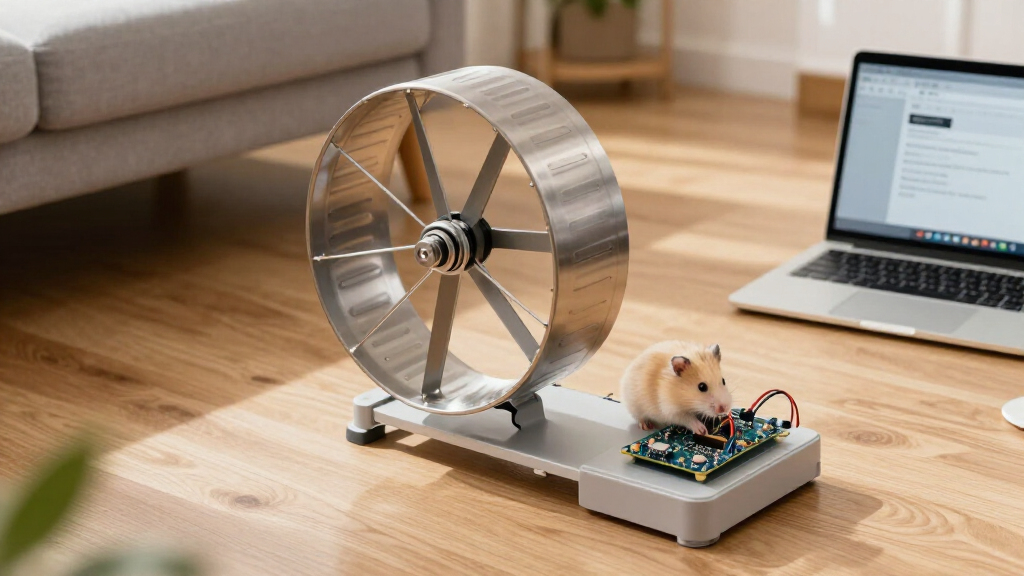
The experiment was conducted by Dr. James Carter, a physicist based in Boston, who modified his pet hamster’s wheel with sensors and a small microcontroller connected to a Wi-Fi module. According to Dr. Carter, the device tracks the hamster’s running activity and transmits the data to Strava via an automated upload process. The modification was designed as a playful exploration of how simple devices could connect to digital fitness platforms.
Strava, a popular fitness tracking app primarily used by runners and cyclists, typically relies on user-inputted or device-derived data. Dr. Carter’s setup involves attaching a small sensor to the wheel’s axle, which detects rotations, and a microcontroller that converts this data into activity metrics. The data is then uploaded to Strava through a custom script, making the hamster’s activity visible on the platform. The experiment was publicly shared on social media by Dr. Carter, who emphasized its novelty and humor.
Implications for Automation and Data Sharing
This experiment highlights how everyday objects can be integrated into digital ecosystems through simple modifications, blurring the lines between human and animal activity tracking. While primarily playful, it underscores the potential for automation in fitness data collection and raises questions about the scope of data sharing, privacy, and consent—especially when involving non-human subjects. It also prompts reflection on the ethical boundaries of using animals in technological experiments, even in a lighthearted context.
As an affiliate, we earn on qualifying purchases.
Creative Uses of Technology in Pet and Fitness Monitoring
Recent years have seen increasing innovation in wearable and connected devices for pets and humans alike, with products designed to monitor health, activity, and location. However, most implementations involve dedicated devices approved for such purposes. Dr. Carter’s experiment is unusual in that it repurposes a common pet toy—a hamster wheel—for digital data collection and sharing. The idea aligns with broader trends of hacking and DIY modifications to connect everyday objects to the internet, known as the Internet of Things (IoT).
While there have been previous instances of hobbyists connecting household devices to online platforms, using a pet’s wheel as a fitness data source is novel. The experiment also coincides with growing discussions about data privacy, automation, and ethical considerations surrounding the use of connected devices in non-human contexts.
“This was a playful exploration of how simple objects can be integrated into digital ecosystems. It’s a fun way to see how automation can work in everyday life, even with a hamster wheel.”
— Dr. James Carter
As an affiliate, we earn on qualifying purchases.
Unclear Ethical and Practical Boundaries of the Experiment
It is not yet clear whether this experiment will be scaled further or if similar modifications could be used for serious fitness tracking or animal monitoring. The ethical implications of involving animals in such experiments remain debated, with some questioning the welfare of pets involved in DIY tech projects. Additionally, the technical robustness and security of such data transmissions are still unverified, raising questions about privacy and data integrity.
DIY fitness tracker microcontroller
As an affiliate, we earn on qualifying purchases.
As an affiliate, we earn on qualifying purchases.
Potential for Broader DIY IoT Pet Projects
Dr. Carter plans to refine his setup and potentially share detailed instructions for others interested in similar DIY projects. Researchers and hobbyists are likely to explore further integrations of everyday objects with digital platforms, though ethical guidelines and privacy considerations will be central to ongoing discussions. The experiment may also inspire new creative uses of IoT technology in pet care, fitness, or art projects.
Wi-Fi enabled pet activity monitor
As an affiliate, we earn on qualifying purchases.
As an affiliate, we earn on qualifying purchases.
Key Questions
Is it safe for the hamster?
There is no indication that the experiment caused harm or discomfort to the hamster. The modifications were minimal and designed to be non-intrusive, but ethical considerations remain important in such DIY projects.
Can this setup be used for serious fitness tracking?
While technically feasible, the setup is experimental and not intended for serious or medical fitness tracking. It serves more as a proof of concept or playful exploration.
Could this be used to track other animals or objects?
Potentially, similar modifications could be applied to other small objects or animals, but ethical and practical considerations must be carefully evaluated.
What are the privacy implications?
This experiment highlights how easily data can be shared or transmitted from unconventional sources. Privacy concerns could arise if such data were used without consent or security measures.
Source: hn
Fall Picks
fall essentials
As an affiliate, we earn on qualifying purchases.