
🔍 Read the full analysis: What Can AI Workflow Automation Software Do For Your Business In 2027? on ThorstenMeyerAI.com

Get the latest gadgets delivered free with Prime
- Fast, free delivery on millions of items
- Prime Video, Amazon Music and more included
- Member-only deals all year
TL;DR
A buyer’s guide from ThorstenMeyerAI.com compares 14 resources for understanding AI workflow automation, grouped by business-user, developer and enterprise needs. It recommends matching a resource to a team’s technical skills and operational goals, while noting that cost, integrations, security and maintenance can shape whether an automation is practical.
ThorstenMeyerAI.com’s guide compares 14 resources for businesses exploring AI workflow automation, from no-code playbooks to developer-focused frameworks and enterprise guidance. The guide’s central advice is to choose based on a team’s technical ability and operational needs, rather than assuming one platform or method will suit every business.
According to the ThorstenMeyerAI.com guide, the field can be divided into three broad groups: no-code resources for business users, developer handbooks for building more customized systems, and enterprise material aimed at complex cloud environments. The guide describes tools such as Zapier and n8n as common mid-market options, and argues that useful automation depends on designing workflows with appropriate logic, not simply connecting tasks in a straight line.
The guide names The No-Code AI Automation Playbook as its best overall choice for business users seeking to get started without coding. It points developers looking for greater control toward n8n AI Automation, while identifying Microsoft Power Automate as a likely fit for organizations already using Microsoft products. These are the guide’s assessments, not independently verified rankings or evidence of measured business results.
The source says its selections were judged on practical instruction and accessibility for different technical audiences. The supplied text does not provide detailed evaluations of all 14 options. Instead, it emphasizes considerations such as API support, projected costs at higher volumes, data handling and the work required to maintain workflows when applications or business processes change.
The 14 picks
- 1
 Agentic AI for DevOps Engineers: Building Autonomous CI/CD, Infrastructure, a…View on Amazon →
- 2
 Workflow Automation with Microsoft Power AutomateView on Amazon →
- 3
 Claude AI for Smart Automation: No-Code Strategies to Build Intelligent Workf…View on Amazon →
- 4
 The No-BS Guide to AI Agents & Automation: Build AI Workflows, Automate Your…View on Amazon →
- 5
 AI Agents: From Theory to Operations — A Practical Guide to Business Automati…View on Amazon →
- 6
 50 AI Workflows for Engineers: From Debugging to System Design, Code Review &…View on Amazon →
- 7
 AI-Powered Automation and Workflows for Small Business OwnersView on Amazon →
- 8
 Practical Autonomous Workflow Automation: Build AI Agents and Automate Real-W…View on Amazon →
- 9
 Hands-On AI Workflow Automation: A Beginner-Friendly Roadmap to Eliminating R…View on Amazon →
- 10
 The No-Code AI Automation Playbook: Build Practical AI Workflows with Zapier,…View on Amazon →
- 11
 AI for Everyday Automation: 7 AI Workflows to Save Hours at Work Every WeekView on Amazon →
- 12
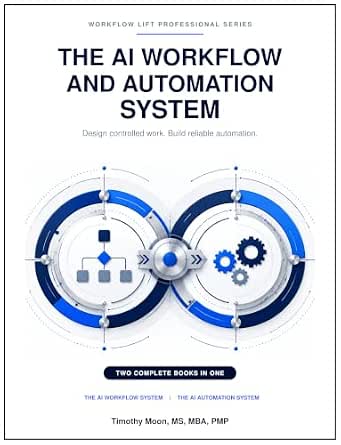 AI Workflow and Automation System – Workflow Lift Professional SeriesView on Amazon →
- 13
 n8n AI Automation: Build Smarter Workflows, Agents, and Intelligent Systems w…View on Amazon →
- 14
 Agentic Coding with Claude Code (5-in-1): A Practical Developer’s Handbook fo…View on Amazon →
How Automation Choices Affect Teams
The practical consequence is that adopting AI automation is not just a software decision. The ThorstenMeyerAI.com guide notes that a tool that is easy for a small team to start using may become difficult to manage as workflows grow more complex; a code-first option can offer greater control but may be unsuitable without developers to build and maintain it. The guide frames this as a simplicity-versus-flexibility tradeoff, rather than a contest with one universal winner.
For businesses, the stakes include operational reliability and cost as well as time saved. The guide warns that a failed connector can interrupt a workflow and that usage-based pricing may rise with volume. It also flags privacy and compliance concerns when sensitive information moves among connected services. The source recommends checking these issues before implementation, but supplies no comparative cost, security or performance measurements for the 14 resources.
The guide recommends starting with high-impact, low-complexity tasks to reduce the risk of overbuilding. This may help teams test whether a workflow solves a real bottleneck before committing to a more elaborate system. Any expected gains, however, would depend on the business process and implementation; the supplied material reports no quantified outcomes.
Products Worth Considering

EcoFlow Delta 3 Portable Power Station – 1024 Wh, 1800 W

Jackery Explorer 300 Portable Power Station, 292Wh

Anker SOLIX C300 Portable Power Station, 288Wh
As an affiliate, we earn on qualifying purchases.
From Simple Tasks to AI Agents
The ThorstenMeyerAI.com guide describes a category that spans basic app-to-app connections and more advanced systems that can make decisions within a workflow. It cites Agentic Coding with Claude Code and Agentic AI for DevOps as resources reflecting interest in agent-style automation. The source characterizes these as a shift beyond simple task automation, but does not provide evidence that such systems can operate reliably without human oversight.
The guide also cautions that a platform’s usefulness depends on whether it connects to the applications a business actually uses. It notes that pre-built integrations may not cover niche software or older systems, while custom connectors and APIs can demand technical work. The source advises buyers to check integration support, connector upkeep and documentation rather than relying on a product’s general claims about compatibility.
For enterprise users, the guide singles out Microsoft Power Automate for organizations already embedded in Microsoft’s ecosystem. This is the source’s recommendation based on fit, not a claim that it is the best choice for every large organization. The supplied material does not include the full list of 14 resources, pricing comparisons or independent product testing.
What the Guide Does Not Establish
The ThorstenMeyerAI.com piece is a buyer’s guide, not a report on a newly announced product, independent benchmark or measured business deployment. Its “best overall” label and other recommendations reflect the guide’s own evaluation. The supplied material does not name all 14 options, provide scores or explain how the products performed under controlled tests.
It is also unclear what will change specifically in 2027. The source offers selection criteria and discusses current categories, but gives no dated forecast, release schedule or market data for that year. Claims about savings, accuracy, reliability and return on investment would need evidence from specific implementations; none is included in the supplied guide material.
Security and compliance requirements vary by industry and by data flow. The guide advises checking for controls such as single sign-on, audit logs and clear data-processing terms, and warns against routing sensitive information through tools without stated compliance support. It does not verify the compliance status of any named product.
Questions to Resolve Before Adoption
Based on the guide’s recommendations, businesses considering automation can start by identifying a repetitive process, estimating its volume and checking which applications and data it touches. They can then compare the required integrations, the team’s ability to build and maintain the workflow, and the cost at a realistic higher volume. The source recommends matching those requirements to a tool or learning resource before expanding deployment.
The guide also advises teams to review data retention, access controls, error alerts and recovery procedures before moving sensitive or business-critical processes. Its supplied material does not announce a next update or a specific 2027 milestone, so further developments in the market—and whether the guide’s recommendations change—remain open.
Key Questions
What is the main news in this article?
ThorstenMeyerAI.com has published a guide comparing 14 resources for AI workflow automation. The guide groups them by user needs and offers selection advice; it is not a report of a new product launch.
Which option does the guide recommend for non-coders?
The ThorstenMeyerAI.com guide names The No-Code AI Automation Playbook as its best overall choice for business users seeking an entry point without coding. That is the source’s assessment, not an independently established ranking.
Why might a business choose a code-first framework?
The guide says a code-first framework such as n8n may give developers more control over custom workflows and agents. It also notes that this approach requires programming skills and ongoing technical support.
What should a business check before choosing a platform?
The guide advises checking integration support, team skills, costs at higher volumes, security and maintenance needs. A platform’s fit depends on the applications and data involved, not just how easy it is to start.
Does the source prove that automation will save money in 2027?
No. The supplied guide material provides no measured savings, return-on-investment results or 2027 forecast. Outcomes would depend on the workflow, implementation and operating costs.
Source: ThorstenMeyerAI.com